
Non-FictionSelf-HelpSpeed Reading
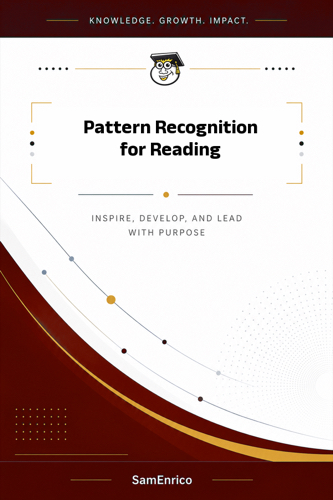
Pattern Recognition for Reading eBook
Speed read by recognizing sentence and paragraph s
Speed read by recognizing sentence and paragraph structures quickly.
Formats
Free sample
Chapter 1: The Liar’s Gambit...–- Every morning, you wake up believing you know how to read. This is your first mistake.The second mistake happens before lunch. You open an email, a report, or a news article. Your eyes move from left to right, word by word, like a plow cutting through heavy soil. You hear a voice in your head—sometimes your own, sometimes a ghost of a teacher from decades ago—pronouncing each syllable.
Periods become brief exhales. Commas become tiny hiccups. By the time you reach the bottom of the page, you have spent thirty seconds on two hundred words. You understand perhaps seventy percent of what you just read. And you call this reading.You have been lied to.
Not by any single person, but by an entire educational system that confused decoding with comprehension, effort with virtue, and slowness with thoroughness. The lie sounds like common sense: “To understand a text, you must read every word.” This is the Liar’s Gambit—a seemingly innocent proposition that has stolen more hours from your life than any other habit you possess.Here is the truth that will transform how you interact with every page, screen, and document for the rest of your life: Writers are lazy. Not in a malicious way. In a structural, predictable, almost mathematical way. Every writer who has ever lived—from Shakespeare to your boss who just sent that confusing memo—follows the same unconscious rules.
They repeat themselves. They bury their main point under layers of polite throat-clearing. They use predictable sentence structures because their brains, like yours, crave patterns. And once you learn to see those patterns, you stop reading words and start reading intentions.This chapter is called The Liar’s Gambit because we are going to expose the lie, dismantle it, and replace it with a new operating system for your eyes and brain. By the time you finish these pages, you will have taken the first and most important step toward reading not as a dutiful pilgrim trudging through every word, but as a thief who knows exactly where the treasure is buried.The Invention of Slow Reading Before we fix the problem, we need to understand where it came from.
Slow reading—the word-by-word, subvocalized, linear march across the page—is not natural. It is not how the human brain evolved to process visual information. It is a technology that was invented, taught, and enforced by an educational system designed for a world that no longer exists.Consider this: For most of human history, reading was rare. Scribes, monks, and the elite read aloud, even when alone, because silent reading was considered a miracle. Saint Augustine, writing in the 4th century, described watching his teacher Ambrose read silently with astonishment: “When he read, his eyes scanned the page and his heart sought out the meaning, but his voice was silent.” Augustine found this so unusual that he wrote it down.
Silent reading was a superpower.Fast forward to the Industrial Revolution. Mass education required mass standardization. Schools needed to teach reading efficiently to hundreds of children at once. The solution was phonics and whole-language instruction—methods that break reading into discrete skills: letter recognition, sound production, word decoding, sentence parsing. These methods work.
They turn illiterate children into functional readers. But they also install a permanent speed limit in your brain.Here is what your elementary school teacher never told you: The methods that teach you to read are not the methods you should keep using as an adult. Training wheels help you learn to ride a bicycle, but if you never take them off, you will never go faster than a toddler’s jog. Yet most adults still read with the cognitive equivalent of training wheels—sounding out words internally, pausing at every comma, treating every sentence as if it were a legal deposition.The result is a population that reads at roughly the same speed as a 5th grader: 200 to 300 words per minute. That is not an insult.
That is data. And that data represents billions of hours of wasted potential.The Liar’s Gambit Deconstructed Let us examine the lie with surgical precision. The liar’s gambit has three components, each of which we will dismantle separately.Component One: “You must read every word.”This is false for a simple mathematical reason: language is redundant. Information theory, developed by Claude Shannon in the 1940s, demonstrated that English text contains between 50% and 80% redundancy. That means most of the letters, words, and even entire phrases in any given sentence can be removed without losing the core meaning.Here is a demonstration.
Read this sentence:“The quick brown fox jumps over the lazy dog.”Now read this version with 50% of the letters removed:“Th qck brwn fx jmps vr th lzy dg.”You can still understand it, though it takes effort. Now read this version with function words (articles, conjunctions, prepositions) removed:“Quick brown fox jumps over lazy dog.”That took no effort at all. You lost zero meaning. And you just skipped four words: The, the, the. Those words are not carrying information.
They are grammatical furniture. Your brain predicts them automatically, so reading them consciously is like reading a sign that says “SIGN” instead of the message beneath it.The liar’s gambit insists that every word is a precious jewel that must be examined. In reality, most words are packing peanuts—filler that protects the few valuable items (the nouns and verbs that carry meaning). Once you learn to see the difference, you can throw away the packing peanuts without a second thought.Component Two: “Slower reading means better comprehension.”This is the most seductive part of the lie because it feels true. When you slow down, you feel more “in control.” You feel like you are absorbing more.
But study after study in reading psychology has shown that the relationship between speed and comprehension is not linear. It is U-shaped.Too slow (under 150 words per minute) and your comprehension drops because you lose the thread of the sentence. Your brain is holding onto individual words so tightly that it cannot assemble them into larger meaning. Too fast (over 600 words per minute for untrained readers) and your comprehension also drops because you are skipping too much structure. The sweet spot—the zone of maximum efficiency—is between 300 and 500 words per minute for most non-fiction texts.
And here is the kicker: many people who read at 200 words per minute could read at 400 words per minute tomorrow without any loss of comprehension, simply by removing the unconscious pauses and subvocalizations that serve no purpose.The liar’s gambit convinces you that the discomfort of reading faster equals a loss of understanding. But discomfort is not data. Your brain is perfectly capable of processing information much faster than your mouth can speak. The bottleneck is not your eyes or your brain. The bottleneck is your internal narrator—that voice that insists on “saying” every word as if you were reading aloud to a child.Component Three: “Reading is a linear process.”This is the most invisible part of the lie.
Your eyes, you have been taught, should move from left to right, top to bottom, in straight lines. Any deviation…
This is the end of the free sample. Get the eBook to keep going. Buy now
About this book
Details
- Author
- Almeida Lorrie
- Publisher
- SamEnrico
- Language
- English
- Genre
- Non-Fiction, Self-Help, Speed Reading
- Released
- 2026-06-07
- Pages (approx.)
- 160
- Available as
- eBook, Audiobook

Read better in the ZLOADR app
Your eBooks on your phone or tablet. Sign in with your SamEnrico account and start reading.
More by Almeida Lorrie
 Managing Slack DistractionsAlmeida Lorrie$11.99
 Complicated Grief Self AssessmentAlmeida Lorrie$11.99
 1031 Exchange Cross Border Real EstateAlmeida Lorrie$11.99
 Rocking Chair PorchAlmeida Lorrie$11.99
 Resume UK Specific GuideAlmeida Lorrie$11.99
 Woman SubmarinerAlmeida Lorrie$11.99
 Evan Spiegel SnapchatAlmeida Lorrie$11.99
 The Bitcoin Heist: How One Man Lost a Fortune in 24 HoursAlmeida Lorrie$11.99
 The Maestro of Monte Cassino: Music Amid the RuinsAlmeida Lorrie$11.99
 The Djinn of the Empty Quarter: Wisdom from the WhirlwindAlmeida Lorrie$11.99
 The Complete Guide to Hungry GirlAlmeida Lorrie$11.99
 How to Become a Ampoule-washing-machine OperatorAlmeida Lorrie$11.99
You may also like
 Hong Kong Handover 1997Dunn Johnnie$11.99
 Zumba For Postnatal Recovery CourseNeal Christian$11.99
 Zumba for BeginnersLadner Nikia$11.99
 YouTube Comment Mining GuideHumes Pandora$12.99
 Worry Box MeditationCarlin Rudy$11.99
 Workplace Stress MeditationNguyen Lynn$11.99
 Workplace Stress and Sleep RepairHawley Ivory$11.99
 Workplace Perfectionism CureDelaney Jeffry$11.99
 Workplace Injustice Anger GuideWallen Isabelle$11.99
 Work Addiction and Burnout LinkGreenwood Ester$11.99
 Women in Yoga and WellnessBeattie Galina$11.99
 Women in Stand Up ComedyChun Evangeline$11.99