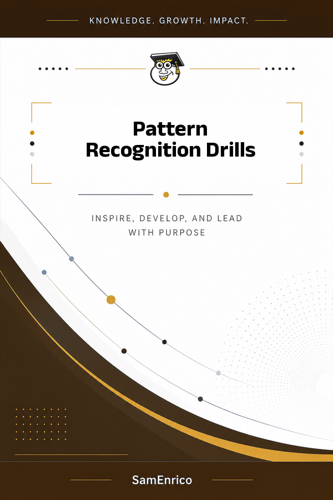
Pattern Recognition Drills eBook
Quick daily exercises to train your brain to spot
Quick daily exercises to train your brain to spot patterns faster.
Formats
Free sample
Chapter 1: The Algorithm of Intuition...--–- The firefighter knew the floor would collapse three seconds before it did. He didn't hear a crack. He didn't see a sagging beam. He simply stopped walking, grabbed his partner by the back of the jacket, and yanked him backward. A moment later, the living room floor vanished into the basement in a cloud of plaster and smoke.
When a journalist asked him how he knew, the firefighter shrugged and said, "I don't know. It just felt wrong."That feeling—the "just knew" sensation—is not magic. It is not luck. It is not a sixth sense reserved for first responders and poker champions. It is compressed experience, accelerated by millions of years of evolution and refined by every pattern your brain has ever processed.
The firefighter had seen hundreds of floors before this one. His conscious mind had noticed nothing unusual. But his basal ganglia—a fist-sized cluster of neurons buried deep beneath the cortex—had noticed everything. It compared the visual input from that floor to a library of thousands of previous floors, detected a mismatch in the way light fell across the surface, and fired an alarm before his prefrontal cortex could articulate the problem in words.This is intuition. And it is trainable.Most people believe that pattern recognition is something you either have or you don't.
They point to the coworker who spots a typo in a thirty-page document, the friend who always knows when someone is lying, the surgeon who feels which tissue to cut before she sees it. These people, the thinking goes, were born with sharper minds. But neuroscience has overturned that assumption. The brain is not a fixed organ. It is a plastic, malleable machine that rewires itself every time you use it.
The question is not whether you have pattern recognition ability. The question is whether you have deliberately trained it.This chapter begins where all pattern recognition training must begin: with the distinction between two thinking systems, the neuroscience of automaticity, and a single drill that will change how your brain processes visual information. By the end of this chapter, you will understand why "just knowing" is not a gift but a skill. You will have a five-minute daily exercise that transfers pattern recognition from your slow, energy-hungry prefrontal cortex to your fast, efficient basal ganglia. And you will have taken the first step toward seeing what others miss.The Two Engines of Thought In 2011, the psychologist Daniel Kahneman won a Nobel Prize for work that can be summarized in a simple idea: your brain has two operating systems.
System 1 is fast, automatic, effortless, and pattern-based. It is the part of you that recognizes a friend's face in a crowd, completes the phrase "bread and..." with "butter," and brakes the car before you consciously register the red light. System 2 is slow, deliberate, analytical, and exhausting. It is the part of you that solves a long division problem, compares mortgage rates, or decides which route to take when the highway is closed.Here is the problem. System 2 is terrible at pattern recognition.
It works by applying explicit rules to explicit data. It is the accountant, not the artist. When you force System 2 to handle visual comparison tasks—when you deliberately analyze whether two shapes are the same by counting their vertices or measuring their angles—you are using a sledgehammer to crack a nut. It works, but it is slow, and it drains your mental energy.System 1, by contrast, is the world's fastest pattern-matching engine. It processes approximately eleven million bits of information per second, compared to System 2's meager forty to fifty bits.
But System 1 has a catch: it only works on patterns it has seen before. You cannot recognize a face you have never seen. You cannot complete a phrase you have never heard. System 1 is a library of compressed experiences, and most people's libraries are understocked because they have never deliberately fed them the right data.The firefighter's System 1 was exquisitely trained. Not because he was born that way, but because he had seen thousands of floors in thousands of burning buildings.
Each floor added a book to his library. By the time he walked into that living room, his System 1 had a chapter on floor collapse that his conscious mind had never read.The goal of this chapter—and of every drill in this book—is to systematically stock your System 1 library. You will not do this by thinking harder. You will do this by drilling faster, because speed is the lever that moves pattern recognition from System 2 to System 1.The Neuroscience of Automaticity To understand why speed matters, you need to understand where in the brain pattern recognition actually happens. The prefrontal cortex—the part of your brain just behind your forehead—is the seat of System 2.
It is brilliant at novel problems. It can work through logic puzzles, plan your retirement, and decide what to eat for dinner. But it is metabolically expensive. Your prefrontal cortex consumes glucose at a furious rate, which is why you feel mentally tired after an hour of focused analytical work. More importantly for our purposes, the prefrontal cortex is slow.
It processes information serially, one chunk at a time, like a computer running a single-threaded program.Deep beneath the cortex, wrapped around the center of your brain like a C-shaped shell, lies the basal ganglia. This structure is ancient in evolutionary terms—reptiles have basal ganglia. Its job is to handle well-learned routines. Walking, tying your shoes, recognizing your mother's voice, and flinching at a sudden loud noise are all basal ganglia functions. The basal ganglia processes information in parallel, comparing current input to thousands of stored patterns simultaneously.
It does not get tired. It does not require conscious attention. And it is blindingly fast.Here is the critical insight: any task that you perform repeatedly under time pressure will eventually transfer from the prefrontal cortex to the basal ganglia. This is automaticity. It is why you struggled to tie your shoes as a child (prefrontal cortex) but do it effortlessly as an adult (basal ganglia).
It is why a beginner chess player calculates each move (prefrontal cortex) while a grandmaster "just sees" the best move (basal ganglia).The Same/Different drill that follows is designed to force this transfer for visual pattern recognition. You will start by consciously comparing shapes. Your prefrontal cortex will count angles, measure sizes, and check rotations. This will feel slow and effortful. That is the point.
As you repeat the drill under increasing time pressure, your prefrontal cortex will begin to fail—it simply cannot process that fast. In response, your basal ganglia will step in. At first, accuracy will drop. You will make mistakes. Then, after a few days, accuracy will recover.
That recovery is neuroplasticity. That recovery is your brain rewiring itself. That recovery is intuition.The Drill: Same/Different Reaction This is your daily drill for the next two weeks. It takes five minutes. Do it every morning, before your brain gets cluttered with the day's noise.
Do it before coffee if you can—mild caffeine deprivation actually sharpens early-morning pattern recognition by reducing cortical noise.Setup:You will need…
This is the end of the free sample. Get the eBook to keep going. Buy now
About this book
Details
- Author
- Boatwright Tilda
- Publisher
- SamEnrico
- Language
- English
- Genre
- Non-Fiction, Self-Help, Brain Training
- Released
- 2026-06-09
- Pages (approx.)
- 147
- Available as
- eBook, Audiobook

Read better in the ZLOADR app
Your eBooks on your phone or tablet. Sign in with your SamEnrico account and start reading.
More by Boatwright Tilda
 The Not-To-Do List for InterruptionsBoatwright Tilda$11.99
 Self Esteem For IntrovertsBoatwright Tilda$11.99
 Geo Arbitrage for FreelancersBoatwright Tilda$11.99
 Napoleonic Wars Complete GuideBoatwright Tilda$11.99
 Anger in Parenting GuideBoatwright Tilda$11.99
 Stress Incontinence GuideBoatwright Tilda$11.99
 Postpartum Anxiety Relief GuideBoatwright Tilda$11.99
 Divorce Wars Child Survival GuideBoatwright Tilda$11.99
 The Blood of the Warring States: Sun Tzu's Shadow and the Birth of StrategyBoatwright Tilda$11.99
 The Whispering Harp of the SelkiesBoatwright Tilda$11.99
 The Vanishing Hitchhiker: A Modern Myth RebornBoatwright Tilda$11.99
 Understanding Amelogenesis Imperfecta Local Hypoplastic FormBoatwright Tilda$17.99