
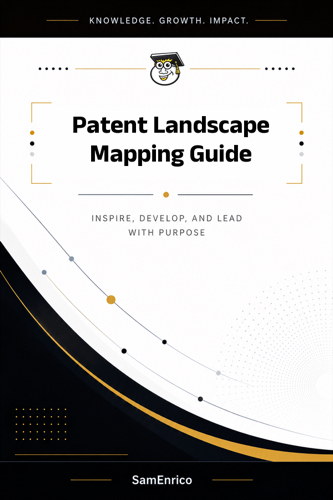
Non-FictionStrategic AtlasIntellectual Property
Patent Landscape Mapping Guide eBook
Position competitors by patent filings and technol
by Heim Exie
Position competitors by patent filings and technology claims to see innovation focus.
Formats
Free sample
Chapter 1: The 18-Month Advantage--You are already behind.Not because you are slow. Not because your team lacks talent. Not because your competitors are smarter or richer or luckier. You are behind for one simple, fixable reason: you are using the wrong data to watch them.Every Monday morning, your competitive intelligence team—if you have one—scrapes press releases, monitors earnings calls, and buys competitor products for teardowns. By Wednesday, they deliver a report.
By Friday, you have a plan. And by the following quarter, you discover that your competitor launched a feature, entered a market, or filed a patent that blindsided everyone.That patent is the clue you missed. Because while you were reading their press releases, they were legally required to tell you exactly what they were building—18 months before you could buy it.This book exists because that gap—the 18 months between a patent filing and its public availability as a product—is the single greatest advantage in competitive intelligence. And almost no one uses it.The Intelligence Gap: What Your Competitors Are Forced to Tell You Let us start with a radical proposition: your competitors are not hiding their R&D. They are publishing it.
They are sending it to government offices in Washington, Munich, Tokyo, and Beijing. They are paying lawyers thousands of dollars to draft it, examine it, and certify it. And then they are waiting 18 months for you to read it.This is not altruism. It is the law.The patent system operates on a grand bargain. In exchange for a temporary monopoly (20 years from filing), an inventor must disclose their invention in sufficient detail that a "person skilled in the art" could replicate it.
This is called "enabling disclosure." It is not optional. It is not vague. It is a legally enforceable requirement.Here is what that means for you: when a competitor files a patent, they must describe their invention precisely enough that someone with ordinary skill in your field could build it. Not guess at it. Not theorize about it.
Build it.The result is staggering. Studies of technical literature have found that approximately 80% of all technical information appears only in patent documents. Not in scientific journals. Not in conference proceedings. Not in press releases.
Only in patents.Think about that for a moment. Your competitors are producing technical knowledge at an enormous rate. They are paying inventors, funding labs, running experiments, and reducing ideas to practice. And then they are writing all of it down—the materials, the methods, the measurements, the mistakes, and the breakthroughs—and submitting it to public patent offices.And you are not reading it.The Data You Are Using Is Already History Why are you not reading it? Because competitive intelligence has been trained on the wrong sources.Let us examine the standard CI diet.Annual reports.
These are published once per year, typically 60-90 days after the fiscal year ends. They are written by investor relations teams, reviewed by lawyers, and polished by communications professionals. They contain exactly what the company wants you to know. They omit everything else. They are historical fiction with financial statements attached.Earnings calls.
These occur quarterly. Executives read prepared remarks, answer analyst questions, and carefully avoid saying anything that could be construed as forward-looking guidance. The most revealing moments are the ones where they say "we cannot comment on that at this time." The signal-to-noise ratio is terrible.Press releases. These are marketing documents. They announce product launches (already too late), partnerships (often negotiated months earlier), and executive hires (someone you should have recruited yourself).
They are designed to shape perception, not reveal reality.Product teardowns. This is the most expensive and least useful form of CI. You buy a competitor's product, take it apart, measure its components, and reverse-engineer its features. By the time you finish, the competitor is already designing the next version. You are analyzing history while they are building the future.Trade shows and conferences.
These are useful for networking and spotting trends. But by the time a company demos a product at CES or Mobile World Congress, the patents for that product have been sitting in the public record for 12-24 months.Every single one of these sources shares a fatal flaw: they are lagging indicators. They tell you what already happened. They cannot tell you what is coming.Patents are different.The Patent Lifecycle: Your 18-Month Window To understand why patents are forward-looking, you need to understand the patent lifecycle. This is the only time we will explain it in full.
Pay attention, because this timeline is the foundation of everything that follows.Month 0: The filing date. A company files a patent application with a patent office (USPTO, EPO, JPO, CNIPA, etc.). This is the earliest date that matters. The invention exists. The lawyers have been paid.
The clock has started.At this moment, the patent is secret. No one outside the company and the patent office knows it exists. This is the "invisibility window." It lasts for 18 months.During this window, your competitor is building prototypes, testing manufacturing processes, hiring supply chain partners, and planning their go-to-market strategy. You see none of it.Month 18: Publication. The patent application is published.
Anyone can read it. The 18-month window closes.This is the moment you should have marked on your calendar. Because from this day forward, you have access to the competitor's technical specifications, their claimed inventions, their working examples, and their legal strategy.But most companies ignore this date. They do not set alerts. They do not read the publications.
They wait for the product.Months 18-60: Prosecution. The patent office examines the application. Claims are rejected, amended, and allowed. This process takes 2-5 years on average. During this time, the competitor's claims narrow and sharpen.
Broad "land grab" claims get cut back. Specific, commercially relevant claims survive.You can watch this happen in real time. Every rejection, every amendment, every argument is public record. You can see exactly what your competitor fought to protect and what they gave up.Month 60 (typical): Grant. The patent issues.
The competitor now has a legal monopoly on the claimed invention. They can sue anyone who makes, uses, or sells it without permission.By this point, the product is likely on the market or very close. The patent grant is not the signal. It is the confirmation.Month 240 (20 years after filing): Expiry. The patent dies.
The invention enters the public domain. Generics and copycats can enter. This is the "revenue cliff."Here is the key insight: the earliest date you can learn about a competitor's R&D is month 18 (publication). The earliest date you can buy their product is typically month 30-48 (12-30 months after publication). That difference—12 to 30 months—is your advantage window.Let us say that again: you can know what your competitor is building 12 to 30 months before you can buy it.If you are not using that window, your competitor is laughing at you.From Legal Defense to Strategic Offense: A Mindset Shift If you have ever worked with a patent attorney, you know their default question: "Can we sell this without getting sued?"This is Freedom to Operate (FTO).
It is defensive. It asks: where are the landmines? The answer is usually a map of threats, exclusions, and territories…
This is the end of the free sample. Get the eBook to keep going. Buy now
About this book
Details
- Author
- Heim Exie
- Publisher
- SamEnrico
- Language
- English
- Genre
- Non-Fiction, Strategic Atlas, Intellectual Property
- Released
- 2026-06-10
- Pages (approx.)
- 142
- Available as
- eBook, Audiobook

Read better in the ZLOADR app
Your eBooks on your phone or tablet. Sign in with your SamEnrico account and start reading.
More by Heim Exie
 Hydration for Exam RecallHeim Exie$11.99
 Remote Retreats Investor UpdatesHeim Exie$11.99
 Sleep Optimization for Focus WorkHeim Exie$11.99
 Polish Auschwitz Underground GuideHeim Exie$11.99
 The Last Stand of the Great AukHeim Exie$11.99
 Silent Springs: The Unsung Battle Against the DDT Cover-UpHeim Exie$11.99
 PS Solution ArchitectHeim Exie$11.99
 JEE Speed Calculation GuideHeim Exie$12.99
 Budget Transfer And ReallocationHeim Exie$12.99
 Understanding Christianson–fourie SyndromeHeim Exie$17.99
 How to Start a Pouffe Business (Beginners Guide)Heim Exie$11.99
You may also like
 Hong Kong Handover 1997Dunn Johnnie$11.99
 Zumba For Postnatal Recovery CourseNeal Christian$11.99
 Zumba for BeginnersLadner Nikia$11.99
 YouTube Comment Mining GuideHumes Pandora$12.99
 Worry Box MeditationCarlin Rudy$11.99
 Workplace Stress MeditationNguyen Lynn$11.99
 Workplace Stress and Sleep RepairHawley Ivory$11.99
 Workplace Perfectionism CureDelaney Jeffry$11.99
 Workplace Injustice Anger GuideWallen Isabelle$11.99
 Work Addiction and Burnout LinkGreenwood Ester$11.99
 Women in Yoga and WellnessBeattie Galina$11.99
 Women in Stand Up ComedyChun Evangeline$11.99