
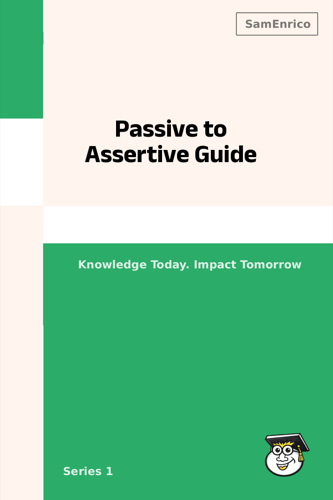
Passive to Assertive Guide eBook
Stop people-pleasing and learn to express your nee
Stop people-pleasing and learn to express your needs directly.
Formats
Free sample
Chapter 1: The Nice Cage--–- Clara had just microwaved her third cup of coffee that morning, watching the mug rotate behind the smudged glass door, when her phone buzzed. It was her colleague, Mark. Again. "Hey, so sorry to do this, but can you cover my 3 PM client call? Something came up." Clara stared at the message.
Her own 3 PM had been blocked off for two weeks—it was the only hour she had set aside to finish the quarterly report that was already two days late. Her chest tightened. Her thumbs hovered over the keyboard. And then, as she had done hundreds of times before, she typed: "Of course! No problem.
Hope everything's okay."She hit send, took a sip of lukewarm coffee, and felt nothing. Not anger. Not resentment. Not even exhaustion. Just a familiar, hollow numbness—the quiet erosion of a woman who had forgotten that her own time belonged to her.Clara is not real.
But if you are reading this book, Clara is probably you.The Disease You Didn't Know You Had Let us name the thing that has been living inside you, probably for decades, disguised as virtue. The psychological literature calls it many things: sociotropy, approval-seeking, the fawning response, or, most accessibly, the disease to please. Dr. Harriet Braiker, who studied this pattern extensively, described it as a toxic belief system in which your self-worth depends entirely on making other people happy. Not on your values.
Not on your integrity. Not on your own measure of a life well lived. On their happiness.Here is the sentence that changes everything: Being "nice" is not a virtue when it comes at the expense of your own truth.Read that again. Let it land in your chest. Because for most people-pleasers, "nice" has been their entire identity.
"I'm just a nice person." "I don't like conflict." "I hate letting people down." These statements feel like harmless self-descriptions, like saying you prefer tea over coffee or that you're more of a morning person. They are not harmless. They are the bars of a cage you have built around yourself, one "yes" at a time, over decades, with the best of intentions.The Nice vs. Good Distinction Let me draw a line that will become the backbone of everything that follows. There is a profound difference between being nice and being good.
They are not the same thing, and confusing them has cost you years of your life.Nice is external. It seeks approval. It avoids conflict at all costs. It prioritizes comfort—specifically, the comfort of others—over honesty. The nice person says "yes" to a dinner invitation they do not want to attend because saying no feels uncomfortable.
The nice person stays late at work even though their child is waiting at home because they do not want to be seen as difficult. The nice person swallows their opinion in a meeting because speaking up might cause a ripple. Nice is a performance. It is the mask you wear to ensure that everyone around you feels good, even if you feel nothing at all.Good is internal. It acts with integrity.
It tells the truth kindly but without apology. It accepts that sometimes, doing the right thing will disappoint someone, and it makes peace with that disappointment. The good person declines the dinner invitation because they need rest, and they do not over-explain or grovel. The good person leaves work on time because their child needs them, and they trust that the workplace can survive without their martyrdom. The good person speaks their perspective in the meeting because the team needs the truth, not another silent body.
Good is an orientation. It is the compass you consult before you open your mouth.Here is what you must understand: People will often mistake your goodness for meanness. When you stop being nice—when you stop performing approval-seeking pleasantness—people who benefited from your passivity will suddenly call you difficult, selfish, cold, or aggressive. This is not a sign that you have done something wrong. It is a sign that you have stopped being a resource that they could exploit.
The discomfort they feel is not evidence of your failure. It is evidence of your growth.The Physiological Cost of Chronic Niceness Let me tell you what is happening inside your body when you say yes and mean no. Because this is not just a psychological problem. It is a medical one.When you suppress an authentic impulse—the impulse to say no, to set a boundary, to ask for what you need—your nervous system registers a threat. The amygdala, your brain's alarm system, activates.
Cortisol and adrenaline spike. Your body prepares for action. But then you override that signal. You smile. You say "of course." You swallow the truth.
And the physiological arousal has nowhere to go. So it stays. It accumulates. Layer by layer, boundary violation by boundary violation, your body contracts.This is not metaphor. Somatic psychology has documented the physical postures of passivity for decades.
The clenched jaw. The shallow breathing. The shoulders that have crept up toward your ears until they live there permanently. The tightness in your chest that you have learned to ignore. The hollow, sinking feeling in your gut when someone asks for a favor.
The sudden exhaustion that hits you the moment you agree to something you did not want to do.These are not random symptoms. They are your body's honest signal. They are the whisper before the scream.The whisper is that small twinge of "I don't want to do this." It lasts maybe half a second. It is subtle. But it is true.
Most people-pleasers have been trained, through years of conditioning, to ignore the whisper entirely. They have become experts at overriding their own somatic truth.The scream is what happens when the whisper has been ignored too many times. The scream is the rage that explodes at your spouse because they left their socks on the floor—not about the socks, never about the socks, but about the 847 unexpressed boundaries that preceded them. The scream is the burnout that lands you in bed for three days, unable to move. The scream is the snapping at your child, the crying in the car, the sudden, overwhelming sense that you cannot do this anymore.The goal of this book is not to help you live in the scream.
It is to teach you to hear the whisper again. And to honor it.The Resentment Audit Before we go any further, I want you to do something concrete. This is not theoretical. This book is a workshop, not a lecture.Take out a piece of paper or open a new note on your phone. Write down three times in the past week when you said "yes" to something but wanted to say "no." Do not judge yourself.
Just list them. They can be small—agreeing to a call when you needed to focus, saying yes to a favor you did not have time for, accepting an invitation you secretly dreaded. They can be large—staying late at work again, taking on another responsibility when you are already…
This is the end of the free sample. Get the eBook to keep going. Buy now
About this book
Details
- Author
- Valentine Margy
- Publisher
- SamEnrico
- Language
- English
- Genre
- Non-Fiction, Self-Help, People Pleasing
- Released
- 2026-06-06
- Pages (approx.)
- 139
- Available as
- eBook, Audiobook

Read better in the ZLOADR app
Your eBooks on your phone or tablet. Sign in with your SamEnrico account and start reading.
More by Valentine Margy
 TANF Cliff MemoirValentine Margy$11.99
 Senior Inner Critic GuideValentine Margy$11.99
 Gratitude for AncestorsValentine Margy$11.99
 Mindful Eating for Beginners GuideValentine Margy$11.99
 The Philosopher and the Queen: Hypatia’s Last LessonValentine Margy$11.99
 How to Become a Laboratory SupervisorValentine Margy$11.99
 Biohazard Spill Cleanup (Osha-trained)Valentine Margy$11.99
 AMD SWOT Analysis Library GuideValentine Margy$12.99
 Accounting Formulas for Small Business OwnersValentine Margy$12.99
 Understanding Myoclonus Cerebellar Ataxia DeafnessValentine Margy$17.99
You may also like
 The Workaholic People Pleasing ConnectionLove Laurence$11.99
 The Disappointment Of OthersEscobar Paige$11.99
 People Pleasing Recovery AffirmationsGetz Yolonda$11.99
 NVC For People PleasingHelms Charla$11.99
 Assertiveness For People Pleasers CourseDarling Fanny$11.99
 Workaholic People PleasingRyan Guadalupe$11.99
 People Pleasing at Work CureBelanger Denny$11.99
 Boundary for People PleasersMatheny Phung$11.99
 Assertiveness for People Pleasers GuideCarlisle Cathryn$11.99
 People Pleasing Partnership RecoveryMobley Manuela$11.99
 People Pleasing at Job GuideSchroeder Sung$11.99
 The People Pleaser AdultJoy Verlie$11.99