
Non-FictionInformativeEducational
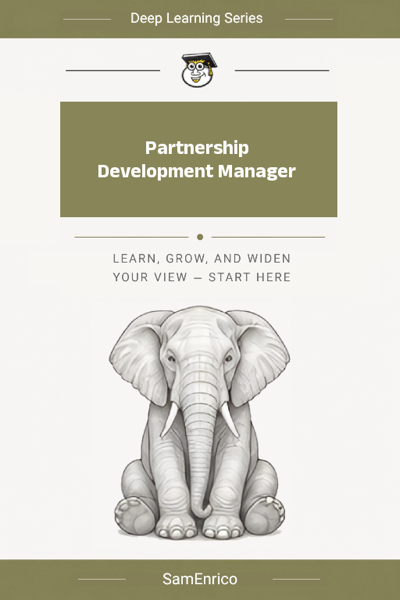
Partnership Development Manager eBook
A Coursebook on Partnership Development Manager
A Coursebook on Partnership Development Manager
Formats
Free sample
Chapter 1: The Ecosystem Epiphany...–- Most partnership development managers discover their true job description about six months too late. They are hired with titles that sound strategic—"Partnerships Lead," "Alliance Manager," "Ecosystem Director"—and then handed a spreadsheet of 200 potential partners with a directive to "go sign some deals." What follows is a predictable spiral: frantic outreach, hollow agreements, zero pipeline, and a quiet conversation with HR about "role fit.” This chapter exists to ensure that is not your story.The first and most important truth about partnership development is also the most frequently misunderstood: your job is not to sell to partners. Your job is to sell through partners. This single distinction separates the top 5% of PDMs from the 95% who burn out within 18 months. Selling to a partner means convincing them to sign a contract, put your logo on their website, and maybe attend a quarterly business review.
Selling through a partner means enabling them to generate pipeline, close deals, and solve customer problems using your product as a lever. The former produces paper. The latter produces revenue.I have watched dozens of PDMs walk into their first week with a list of 500 potential partners and a mandate to "get them all onboarded.” They treat the role like a volume game, measuring success by how many signatures they collect. Six months later, they have 200 signed agreements and zero revenue. Their partners have no idea how to sell the product, no incentive to learn, and no memory of why they signed in the first place.
The PDM is fired. The partners churn. The ecosystem collapses.This book exists to replace that broken model with a disciplined, repeatable, and scalable framework for building partnerships that actually work. Chapter 1 establishes the foundational shift every PDM must make before writing a single contract or scheduling a single discovery call. We will dismantle the myths that kill partnerships, define the role with surgical precision, introduce the five partnership types that actually matter, and demonstrate—through a detailed case study—why ecosystem-led growth outperforms linear selling in every measurable dimension.The Death of the Linear Sales Funnel For the past fifty years, business growth has been dominated by a single metaphor: the sales funnel.
Wide at the top, narrow at the bottom, linear from first touch to closed deal. Marketing fills the top with leads. Sales nurtures them through the middle. A small percentage emerges at the bottom as customers. This model has generated trillions of dollars in revenue, and it has also reached the outer limits of its effectiveness.The problem with the funnel is not that it stops working.
The problem is that it runs out of gas. Every lead you generate costs money. Every salesperson you hire adds fixed expense. Every percentage point of conversion requires marginal investment. The funnel scales additively—to double revenue, you must roughly double your lead generation and sales capacity.
For startups and high-growth companies, this arithmetic becomes brutal. Customer acquisition costs rise. Sales cycles lengthen. Competition for attention intensifies.Now consider an alternative model: the partnership ecosystem. You build a product.
A complementary company integrates with your API. Their customers discover your product through that integration. Those customers tell other customers. Partners refer partners. Every new relationship multiplies the reach of every existing relationship.
The ecosystem scales exponentially—because every participant becomes a growth channel for every other participant.This is not theoretical. Companies like Salesforce, Hub Spot, Shopify, and Stripe have built billion-dollar revenue streams almost entirely through ecosystems. Salesforce's App Exchange has generated more than 10billioninpartnerrevenue.Shopify′spartnerecosystemdroveover10 billion in partner revenue. Shopify's partner ecosystem drove over 10billioninpartnerrevenue.Shopify′spartnerecosystemdroveover5 billion in merchant GMV in a single year. These companies did not outspend their competitors on advertising.
They out-architected them on partnerships.The shift from funnel to ecosystem requires a fundamental change in how you measure success. A funnel PDM asks: How many partners did we sign this quarter? An ecosystem PDM asks: How much influenced revenue did our partners generate? The first metric rewards activity. The second metric rewards outcomes.
Throughout this book, we will return to this distinction. Activity without outcomes is noise. Outcomes without activity is impossible. The art of partnership development is aligning the two.Defining the PDM: Four Roles, One Distinction Before we go any further, let us eliminate a source of perpetual confusion. The job title "Partnership Development Manager" means different things at different companies, and the ambiguity destroys careers.
I have interviewed PDMs who were, in practice, channel salespeople. I have interviewed others who were product integrators. Still others who were event marketers with a fancier business card.To build a successful career in this field, you must understand four distinct roles and choose where you belong. Each role is legitimate. Each role is valuable.
But only one of them is the subject of this book.Channel Manager: This role focuses on resellers and distributors. The channel manager recruits partners who will buy the company's product at a discount and resell it at a markup. Success metrics are volume-driven: number of resellers, units sold, deal registration velocity. The channel manager is a sales operator with a different go-to-market motion. They do not typically manage strategic relationships or co-innovation.Business Development (BD): This role focuses on one-off deals or joint ventures.
The BD professional identifies a specific opportunity—a technology integration, a co-marketing campaign, a distribution agreement—structures the deal, negotiates the terms, and then moves on to the next opportunity. BD is transactional in the best sense of the word: find the deal, close the deal, repeat. BD professionals rarely manage ongoing relationships after the contract is signed.Strategic Alliances: This role focuses on long-term, high-stakes corporate partnerships. Strategic alliance managers work with partners like Accenture, Deloitte, or Microsoft—partners that require executive alignment, joint roadmaps, and multi-year commitments. The strategic alliance manager is part diplomat, part program manager, and part executive sponsor.
They manage a small number of relationships with extreme intensity.Partnership Development Manager (This Book): This role builds ongoing, mutually beneficial ecosystems. The PDM recruits partners across multiple types (which we will cover in the next section), enables them to sell or integrate the product, co-markets to generate pipeline, and manages the relationship through regular governance. Unlike BD, the PDM does not walk away after the deal closes. Unlike channel management, the PDM focuses on quality over volume. Unlike strategic alliances, the PDM manages a portfolio of partners at different tiers.Here is the critical insight: great PDMs know how to borrow from all three adjacent roles.
They think like a channel manager about volume economics. They think like a BD professional about deal structure. They think like a strategic alliance manager about executive governance. But they anchor themselves in the ecosystem mindset—the belief that partnerships are a multiplicative growth engine, not an additive sales channel.If you came to this book hoping to learn how to sign 500 resellers in 90 days, you will be disappointed. That is channel management, and it requires a different playbook.
If you came hoping to learn how to negotiate a single billion-dollar joint venture, you will also be disappointed. That is strategic alliances, and it requires a different…
This is the end of the free sample. Get the eBook to keep going. Buy now
About this book
Details
- Author
- Gleason Lanita
- Publisher
- SamEnrico
- Language
- English
- Genre
- Non-Fiction, Informative, Educational
- Released
- 2026-05-11
- Pages (approx.)
- 142
- Available as
- eBook, Audiobook

Read better in the ZLOADR app
Your eBooks on your phone or tablet. Sign in with your SamEnrico account and start reading.
More by Gleason Lanita
 The Listening Leader In EducationGleason Lanita$11.99
 Emotion Regulation FlashcardsGleason Lanita$11.99
 The IBS Diet GuideGleason Lanita$11.99
 The Cross Sell Email GuideGleason Lanita$11.99
 Anger Triggers in Parenting PrimerGleason Lanita$11.99
 The Last Emperor of Atlantis: A Forgotten Myth RebornGleason Lanita$11.99
 Understanding ThalassemiaGleason Lanita$17.99
 Green Credit Annual Update 2025Gleason Lanita$12.99
 ARIPO Designation GuideGleason Lanita$12.99
 How to Start a NAAFI Club Business (Beginners Guide)Gleason Lanita$11.99
You may also like
 Hong Kong Handover 1997Dunn Johnnie$11.99
 Zumba For Postnatal Recovery CourseNeal Christian$11.99
 Zumba for BeginnersLadner Nikia$11.99
 YouTube Comment Mining GuideHumes Pandora$12.99
 Worry Box MeditationCarlin Rudy$11.99
 Workplace Stress MeditationNguyen Lynn$11.99
 Workplace Stress and Sleep RepairHawley Ivory$11.99
 Workplace Perfectionism CureDelaney Jeffry$11.99
 Workplace Injustice Anger GuideWallen Isabelle$11.99
 Work Addiction and Burnout LinkGreenwood Ester$11.99
 Women in Yoga and WellnessBeattie Galina$11.99
 Women in Stand Up ComedyChun Evangeline$11.99