
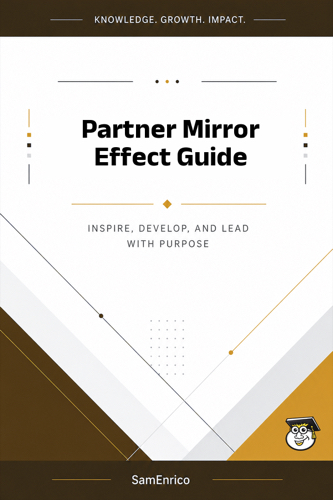
Partner Mirror Effect Guide eBook
Recognize how your self view affects your partner
by Reno Lupita
Recognize how your self view affects your partner treatment of you.
Formats
Free sample
Chapter 1: The Invisible Contract...--–- You are standing in the bathroom, door closed, water running so no one can hear you cry. Your chest is tight. Your throat burns. Outside, your partner sits on the couch, scrolling through their phone, completely unaware—or so you tell yourself—that you have just shattered into a thousand pieces on the tile floor. The fight was stupid.
It was always stupid. They forgot to take out the trash. Or they worked late again. Or they looked at you with that face—the one that says you are exhausting, you are too much, you are never enough.You wipe your eyes, splash cold water on your face, and walk back out. They glance up.
"You okay?" they ask. And you say, "Yeah. Fine." Because what else is there to say? You have already explained how you feel a hundred times. You have already begged, cried, negotiated, and screamed into the void.
Nothing changes. So you swallow it. Again. And you tell yourself the same story you have told yourself for years: They don't care. They never will.
I chose the wrong person.What if that story is wrong?What if your partner is not the villain of this story?What if—and stay with me here because this is going to sting—what if your partner is treating you exactly the way you have unconsciously trained them to treat you?This is not blame. This is not victim-shaming. This is the single most liberating truth you will ever encounter about relationships: The way your partner treats you is often a mirror of how you truly see yourself. Not how you say you see yourself. Not how you wish you saw yourself.
But how you actually, secretly, deep in your bones, believe you deserve to be treated.This chapter introduces the Partner Mirror Effect—the central hypothesis of this entire book. And before you reject it, before you list all the ways your partner is objectively wrong, I need you to do something uncomfortable. I need you to consider that you have been looking at the reflection and blaming the mirror for showing you what is actually there.The Myth of the One-Way Mirror Most people enter relationships with a fundamental misunderstanding. They believe that their partner's behavior—whether loving, critical, distant, angry, or affectionate—is solely a product of that partner's personality. In other words: He ignores me because he is selfish.
She criticizes me because she is controlling. They withdrew because they are avoidant. Full stop. End of analysis.This is what I call the One-Way Mirror Myth. It assumes that your partner's treatment of you is a closed loop, generated entirely from their own psychology, with no input from you whatsoever.
It assumes you are a passive recipient of their behavior, not an active participant in its creation.Here is the problem with that myth: It leaves you powerless.If your partner's behavior is entirely about them, then you have no leverage. You can beg, plead, threaten, or leave—but you cannot influence them from the inside. You are a passenger on a plane you did not pilot, headed toward a destination you did not choose.The Partner Mirror Effect offers a different model. It suggests that your partner's behavior is not a one-way street but a feedback loop. You emit signals—thousands of them, every day, most of which you do not even know you are sending—about what you believe you are worth.
Your partner receives those signals and responds accordingly. Not because they are cruel or manipulative (though some are; we will get to that in Chapter 7), but because human beings are exquisitely sensitive to cues about where they stand in a relationship hierarchy.Let me give you an example.Sarah had been married to Mark for eleven years. She came to see me because she was convinced Mark was a narcissist. "He never asks about my day," she said. "He makes plans without consulting me.
He forgot our anniversary two years in a row. When I try to tell him how I feel, he sighs and walks away."I asked Sarah to describe the last time she had asked Mark for something she needed—not a complaint about what he had done wrong, but a direct, clear request for what she wanted.She thought for a long time. "I don't really ask for things," she admitted. "I hint. I say things like, 'It would be nice if someone remembered my birthday.' Or I get quiet, and he's supposed to notice.
When he doesn't, I get angry, and then he says I'm being passive-aggressive.""Does he know what you actually want?" I asked."He should," she said. "We've been married for eleven years."There it was. The invisible contract. Sarah believed that after eleven years, Mark should be a mind reader. She believed that hinting was the same as asking.
She believed that her silence was a form of communication that any decent husband would understand.But Mark was not a mind reader. Mark was a human being who had learned, over eleven years, that when Sarah went quiet, she would eventually get over it. He had learned that her hints did not require a response because they were not actually requests—they were emotional weather patterns. He had learned that his lack of response did not have consequences because Sarah never enforced any.Mark was not ignoring Sarah because he was a narcissist. Mark was ignoring Sarah because she had trained him, through eleven years of dropped hints and unenforced boundaries, that her needs were optional.That is the Partner Mirror Effect in action.
Sarah saw herself as someone whose needs were less important than peace. She acted accordingly—by hinting instead of asking, by swallowing her anger instead of stating boundaries. And Mark, being a normal human being who responds to feedback, mirrored that self-view back to her. He treated her needs as optional because she had signaled, thousands of times, that they were optional.The actress did not write the script. The playwright did.
And the playwright was Sarah.Where the Script Comes From (And Why It Feels Like Fate)If the Partner Mirror Effect is real—if we are unconsciously training our partners to treat us the way we believe we deserve—then where does that belief come from? Why does one person grow up believing they are worth chasing, while another grows up believing they are worth ignoring?The answer, as you have probably guessed, is childhood. But not in the way you might think. This is not about blaming your parents. This is about understanding the operating system you were given before you had any choice in the matter.By the age of five or six, every human being writes an unconscious life script.
This concept comes from transactional analysis, developed by Eric Berne and popularized by Thomas Harris in the bestselling book I'm OK, You're OK. A life script is not a literal document. It is a set of deeply held beliefs about three things: who you are, who other people are, and what you can expect from relationships.You did…
This is the end of the free sample. Get the eBook to keep going. Buy now
About this book
Details
- Author
- Reno Lupita
- Publisher
- SamEnrico
- Language
- English
- Genre
- Non-Fiction, Self-Help, Relational Dynamics
- Released
- 2026-06-11
- Pages (approx.)
- 144
- Available as
- eBook, Audiobook

Read better in the ZLOADR app
Your eBooks on your phone or tablet. Sign in with your SamEnrico account and start reading.
More by Reno Lupita
 Dark Therapy for RhythmReno Lupita$11.99
 Trauma Response Patterns HandbookReno Lupita$11.99
 DT Prevention Medical GuideReno Lupita$11.99
 Personal Brand ROI GuideReno Lupita$11.99
 Trigger Identification GuideReno Lupita$11.99
 Crime Insurance CoverageReno Lupita$11.99
 Cognitive Load ManagementReno Lupita$11.99
 The Court of Mozart: Music as RoyaltyReno Lupita$11.99
 The Forger’s Gamble: How a Japanese Master Tricked the Art World (1980s-1990s)Reno Lupita$11.99
 How to Become a Hat MakerReno Lupita$11.99
 How to Trade RiceReno Lupita$11.99
 A Collector's Handbook to the Aston Martin Db5Reno Lupita$11.99