
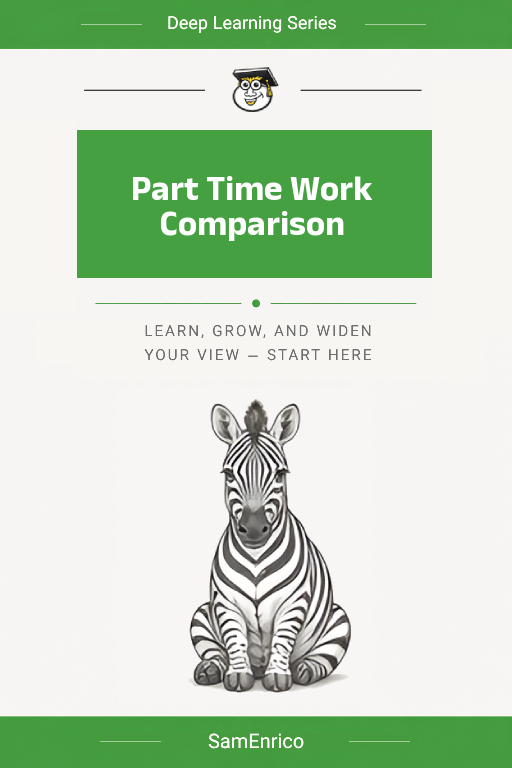
Non-FictionStudent's ShortcutStudent Employment
Part Time Work Comparison eBook
Compare student visa work limits, minimum wages, a
Compare student visa work limits, minimum wages, and job availability for international students.
Formats
Free sample
Chapter 1: The Four Archetypes--Every year, nearly six million international students pack their bags, max out their savings accounts, and board planes to countries they have only seen in movies or on Instagram. They arrive with dreams of prestigious degrees, cultural immersion, and the vague but persistent hope that somehow, through hard work and determination, they will figure out the money part along the way. Most of them make the same catastrophic mistake within their first six months: they assume that the rules for student work are roughly the same everywhere. They are wrong. And for thousands of them every year, that wrongness ends in deportation, bankruptcy, or both.The student visa is not a work permit with a study attachment.
It is a study permit with a carefully rationed work attachment. Every country that hosts international students has calculated, often to the decimal point, exactly how much labor it wants from you and exactly how little of its permanent residency it wants to give in return. These calculations are not random. They are the product of demographic panic, labor market shortages, political pressure from local workers, and the quiet, relentless competition among English-speaking countries to attract tuition-paying students without letting them stay permanently.Understanding this hidden machinery is the difference between graduating with savings and a job offer versus being escorted to an airport holding a deportation order. This chapter introduces the four archetypes of host countries—a framework that will guide every decision you make about where to study, how many hours to work, and whether you will ever be allowed to call that country home.Before we dive into the archetypes, you need to understand the single most important legal concept in this entire book: your visa is a contract.
Not a suggestion. Not a guideline. A contract with the government, and you are the only party that can be deported for breach. Every hour you work beyond the limit, every job you take without proper authorization, every tax return you fail to file is a potential breach. Some countries monitor this contract aggressively.
Others monitor it casually. But all of them have the power to cancel your visa with no warning, no appeal, and no refund of your tuition. The case studies in this chapter are real. The names have been changed. The deportations were not.Archetype One: The High-Wage Earners Australia and New Zealand belong to a small, exclusive club of countries that have done the math and decided that international students are worth paying.
Not out of generosity. Out of necessity. Both countries have aging populations, geographically isolated labor markets, and economies heavily dependent on hospitality, agriculture, healthcare, and retail sectors that cannot find enough local workers. The solution has been to offer international students genuinely high minimum wages—A24.80perhourin Australia,NZ24.80 per hour in Australia, NZ24.80perhourin Australia,NZ23.15 per hour in New Zealand—and then allow them to work enough hours (24 to 25 per week during term, unlimited during breaks) to actually cover their living expenses.But high wages come with high costs. Sydney, Melbourne, and Auckland rank among the most expensive rental markets in the world.
A room in a shared apartment in central Sydney costs between A300and A300 and A300and A500 per week. A monthly public transport pass adds another A150to A150 to A150to A200. Groceries, mobile phone bills, and the occasional social outing quickly consume the remainder of a student’s paycheck. The net result is that a student working the maximum 48 hours per fortnight in Sydney takes home approximately A3,200permonthbeforerent.Afterpaying A3,200 per month before rent. After paying A3,200permonthbeforerent.Afterpaying A1,600 for a room, A200fortransport,and A200 for transport, and A200fortransport,and A400 for food, they have roughly A$1,000 left for savings, emergencies, or the dental work they have been postponing.
That is not wealthy. But it is survivable. And in the world of international student finance, survivable is a victory.The immigration pathways in Australia and New Zealand are similarly generous, though tightening. Australia’s Temporary Graduate Visa (subclass 485) allows graduates to stay and work for two to four years, depending on their degree and location. After that, the skilled migration points test determines who gets permanent residency.
Points are awarded for age (younger is better), English ability, work experience, and whether your occupation appears on the skilled shortage list. As of 2026, Australia has begun reducing post-study work rights for certain degrees, including business, marketing, and communications, while expanding them for nursing, teaching, and social work. The message is clear: Australia wants workers it cannot produce domestically. It does not want more business school graduates.New Zealand’s pathway is smaller and more intimate. The Post-Study Work Visa lasts one to three years, after which applicants must qualify under the Skilled Migrant Category, which also uses a points system but with greater emphasis on a job offer from an accredited employer.
Both countries score a pathway difficulty rating of 2 out of 5—relatively easy compared to the United States or Singapore, but not automatic like Canada. The key to success in the High-Wage Earners is simple: do not waste your break periods. A student who works 20 hours per week during term and 50 hours per week during a 12-week summer break can bank A8,000to A8,000 to A8,000to A10,000 in a single season. That money is not pocket change. That money is the difference between staying for a second year or going home broke.Consider the case of Priya, a nursing student from India who arrived in Melbourne in 2024.
She worked 20 hours per week at a hospital cafe during her first semester, earning A24.80perhourpluspenaltyratesforweekendshifts.Duringherthree−monthsummerbreak,shepickedupasecondjobatanagedcarefacility,working50hoursperweekbetweenbothroles.Bytheendofherfirstyear,shehadsaved A24.80 per hour plus penalty rates for weekend shifts. During her three-month summer break, she picked up a second job at an aged care facility, working 50 hours per week between both roles. By the end of her first year, she had saved A24.80perhourpluspenaltyratesforweekendshifts.Duringherthree−monthsummerbreak,shepickedupasecondjobatanagedcarefacility,working50hoursperweekbetweenbothroles.Bytheendofherfirstyear,shehadsaved A14,000. More importantly, she had documented work experience in the aged care sector, which gave her additional points on her skilled migration application. She received permanent residency eighteen months after graduation.
Her friend Vikram, who studied marketing at the same university, spent his summer breaks traveling and worked only the minimum hours during term. He saved nothing, could not afford the application fees for the graduate visa, and returned to India with a degree but no pathway to stay. The same country. The same university. Wildly different outcomes.
The difference was not luck. It was strategy.Archetype Two: The Pathway Powerhouse Canada occupies a unique position in the global market for international students. It does not offer the highest wages—minimum wages range from CAD 15in Albertato CAD15 in Alberta to CAD 15in Albertato CAD17.40 in British Columbia, which puts Canada in the mid-range globally. It does not offer the most flexible hours—24 per week during term, which is comfortable but not generous. What Canada offers is the clearest, most predictable, and most forgiving pathway from student visa to permanent residency in the English-speaking world.The secret is not any single policy but the architecture of the entire system.…
This is the end of the free sample. Get the eBook to keep going. Buy now
About this book
Details
- Author
- Fredericks Refugia
- Publisher
- SamEnrico
- Language
- English
- Genre
- Non-Fiction, Student's Shortcut, Student Employment
- Released
- 2026-06-01
- Pages (approx.)
- 152
- Available as
- eBook, Audiobook

Read better in the ZLOADR app
Your eBooks on your phone or tablet. Sign in with your SamEnrico account and start reading.
More by Fredericks Refugia
 Spending Urge Surfing HandbookFredericks Refugia$11.99
 Russian Money Laundering GuideFredericks Refugia$11.99
 Paper Dream Journal SetupFredericks Refugia$11.99
 Sugar Addiction in Diabetes ManagementFredericks Refugia$11.99
 Mindfulness for Anxiety ReliefFredericks Refugia$11.99
 The Diamond Heist That Shocked the World: The 1972 Cartier AffairFredericks Refugia$11.99
 The Peruvian Dynamo: Julio César Tapia and the Hidden Power of the AndesFredericks Refugia$11.99
 Distribution In Low Income MarketsFredericks Refugia$12.99
 How to Start a Shop Letting Business (Beginners Guide)Fredericks Refugia$11.99
 Histogram GeneratorFredericks Refugia$11.99
You may also like
 Hong Kong Handover 1997Dunn Johnnie$11.99
 Zumba For Postnatal Recovery CourseNeal Christian$11.99
 Zumba for BeginnersLadner Nikia$11.99
 YouTube Comment Mining GuideHumes Pandora$12.99
 Worry Box MeditationCarlin Rudy$11.99
 Workplace Stress MeditationNguyen Lynn$11.99
 Workplace Stress and Sleep RepairHawley Ivory$11.99
 Workplace Perfectionism CureDelaney Jeffry$11.99
 Workplace Injustice Anger GuideWallen Isabelle$11.99
 Work Addiction and Burnout LinkGreenwood Ester$11.99
 Women in Yoga and WellnessBeattie Galina$11.99
 Women in Stand Up ComedyChun Evangeline$11.99