
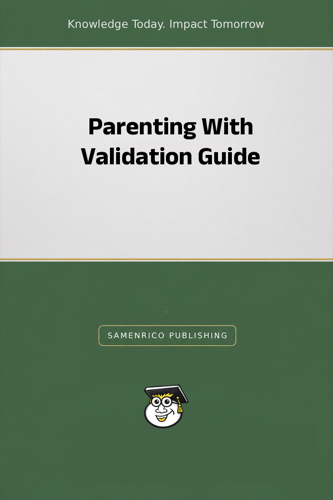
Parenting With Validation Guide eBook
Validate your child's emotions while still setting
Validate your child's emotions while still setting boundaries and teaching regulation.
Formats
Free sample
Chapter 1: The Cracker Incident--It was a Tuesday morning, and I had exactly four minutes to get my three-year-old into his car seat before we missed the preschool drop-off window and I would be late for a meeting I had already rescheduled twice. The cracker—a standard, unremarkable saltine—snapped in half as he tried to pull it from the plastic sleeve. What happened next was not a tantrum. It was an detonation. He threw himself onto the kitchen floor, legs kicking, face crimson, screaming as though I had personally betrayed every cell of his body.
His sister stared. The dog hid under the table. And I, a supposedly competent adult who had read parenting books and listened to podcasts and theoretically knew better, leaned down and said the worst possible thing: "It's just a cracker. Stop crying. We have more."The screaming got louder.I tried reason: "I can get you another one." Louder still.
I tried threats: "If you don't stop, no TV today." The volume somehow increased past what I believed was physically possible. I tried walking away—the classic "ignore the behavior" technique I had read about in a popular discipline book. He followed me, still screaming, now also grabbing at my leg. I tried time-out. He refused to stay.
I tried picking him up and buckling him into the car seat while he arched his back like a feral cat. By the time we arrived at preschool, I was sweating, he was hoarse, and we had not spoken a single kind word to each other in twenty minutes.I sat in the parking lot after dropping him off and cried. Not because I was sad. Because I was humiliated. I had just lost a battle to a three-year-old over a cracker.
But worse than that: I had no idea what else I could have done. Every tool I had been given—ignore it, punish it, distract from it, reason it away—had failed. I had tried compliance, and I had gotten compliance's cousin: rebellion. What I had not tried, because no one had taught me how, was simply letting him be upset without trying to fix it, minimize it, or make it stop.This book exists because of that cracker. And because I eventually learned that the cracker was never the point.The Great Misunderstanding For generations, parents have been taught a seductively simple lie: that children cry, whine, tantrum, and talk back because they are trying to manipulate us.
This lie appears in different costumes—"he's just doing it for attention," "she knows exactly what she's doing," "if you give in now, you'll be training him to do it again." The underlying assumption is that a child's emotional outburst is a calculated strategy, a chess move aimed at getting something they want. And if it is a strategy, then the parent's job is to out-strategize them: ignore, punish, distract, or threaten until the behavior stops.This assumption is wrong. It is not merely unhelpful. It is actively destructive.Here is what we now know from decades of neuroscience research, much of it led by people like Dr. Dan Siegel and Dr.
Bruce Perry: when a young child is in the middle of a meltdown, they are not choosing to behave badly. They are literally incapable of choosing otherwise. The part of their brain responsible for reasoning, impulse control, and emotional regulation—the prefrontal cortex—has gone offline. In its place, the amygdala, the brain's ancient alarm system, has taken over. The amygdala does not reason.
It does not negotiate. It detects a threat and sounds the alarm. Fight. Flight. Freeze.
That is all it knows.From the outside, a toddler screaming over a broken cracker looks ridiculous. From the inside, it feels like an emergency. His brain has registered the broken cracker as a disruption to his expectations, and for a three-year-old whose entire sense of safety depends on predictable routines, a disruption feels like a threat. The alarm sounds. The prefrontal cortex disconnects.
And now you are standing in front of a small person whose brain is operating on pure survival instinct, telling him to "calm down" as though he had access to the calm-down controls. He does not. Those controls are currently unplugged.This is what I mean when I say that behavior is not a problem to be fixed. Behavior is a signal to be understood. A tantrum is not a failure of parenting.
It is a symptom of a dysregulated nervous system. Your job in that moment is not to stop the behavior. Your job is to help the child's nervous system find its way back to safety. And you cannot do that by threatening, ignoring, or punishing—all of which register to the amygdala as additional threats.Compliance vs. Cooperation One of the most important distinctions you will learn in this book is the difference between compliance and cooperation.
They look similar from the outside. Both produce a child who stops screaming, puts on their shoes, or gets into the car seat. But they arrive through completely different pathways, and they produce completely different long-term outcomes.Compliance is fear-based behavior. A child complies because they are afraid of what will happen if they do not. They may be afraid of your anger, your withdrawal, your punishment, or simply the uncomfortable feeling of disappointing you.
Compliance is efficient in the short term—it often stops the behavior quickly—but it comes at a cost. A compliant child is not learning self-regulation. They are learning to suppress their feelings to avoid punishment. And suppressed feelings do not disappear; they reappear later as anxiety, defiance, or physical symptoms.Cooperation, on the other hand, is trust-based behavior. A child cooperates because they feel safe enough to move through their difficult feelings with your support, and then choose to follow the limit because they trust that you are on their side.
Cooperation takes longer in the moment. It requires you to sit in the discomfort of a meltdown without trying to shut it down. But cooperation builds the internal skills that compliance never touches: emotional awareness, impulse control, and the ability to tolerate frustration.Here is the hard truth that no one tells you: compliance is easier. It is faster. It feels like you are in control.
But compliance produces a child who behaves well when you are watching and falls apart when you are not. Cooperation produces a child who develops their own internal compass, because they have learned that their feelings are not dangerous, that you will not abandon them when they struggle, and that limits are not threats.Every time you choose a punitive time-out over sitting with a crying child, every time you threaten to take away a privilege instead of validating a feeling, every time you say "stop crying or I'll give you something to cry about," you are teaching compliance. And every time you choose to stay present, name the feeling, and hold the limit with empathy, you are teaching cooperation. The difference is not in the outcome today. The difference is in the adult they become.Why "Sucking It Up" Backfires The phrase "suck it up" has been a staple…
This is the end of the free sample. Get the eBook to keep going. Buy now
About this book
Details
- Author
- Nugent Jaymie
- Publisher
- SamEnrico
- Language
- English
- Genre
- Non-Fiction, Self-Help, Parenting
- Released
- 2026-06-07
- Pages (approx.)
- 132
- Available as
- eBook, Audiobook

Read better in the ZLOADR app
Your eBooks on your phone or tablet. Sign in with your SamEnrico account and start reading.
More by Nugent Jaymie
 First Woman in the MansionNugent Jaymie$11.99
 Peru Remote Tax GuideNugent Jaymie$11.99
 Doctor Data GI360 GuideNugent Jaymie$11.99
 GERD Nighttime Reflux GuideNugent Jaymie$11.99
 Sleep Apnea JournalNugent Jaymie$11.99
 TM for Work Life BalanceNugent Jaymie$11.99
 Pomodoro For SalesNugent Jaymie$11.99
 Lynch Twin PeaksNugent Jaymie$11.99
 Zero Day: How a Russian Hacker Almost Broke the InternetNugent Jaymie$11.99
 The Last Letter: A Voice from the Titanic's Lost CabinNugent Jaymie$11.99
 Silk and Shadows: The Phantom of the Silk RoadNugent Jaymie$11.99
 How to Become a BuckerNugent Jaymie$11.99
You may also like
 Hong Kong Handover 1997Dunn Johnnie$11.99
 Zumba For Postnatal Recovery CourseNeal Christian$11.99
 Zumba for BeginnersLadner Nikia$11.99
 YouTube Comment Mining GuideHumes Pandora$12.99
 Worry Box MeditationCarlin Rudy$11.99
 Workplace Stress MeditationNguyen Lynn$11.99
 Workplace Stress and Sleep RepairHawley Ivory$11.99
 Workplace Perfectionism CureDelaney Jeffry$11.99
 Workplace Injustice Anger GuideWallen Isabelle$11.99
 Work Addiction and Burnout LinkGreenwood Ester$11.99
 Women in Yoga and WellnessBeattie Galina$11.99
 Women in Stand Up ComedyChun Evangeline$11.99