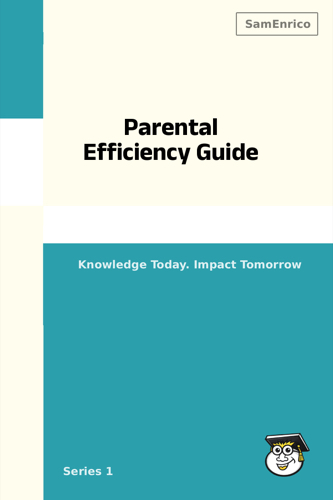
Parental Efficiency Guide eBook
Streamlines daily routines and household tasks.
by Saenz Joana
Streamlines daily routines and household tasks.
Formats
Free sample
Chapter 1: The Data Problem--I want you to pause for a moment and consider something that might sound strange: your family’s chaos is not your fault.Not because you are lazy. Not because you lack discipline. Not because you were born without the “organizing gene” that your neighbor with the matching spice jars clearly possesses. And certainly not because you don’t love your children enough to try harder.The real reason you feel like you are drowning in a sea of permission slips, mismatched socks, forgotten dental appointments, and 4:00 PM “what’s for dinner?” panic is far simpler, far less judgmental, and far more solvable than any of those stories you have been telling yourself. You do not have a character problem.
You have a data problem.Think about the last time your morning fell apart. Maybe you woke up already tired, stumbled to the coffee maker, and then discovered there were no clean bottles for the baby. Or you opened the front door to leave for school and realized that the permission slip you signed last night was still sitting on the kitchen counter instead of in your child’s backpack. Or you arrived at the grocery store only to remember, halfway down the cereal aisle, that you had promised to bring cupcakes to the class party that morning.In each of those moments, what actually happened? You didn’t suddenly become a bad parent.
You didn’t forget how to pour coffee or put paper in a backpack. What happened was that your brain—your beautiful, finite, overworked brain—dropped a ball it was never designed to carry in the first place.This chapter is about that ball. It is about the invisible weight of holding everything in your head. And it is about the single most important shift you will make in this entire book: moving from a reactive mindset that treats each crisis as a surprise to a steady mindset that treats household management as a system. Because once you see the chaos as data, you can finally do something about it.The Martyr Parent vs.
The Professional Parent Let me introduce you to two archetypes. You will recognize both of them because you have lived inside both of them at different moments.The first is the Martyr Parent. This is the mom or dad who wears exhaustion like a crown. You know the script: “I never get a break.” “No one else notices what needs to be done.” “If I don’t do it, it won’t get done.” The Martyr Parent believes that love is measured in sacrifice, and that a clean house is proof of good parenting. They are exhausted, resentful, and secretly terrified that if they stop running, the entire household will collapse.Here is the hard truth about the Martyr Parent: their exhaustion is real, but their strategy is broken.
They are trying to hold every open loop in their head—the soccer sign-up deadline, the leaky faucet, the birthday gift for the party on Saturday, the dog’s vaccine appointment, the school fundraiser form that needs to be returned by Friday. And because the human brain can only actively track about four pieces of information at once, things fall through the cracks constantly. Then the Martyr Parent interprets those cracks as personal failures, which leads to more guilt, more effort, and more exhaustion. It is a vicious cycle, and it has nothing to do with how much they love their children.The second archetype is the Professional Parent. This is not a parent who has more hours in the day or more money or a live-in housekeeper.
The Professional Parent is simply a parent who treats household management with the same intentionality that a project manager treats a product launch. They have systems. They have routines. They have a place where information lives outside their skull. The Professional Parent is not calmer because they have less to do; they are calmer because they have stopped trying to remember everything.
They have outsourced the memory work to a system.Here is the radical difference between these two archetypes. The Martyr Parent asks: “Why can’t I get it together?” The Professional Parent asks: “Where did my system break?” The first question leads to shame and more effort. The second question leads to diagnosis and repair. The Martyr Parent sees chaos as a moral failing. The Professional Parent sees chaos as a data problem.This entire book is about moving you from the first question to the second.Why Your Brain Is Not a To-Do List To understand why the Martyr Parent strategy fails, you need to understand something about how your brain actually works.
And I am going to borrow heavily here from David Allen, the author of Getting Things Done, who has spent decades studying productivity and cognitive load.Here is the short version: your brain is for having ideas, not holding them.Every time you think “I need to remember to pack the diaper bag tonight” or “Don’t forget that Thursday is early dismissal” or “We are almost out of laundry detergent,” your brain treats that thought as an open loop. An open loop is a task or piece of information that has no designated home. It is a mental sticky note that your unconscious mind keeps pinging you about, over and over, to make sure you do not forget.The problem is that open loops are expensive. Cognitive psychologists have found that the human brain can only hold about four discrete items in working memory at any given time. That means if you are already holding “remember to email the teacher,” “schedule the pediatrician,” “buy milk,” “call the plumber,” and “sign the camp form,” you have no room left for anything else.
You are operating at max capacity before you have even gotten out of bed.This is why parents feel so exhausted even when they have not done anything physically demanding. The exhaustion is not from the doing. It is from the holding. You are walking around all day with twenty open loops rattling around your skull, and your brain is constantly, unconsciously, checking to make sure you have not forgotten any of them. That takes energy.
A lot of energy.And here is the cruelest part: the more loops you hold, the worse your brain gets at holding them. Cognitive load is not linear. Once you exceed your brain’s natural capacity, performance drops off a cliff. You forget things you usually remember. You lose your patience faster.
You make small mistakes that lead to big problems. You feel, in a word, overwhelmed.The solution is not to try harder. The solution is to offload.The Reactive vs. Proactive Spectrum Let me give you a framework that you will use for the rest of this book. I call it the Reactive vs.
Proactive Spectrum, and it applies to every single domain of household management: mornings, evenings, meals, cleaning, paperwork, children’s activities, everything.On one end of the spectrum is reactive parenting. Reactive parenting is what happens when you have no system, no data, and no plan. You wake up and react to whatever crisis presents…
This is the end of the free sample. Get the eBook to keep going. Buy now
About this book
Details
- Author
- Saenz Joana
- Publisher
- SamEnrico
- Language
- English
- Genre
- Non-Fiction, Self-Help, Efficiency
- Released
- 2026-06-10
- Pages (approx.)
- 145
- Available as
- eBook, Audiobook

Read better in the ZLOADR app
Your eBooks on your phone or tablet. Sign in with your SamEnrico account and start reading.
More by Saenz Joana
 Small Acts Big LegacySaenz Joana$11.99
 Youth and Teen Smoking CessationSaenz Joana$11.99
 Design Thinking for Inventory ManagementSaenz Joana$11.99
 Warehouse Shift Sleep GuideSaenz Joana$11.99
 Step Seven Humility WorkbookSaenz Joana$11.99
 Open Space TechnologySaenz Joana$11.99
 NVC for Animal AdvocacySaenz Joana$11.99
 Raphael's Divine Harmony: Painting the Soul of the RenaissanceSaenz Joana$11.99
 The Clown’s Last Laugh: Shanghai’s Prohibition-Era VigilanteSaenz Joana$11.99
 10 Ways to Use Honey Dill (Recipe Book)Saenz Joana$11.99
 How to Produce InkSaenz Joana$11.99
 A Collector's Handbook to the Hotchkiss 2050Saenz Joana$11.99