
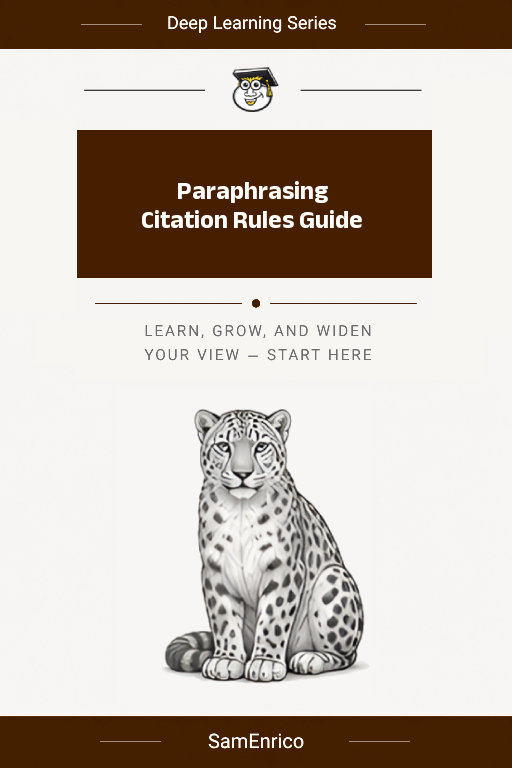
Non-FictionStudent's ShortcutParaphrasing
Paraphrasing Citation Rules Guide Audiobook
Cite paraphrased ideas correctly without quoting i
by New Kathrine
Cite paraphrased ideas correctly without quoting including when to add page numbers and author names.
Formats
Free sample
Chapter 1: The Copycat Illusion--–- Emily had spent fourteen hours on her research paper. She had been meticulous, careful, ethical. She found a dense, technical passage in a medical journal about circadian rhythms and sleep disorders. The original read: “The suprachiasmatic nucleus, a tiny region in the hypothalamus, receives direct input from the retina and synchronizes the body’s internal clocks to the external light-dark cycle, thereby regulating melatonin secretion and sleep-wake timing.” Emily changed “tiny region” to “small area.” She swapped “receives direct input from” to “gets signals from.” She changed “synchronizes” to “aligns” and “thereby regulating” to “thus controlling.” She did not use a single identical phrase longer than three words. She submitted her paper confident that she had paraphrased successfully.–- She received a failing grade for plagiarism.
The professor’s comment read: “You have changed the words but kept the sentence structure, syntax, and order of evidence intact. This is patchwriting, not paraphrasing.” Emily was devastated and confused. “But I didn’t quote a single sentence,” she protested. “I used all my own words.”–- This chapter confronts the single most damaging misconception in academic writing: that paraphrasing is simply swapping synonyms while keeping the original sentence structure intact. It is not.
And the consequences of this misunderstanding range from failing grades to academic probation to, in professional contexts, lawsuits and retractions. Emily’s story is not an outlier. It happens in every university, every semester, in every discipline. And it happens because students are taught that paraphrasing is about words when, in fact, it is about structure.The Dangerous Myth–- The myth sounds reasonable. Most students learn it implicitly from well-meaning teachers: “If you change the words, it is not plagiarism.” This is technically true but dangerously incomplete.
Changing words is necessary but not sufficient. You can change every noun, verb, and adjective in a sentence and still commit plagiarism. How? By preserving the original sentence’s grammatical skeleton.–- Consider a simple example. The original sentence reads: “The cat sat on the mat because the floor was cold.” A student who changes words but keeps the structure writes: “The feline rested upon the rug since the ground was chilly.” Every word is different.
The structure is identical: [Subject] [past tense verb] [prepositional phrase] [conjunction] [subject] [past tense verb] [adjective]. This is not paraphrasing. This is theft dressed in a thesaurus.–- Why is this…
This is the end of the free sample. Get the Audiobook to keep going. Buy now
About this book
Details
- Author
- New Kathrine
- Publisher
- SamEnrico
- Language
- English
- Genre
- Non-Fiction, Student's Shortcut, Paraphrasing
- Released
- 2026-05-29
- Pages (approx.)
- 157
- Available as
- eBook, Audiobook

Listen in the VoxFlicks app
Audiobooks and audio dramas wherever you go. Sign in with your SamEnrico account and press play.
More by New Kathrine
 Burnout Prevention For Customer ServiceNew Kathrine$11.99
 Hoffa Case Solved By Amateur Sleuths GuideNew Kathrine$11.99
 The Guilt Time MachineNew Kathrine$11.99
 Virtual Team Time CourseNew Kathrine$11.99
 Commission Income AnxietyNew Kathrine$11.99
 Letterboxd Film Snobbery TrapNew Kathrine$11.99
 Home Gym SetupNew Kathrine$11.99
 Sundown Serenade: The Last Blues of Robert JohnsonNew Kathrine$11.99
 Vanished Masterpiece: The Phantom of the LouvreNew Kathrine$11.99
 How to Produce Multipurpose LubricantNew Kathrine$11.99
 A Collector's Handbook to the Rover 2000tcNew Kathrine$11.99
 Nigeria VAT on Imported ServicesNew Kathrine$12.99
You may also like
 Hong Kong Handover 1997Dunn Johnnie$11.99
 Zumba For Postnatal Recovery CourseNeal Christian$11.99
 Zumba for BeginnersLadner Nikia$11.99
 YouTube Comment Mining GuideHumes Pandora$12.99
 Worry Box MeditationCarlin Rudy$11.99
 Workplace Stress MeditationNguyen Lynn$11.99
 Workplace Stress and Sleep RepairHawley Ivory$11.99
 Workplace Perfectionism CureDelaney Jeffry$11.99
 Workplace Injustice Anger GuideWallen Isabelle$11.99
 Work Addiction and Burnout LinkGreenwood Ester$11.99
 Women in Yoga and WellnessBeattie Galina$11.99
 Women in Stand Up ComedyChun Evangeline$11.99