
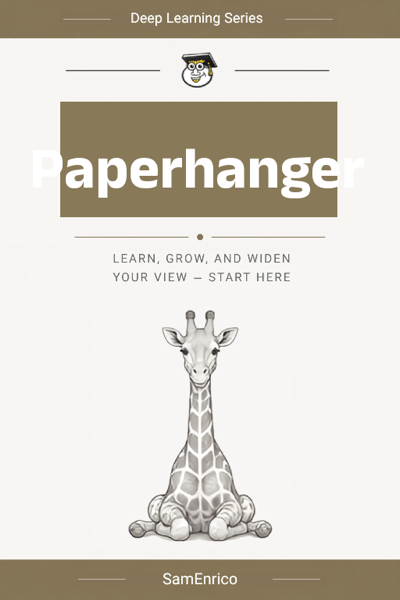
Paperhanger
A Coursebook on Paperhanger
A Coursebook on Paperhanger
Formats
About this book
Free sample
Chapter 1: The Apprentice’s First Cut--–- The first time I watched a master paperhanger work, I understood why this trade had once been spoken of in the same breath as cabinetmaking. He stood before a bare wall—scraped, patched, primed, and waiting—with a pasted strip of William Morris floral draped over his forearm like a living thing. He climbed his step ladder, pressed the top edge to a chalk line he’d snapped an hour earlier, and then he did something I didn’t expect. He stopped. He placed his brush down.
He stepped back, looked at the plumb line, looked at the corner, and adjusted his mark by a quarter of an inch. “The wall lied,” he said. “They always do.”That single moment contained the entire philosophy of paperhanging. The wall always lies. Corners are never square.
Ceilings are never level. Plaster swells and drywall sags. And the beginner’s first instinct—to trust the architecture—is the surest path to a crooked, gapped, shameful job. This book exists to teach you otherwise. It exists to give you not just the techniques but the eyes of a paperhanger.
And that education begins here, in Chapter 1, with the history of the craft, the tools that have survived two centuries, and the workshop habits that separate professionals from amateurs before the first strip ever touches paste.The Rise of the Trade: Why Paperhanging Once Mattered as Much as Fine Furniture Before there were power tools, before there was drywall, before there was the modern painting contractor who “does wallpaper sometimes,” there was the paperhanger. The trade emerged alongside the Industrial Revolution’s great gift to the middle class: affordable, machine-printed wallpaper. In the 1840s and 1850s, a family’s choice of wallcovering announced their social standing as clearly as the cut of a coat or the polish on a pair of boots. Patterned papers imitated expensive textiles—damask, silk, velvet—for a fraction of the cost. A parlor hung in a flocked paper that mimicked cut velvet told visitors that the family had taste, if not inherited wealth.The men (and occasionally women)…
This is the end of the free sample. Get the eBook to keep going. Buy now
Contents
- Chapter 1
- Chapter 2
- Chapter 3
- Chapter 4
- Chapter 5
- Chapter 6
- Chapter 7
- Chapter 8
- Chapter 9
- Chapter 10
- Chapter 11
- Chapter 12
Details
- Author
- Marchand Mammie
- Publisher
- SamEnrico
- Language
- English
- Genre
- Non-Fiction, Informative, Educational
- Released
- 2026-06-03
- Pages (approx.)
- 135
- Available as
- eBook, Audiobook

Read better in the ZLOADR app
Your eBooks on your phone or tablet. Sign in with your SamEnrico account and start reading.
More by Marchand Mammie
 LGBTQ Conversion Therapy Attempt SurvivorMarchand Mammie$11.99
 Nuclear War Fear Simulation FactMarchand Mammie$11.99
 Norwegian Fishermen Mine SweepersMarchand Mammie$11.99
 Twitch Streaming Addiction GuideMarchand Mammie$11.99
 The Chronic Stress Menopause SeverityMarchand Mammie$11.99
 The Last Stand of the Turtle King: A Forgotten Warrior's RiseMarchand Mammie$11.99
 Understanding Mat DeficiencyMarchand Mammie$17.99
 Remote Review Stakeholder AlignmentMarchand Mammie$12.99
 Executive Decision Blocking GuideMarchand Mammie$12.99
 How to Become a DiverMarchand Mammie$11.99