
Non-FictionHealth & WellnessBreathing Techniques
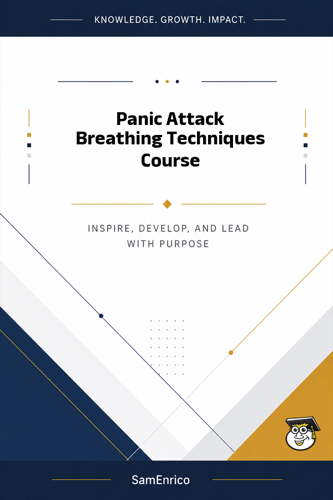
Panic Attack Breathing Techniques Course eBook
Master diaphragmatic breathing and box breathing t
Master diaphragmatic breathing and box breathing to abort panic episodes.
Formats
Free sample
Chapter 1: The Panic Trick--–- The first time it happened, Sarah was reaching for a carton of milk in the fluorescent glare of a grocery store. One second she was fine—mentally calculating whether she had enough eggs at home—and the next second her heart slammed against her ribs like a trapped animal. Her vision tunneled. The fluorescent lights seemed to pulse. Her throat tightened, and a voice in her head screamed a single sentence with absolute certainty: You are dying.
Right here. In the dairy aisle.She abandoned the cart. She didn't pay. She walked—almost ran—to her car, sat in the driver's seat with the doors locked, and waited for the feeling to kill her. It didn't.
Ten minutes later, her heart began to slow. Fifteen minutes later, she drove home, shaken but alive. She told herself it was a fluke. Bad coffee. Low blood sugar.But it happened again.
And again. And again.Each time, the same sequence: a normal moment shattered by an explosion of terror, every symptom screaming "emergency," and then—after ten or fifteen agonizing minutes—a slow retreat back to something resembling normal. Each time, Sarah became more convinced that something was physically wrong with her. She visited her doctor. Her heart was fine.
Her lungs were fine. Her blood work was normal. "It's just anxiety," the doctor said, which felt like being told that the house fire you're standing in is "just a little smoke."Sarah's story is not unusual. It is, in fact, the most common story among the estimated 11 percent of adults who will experience a panic attack in any given year. But here is what Sarah did not know, and what this entire chapter exists to teach you: Panic is a trick.
It is a false alarm system that has learned to pull the fire lever at the wrong moments. And once you understand the trick, you cannot be fooled by it in the same way again.The Anatomy of a False Alarm Let us begin with a fundamental distinction that will change everything: your panic attack is not a heart attack. It is not a stroke. It is not asthma. It is not suffocation.
It is a false alarm.The human body comes equipped with an alarm system called the sympathetic nervous system—often called the "fight or flight" response. This system evolved over millions of years to solve a very specific problem: predators. When a saber-toothed tiger appeared in front of your ancestor, the brain had milliseconds to decide: fight, flee, or freeze. To enable any of those options, the body needed an immediate surge of resources. The heart had to pump faster to send blood to the legs for running.
The lungs had to open wider to take in more oxygen. The senses had to sharpen. Digestion—unnecessary during a life-or-death emergency—had to shut down completely.This system saved lives. It is the reason your ancestors survived long enough to have children, and why you exist to read this sentence. It is elegant, powerful, and absolutely essential.But the system has a vulnerability: it cannot distinguish between a real tiger and a thought about a tiger.
It cannot tell the difference between an actual emergency and a perceived emergency. This is the crack in the foundation where panic enters. Because once your brain learns to interpret certain bodily sensations as threats—a slightly rapid heartbeat, a momentary dizzy spell, a feeling of tightness in the throat—the alarm system will respond exactly as if a tiger were in the room. The heart pounds. The lungs gasp.
The senses narrow. You feel like you are dying.You are not dying. You are having a false alarm.The term "false alarm" is not a minimization. A false fire alarm in a crowded theater is still terrifying. The siren is still loud.
The lights still flash. People still run for the exits. The experience is real. The difference is not in the intensity—it is in the origin. A real fire will burn you.
A false alarm will only scare you. Panic is the false alarm. It will not burn you. It will not kill you. It will not make you crazy or cause your heart to explode.
It will scare you, and then it will end, exactly as it has ended every single time before.The Panic Trick: Why Trying to Control It Makes It Worse Here is the cruelest irony of panic, and the single most important concept in this chapter: the very things you do to try to stop a panic attack are the things that keep it alive.This is The Panic Trick. It works like this:When the first wave of panic hits, you feel a surge of adrenaline. Your heart races. Your breath becomes shallow. Your body is now in full emergency mode.
And because you believe you are in genuine danger, you instinctively try to control the situation. You take a deep, gulping breath to get more air. You tense your muscles to hold yourself together. You scan your body for signs of something worse. You try to think your way out of it.
You may even try to flee—to leave the grocery store, the meeting, the car, the conversation.Each of these actions makes perfect sense from the perspective of someone who believes they are dying. But here is what the panicking brain does not understand: every single one of these control efforts tells the alarm system that it was right to sound the alarm.Think about this logically. If there were no real danger—no tiger, no heart attack, no suffocation—then there would be nothing to control. You would simply sit there, notice the odd sensation, and continue with your day. The fact that you are doing something to try to stop the feeling is interpreted by your primitive alarm system as proof that something worth stopping exists.
The control effort becomes evidence of the threat. And evidence of the threat justifies more adrenaline, more panic, more control efforts. The loop feeds itself.This is why so many people describe panic as a "spiral." It is not a static event. It is a feedback loop in which fear creates more fear, symptoms create more symptoms, and the attempt to escape locks the door from the inside.Let me give you a concrete example. When you hyperventilate—as we will explore in detail in the next chapter—the carbon dioxide level in your blood drops.
This drop causes your blood vessels to constrict, which reduces blood flow to your brain, which produces dizziness. Now: if you were sitting calmly on your couch and felt a wave of dizziness, you might think, "I stood up too fast," and move on. But if you are already in a panicked state, you interpret that same dizziness as, "Oh my God, I'm about to pass out." That interpretation triggers more adrenaline, which makes you breathe even faster, which drops your CO2 even further, which makes the dizziness worse. The dizziness is not dangerous. But your reaction to the dizziness is the engine of the spiral.The Panic Trick, then, is this…
This is the end of the free sample. Get the eBook to keep going. Buy now
About this book
Details
- Author
- Gonzales Travis
- Publisher
- SamEnrico
- Language
- English
- Genre
- Non-Fiction, Health & Wellness, Breathing Techniques
- Released
- 2026-06-06
- Pages (approx.)
- 146
- Available as
- eBook, Audiobook

Read better in the ZLOADR app
Your eBooks on your phone or tablet. Sign in with your SamEnrico account and start reading.
More by Gonzales Travis
 Restaurant Hostage OrdealGonzales Travis$11.99
 Cocaine Recovery Relationships GuideGonzales Travis$11.99
 The Abarbanel StatesmanGonzales Travis$11.99
 AI Voice Cloning for NarratorsGonzales Travis$11.99
 The Phantom of the Paris Catacombs: Unearthing the Bones of HistoryGonzales Travis$11.99
 Gears of the Forgotten: The Clockwork Oracle of DelphiGonzales Travis$11.99
 Crane InspectionGonzales Travis$11.99
 Pinterest Remote Visual InternGonzales Travis$12.99
 Executive Summary Timeline VisualizerGonzales Travis$12.99
 Understanding Brachycephaly Deafness Cataract Mental RetardationGonzales Travis$17.99
 Ultimate Handbook Guide to Quanzhou : (China) Travel GuideGonzales Travis$11.99
You may also like
 Hong Kong Handover 1997Dunn Johnnie$11.99
 Zumba For Postnatal Recovery CourseNeal Christian$11.99
 Zumba for BeginnersLadner Nikia$11.99
 YouTube Comment Mining GuideHumes Pandora$12.99
 Worry Box MeditationCarlin Rudy$11.99
 Workplace Stress MeditationNguyen Lynn$11.99
 Workplace Stress and Sleep RepairHawley Ivory$11.99
 Workplace Perfectionism CureDelaney Jeffry$11.99
 Workplace Injustice Anger GuideWallen Isabelle$11.99
 Work Addiction and Burnout LinkGreenwood Ester$11.99
 Women in Yoga and WellnessBeattie Galina$11.99
 Women in Stand Up ComedyChun Evangeline$11.99