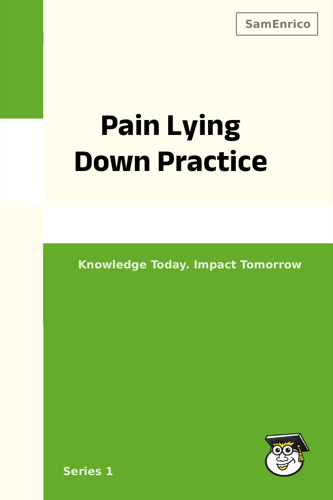
Pain Lying Down Practice
Meditate in reclining position for those who canno
Meditate in reclining position for those who cannot sit due to pain.
Formats
About this book
Free sample
Chapter 1: The Permission Slip--–- I tried to meditate for seven years. Seven years of sitting on hard wooden benches, stacking expensive cushions into wobbly towers, kneeling on foam blocks that promised relief and delivered numbness. Seven years of my hips screaming after ninety seconds, my lower back sending hot spikes of protest up my spine, and my mind concluding the same thing every time: You are doing this wrong.I am not alone in this conclusion. When researchers at the National Institutes of Health surveyed chronic pain patients who had attempted meditation, over sixty percent reported abandoning the practice within the first month. The most common reason was not lack of motivation, not skepticism about the benefits, not even the pain itself.
The most common reason was physical discomfort from the posture. People did not stop meditating because meditation failed them. They stopped because they were told to sit up straight, and sitting up straight hurt.This is the tyranny of the lotus position. It is a tyranny enforced not by malevolent meditation teachers but by an invisible cultural assumption so deeply embedded that most people do not even recognize it as an assumption. We assume that meditation requires a certain posture.
We assume that posture is upright. We assume that upright means cross-legged on the floor, spine straight like a stack of coins, hands resting on the knees, eyes half-closed. These assumptions have been repeated so often in books, apps, videos, and wellness articles that they have achieved the status of fact. But they are not fact. They are tradition.
And traditions, however venerable, are not prescriptions for every body.The Buddha himself, in the foundational texts of the Pali Canon, listed four postures for meditation: sitting, standing, walking, and lying down. Not one posture. Not sitting only. Four. The word "recumbent" appears throughout the sutras as a legitimate, respected posture for practice.
Early Buddhist art depicts the Buddha in the recumbent position not as a symbol of illness or death (though it later became that) but as the posture of deep meditation, particularly the maha-parinibbana, the final…
This is the end of the free sample. Get the eBook to keep going. Buy now
Contents
- Chapter 1
- Chapter 2
- Chapter 3
- Chapter 4
- Chapter 5
- Chapter 6
- Chapter 7
- Chapter 8
- Chapter 9
- Chapter 10
- Chapter 11
- Chapter 12
Details
- Author
- Waterman Jamee
- Publisher
- SamEnrico
- Language
- English
- Genre
- Non-Fiction, Self-Help, Accessible
- Released
- 2026-06-11
- Pages (approx.)
- 137
- Available as
- eBook, Audiobook

Read better in the ZLOADR app
Your eBooks on your phone or tablet. Sign in with your SamEnrico account and start reading.
More by Waterman Jamee
 The Body Scan for BeginnersWaterman Jamee$11.99
 Kigali Female Founder GuideWaterman Jamee$11.99
 Testosterone Therapy Delivery MethodsWaterman Jamee$11.99
 Perfectionism Recovery for High AchieversWaterman Jamee$11.99
 The Unseen Visionary: How Ridley Scott Shaped Sci-Fi ForeverWaterman Jamee$11.99
 The Love Code: How Kim Kardashian and Pete Davidson’s Whirlwind Romance Redefined Modern MarriageWaterman Jamee$11.99
 Understanding ChancroidWaterman Jamee$17.99
 Proposal for Experimental ResearchWaterman Jamee$12.99
 Global Talent Visa For GradsWaterman Jamee$12.99
 Design LeadWaterman Jamee$11.99
 How to Start a Retail Store BusinessWaterman Jamee$11.99