
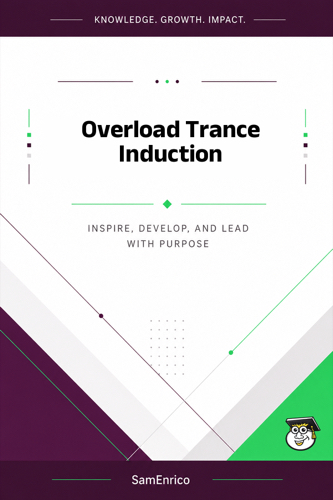
Overload Trance Induction eBook
Bombard senses to exhaust critical factor and ente
Bombard senses to exhaust critical factor and enter trance.
Formats
Free sample
Chapter 1: The Gatekeeper's Trap...--–- Close your eyes for a moment. No, really—pause reading and do it. Now try to think of nothing. Absolutely nothing. No images, no words, no sounds.
Just pure, blank emptiness. How long did you last? Three seconds? Five? If you made it to ten, you are either a Zen monk or lying to yourself.
The moment you tried to empty your mind, something rushed in to fill the void. A to-do list. A song stuck in your head. The memory of an argument from three years ago. The awareness of your own breathing.
That something is not your enemy. It is your gatekeeper. And it is the reason you have failed at every previous attempt to change yourself through meditation, affirmations, willpower, or hypnosis.This book is about one thing: learning how to temporarily disable that gatekeeper. Not through years of practice, not through passive relaxation, and not through any of the gentle methods that work for calm, cooperative minds but fail spectacularly for the rest of us. This book is for the overthinkers, the skeptics, the control freaks, the insomniacs, and the people who have tried meditation and left feeling more anxious than when they started.
You are not broken. Your gatekeeper is just too strong. And strength, as you are about to learn, has a vulnerability. Push it too hard, and it collapses.The Critical Factor: Your Brain's Bouncer Every second of every waking moment, your brain is bombarded by approximately eleven million bits of sensory information. Eleven million.
The light hitting your retina, the pressure of your clothes on your skin, the hum of your refrigerator, the position of your tongue in your mouth, the temperature of the air on your left hand versus your right. You cannot possibly process all of it. So your brain does something remarkable: it filters. By the time this information reaches your conscious awareness, it has been compressed into roughly fifty bits per second. That is a compression ratio of 220,000 to one.
The mechanism performing this compression is what hypnotherapists call the critical factor.Think of the critical factor as a bouncer at the door of your conscious mind. Its job is to evaluate every piece of information trying to enter and ask three questions: Is this familiar? Is this logical? Is this safe? If the answer to any of these questions is no, the bouncer rejects the information.
It does not reach your conscious awareness. It certainly does not reach your subconscious.This filtering process is not a bug. It is a feature—one of the most important features your brain has. Without it, you would be catatonic, overwhelmed by the sheer noise of existence. Every time you drive a car and tune out the engine noise to focus on the road, thank your critical factor.
Every time you walk through a crowded room and ignore fifty conversations to hear the one person speaking to you, thank your critical factor. It is the reason humanity survived long enough to invent electricity, antibiotics, and this book.But here is the problem. The same filter that keeps you safe also keeps you stuck.The Paradox of Protection Consider the smoker who wants to quit. They know cigarettes cause cancer. They know the financial cost.
They have seen the yellowed teeth and heard the wheeze in their own breath. They have tried patches, gum, cold turkey, and hypnosis. And yet, every time they reach for a cigarette, some part of their brain overrides the decision. That part is the critical factor, operating on an outdated rule: nicotine withdrawal is uncomfortable; discomfort is a threat; avoid threats. The critical factor does not care about lung cancer twenty years from now.
It cares about the next twenty minutes.This is the Paradox of Protection. The mechanism that evolved to keep you alive actively rejects the very changes that would improve your life. It treats therapeutic suggestions as hostile invaders because they are unfamiliar. It equates the anxiety of quitting smoking with the anxiety of a predator. It does not distinguish between "this is difficult" and "this is dangerous."And here is the cruelest twist.
The harder you try to change, the more your critical factor resists.The Law of Reverse Effect In 1934, a psychologist named Viktor Frankl (who would later survive the Holocaust and write Man's Search for Meaning) observed a strange phenomenon in his patients. Those who tried hardest to fall asleep were the ones who developed insomnia. Those who tried hardest to suppress a thought found it returning with greater frequency. Those who tried hardest to perform well on a test often choked. Frankl called this the Law of Reverse Effect: the more consciously you pursue a goal that requires unconscious processing, the further you recede from it.Try this now.
For the next ten seconds, do not think about a pink elephant. Ready? Go.If you are like ninety-nine percent of humans, you just thought about a pink elephant. Your conscious mind heard the instruction "do not think about a pink elephant," which required it to first think about a pink elephant in order to know what to avoid. The Law of Reverse Effect in action.This law is the secret weapon of overload trance induction.
Most hypnosis methods try to work with the critical factor—by relaxing it, distracting it, or sneaking past it. Overload does the opposite. It exploits the Law of Reverse Effect by deliberately triggering the critical factor and then overwhelming it until it breaks.Think of it like a fuse. A gentle current flows through indefinitely. But a sudden surge of electricity melts the wire.
The critical factor is the same. Feed it a slow, soothing voice and soft music, and it remains intact, bored, vigilant. But bombard it with simultaneous, competing, impossible-to-process information, and it does not relax. It does not sneak away. It crashes.The Overload Equation Before we go any further, you need to understand the single mechanism that drives every technique in this book.
I am going to state it plainly, and you will see it repeated throughout these chapters because it is the engine of everything that follows. Memorize it. Write it down if you have to.The Overload Equation: Simultaneous inputs exceeding working memory capacity → cognitive collapse → parasympathetic dominance → trance.Let us unpack each term.Simultaneous inputs means multiple streams of sensory information arriving at the exact same time. Not rapidly alternating. Not one after another.
At the same moment. Your ears hear two different sentences. Your eyes track a moving object while also registering a strobe light. Your body feels cold on one hand and warmth on the other while also maintaining an unusual posture. These inputs compete for the same limited processing resources.Working memory capacity is the amount of information your conscious mind can hold at once.
The psychologist George Miller famously proposed that this capacity is "seven plus or minus two" items—roughly five to nine chunks of information. This is why you can remember a seven-digit phone number long enough to dial it but struggle with a twelve-digit international code. Overload works by presenting more chunks than your working memory…
This is the end of the free sample. Get the eBook to keep going. Buy now
About this book
Details
- Author
- Reid Theodore
- Publisher
- SamEnrico
- Language
- English
- Genre
- Non-Fiction, Self-Help, Hypnosis
- Released
- 2026-06-11
- Pages (approx.)
- 147
- Available as
- eBook, Audiobook

Read better in the ZLOADR app
Your eBooks on your phone or tablet. Sign in with your SamEnrico account and start reading.
More by Reid Theodore
 Recurring Dreams and Shadow IntegrationReid Theodore$11.99
 MBSR Eight Week Course GuideReid Theodore$11.99
 Lower Back Pain ChiropracticReid Theodore$11.99
 Hypnosis Cheat SheetReid Theodore$11.99
 Desk Cleanliness ProtocolReid Theodore$11.99
 Wilson LeagueReid Theodore$11.99
 Motivation Emotional IntelligenceReid Theodore$11.99
 Preventing Engineering BurnoutReid Theodore$11.99
 The Sun King's Grandeur: Louis XIV and the Birth of VersaillesReid Theodore$11.99
 The Last Pharaoh's Secret: Cleopatra's Hidden LegacyReid Theodore$11.99
 Anansi Weaves the World: The Spider’s Song of WisdomReid Theodore$11.99
 Retail Media Network StrategyReid Theodore$11.99
You may also like
 Hong Kong Handover 1997Dunn Johnnie$11.99
 Zumba For Postnatal Recovery CourseNeal Christian$11.99
 Zumba for BeginnersLadner Nikia$11.99
 YouTube Comment Mining GuideHumes Pandora$12.99
 Worry Box MeditationCarlin Rudy$11.99
 Workplace Stress MeditationNguyen Lynn$11.99
 Workplace Stress and Sleep RepairHawley Ivory$11.99
 Workplace Perfectionism CureDelaney Jeffry$11.99
 Workplace Injustice Anger GuideWallen Isabelle$11.99
 Work Addiction and Burnout LinkGreenwood Ester$11.99
 Women in Yoga and WellnessBeattie Galina$11.99
 Women in Stand Up ComedyChun Evangeline$11.99