
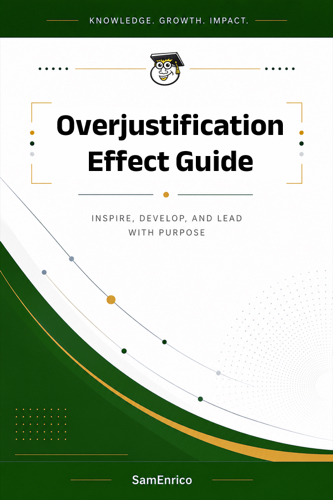
Non-FictionSelf-HelpMotivation
Overjustification Effect Guide eBook
Use minimal rewards to maintain intrinsic motivati
Use minimal rewards to maintain intrinsic motivation.
Formats
Free sample
Chapter 1: The Magic Marker Massacre--In a sunlit nursery school in Palo Alto, California, in the autumn of 1973, a five-year-old girl sat cross-legged on a rainbow-colored carpet, utterly lost in a world of purple horses and orange dragons. She loved to draw. Not for grades, not for praise, not for gold stars pinned to a bulletin board. She drew because the act of dragging a marker across paper produced a feeling she could not yet name—a quiet hum of satisfaction, a sense that her inner world had become visible. She drew so intently that she often skipped snack time, ignoring the smell of peanut butter and apple slices wafting from the corner table.
Her name was Maya, and she had no idea that she was about to become part of one of the most important psychology experiments ever conducted. Nor could she have known that the results would upend everything parents, teachers, and managers believe about motivation—and that forty years later, her brief encounter with a magic marker would help explain why your bonus might be killing your best employee's drive, why your child's chore chart might be backfiring, and why you yourself might have stopped loving the very thing you once did for pure joy.Maya was one of fifty-one preschool children recruited by psychologists Mark Lepper, David Greene, and Richard Nisbett. The researchers had a simple but radical hypothesis: what if rewarding people for doing something they already love actually makes them love it less? The prevailing wisdom of the era—and the wisdom that still dominates most classrooms, offices, and parenting blogs today—was the exact opposite. Behaviorism, the reigning psychological paradigm, held that all behavior is governed by rewards and punishments.
B.F. Skinner had shown that pigeons would peck buttons more frequently if rewarded with food. Why would children be any different? If you want more drawing, reward drawing. If you want more reading, offer pizza coupons.
If you want more productivity, tie bonuses to output. The logic seemed unassailable. It was also, as Lepper and his colleagues suspected, catastrophically wrong.The experiment was elegantly simple. The researchers first identified children who already loved to draw—Maya among them—by observing them during free play and noting which ones spontaneously chose drawing over other activities. These intrinsically motivated young artists were then divided into three groups.The first group, which researchers called the "Expected Award" condition, was shown a colorful "Good Player Award" certificate with a gold seal and a ribbon.
The children were told that if they drew with the magic markers, they would receive this award. The second group, the "Unexpected Award" condition, was also given the opportunity to draw with the same markers, but they were not told anything about an award beforehand. After they finished drawing, the researchers surprised them with the identical certificate. The third group, the control condition, drew with the markers and received no award at all, expected or otherwise.All three groups spent the same amount of time drawing on that first day. On the surface, nothing seemed unusual.
But the researchers were not interested in what happened while the reward system was active. They were interested in what happened afterward—specifically, one to two weeks later, when the children were again given access to the same markers during free play, this time with no rewards mentioned and no researchers offering certificates. The question was simple: who would keep drawing for fun?The results were devastating. The children in the Unexpected Award and control groups continued to draw at the same high levels as before. They had not lost a single degree of intrinsic interest.
But the children in the Expected Award group—the ones who had been promised a certificate for drawing—showed drastically less interest. They drew less frequently, spent less time at the drawing table, and produced fewer drawings. Their expressions, observed the researchers, shifted from absorption to indifference. The very children who had once skipped snack time for the pleasure of creating purple horses now set down their markers after a few desultory strokes and wandered off to other activities. Some of them, researchers suspected, never really drew for themselves again.This was the discovery of the Overjustification Effect: a large, expected, contingent external reward can turn intrinsically enjoyable play into extrinsically motivated work.
When a person receives a reward for doing something they already love, their brain unconsciously reinterprets the activity. The internal question "Why am I doing this?" gets answered not with "Because I love it" but with "Because I am being rewarded." The reward becomes the explanation. And when the reward disappears, the explanation disappears with it—and so does the behavior.The implications were staggering. If this effect held true beyond the nursery school, it meant that millions of parents were accidentally extinguishing their children's natural curiosity with chore charts and allowance systems. It meant that teachers were killing the love of reading with pizza coupons and book-it programs.
It meant that corporations were undermining creativity with performance bonuses. And it meant that you, reading this chapter right now, have almost certainly done this to yourself—by attaching a reward to something you once did for the sheer joy of it.But before we dive into the science and the solutions, we need to clear away three popular misconceptions about the Overjustification Effect. These misconceptions are so widespread, and so damaging, that they have prevented generations of well-intentioned people from understanding what actually motivates human beings.The Three Great Misconceptions Misconception One: "Rewards always motivate."This is the most seductive lie. It is seductive because rewards do motivate—in the short term, under specific conditions, for simple mechanical tasks. If you want a warehouse worker to pack more boxes per hour, a piece-rate bonus will work, at least for a while.
If you want a child to clean their room before a guest arrives, a promised treat will produce compliance. But compliance is not engagement. Obedience is not enthusiasm. And short-term gains are not sustainable growth.The distinction is between mechanical motivation and creative motivation. For purely mechanical tasks—turning a crank, stacking boxes, copying numbers from one column to another—rewards can work without significant damage because there is no intrinsic motivation to undermine.
No child grows up dreaming of stacking boxes. But for tasks that require creativity, problem-solving, conceptual thinking, or any form of genuine engagement, rewards backfire. They narrow focus, discourage exploration, and reward the safest, most conservative approach. Dozens of studies have replicated this finding: the more a task requires "even rudimentary cognitive skill," in the words of economist Dan Ariely, the more large contingent rewards degrade performance.Misconception Two: "Only children are affected."The nursery school study is so vivid, and so visually compelling, that many people assume the Overjustification Effect is a childhood phenomenon—something we outgrow along with thumb-sucking and nap time. This is dangerously wrong.
Adults show the effect just as strongly, often more so, because adults have longer histories of external contingencies shaping their behavior.Consider the classic "dollar versus twenty dollars" study conducted by Leon Festinger and James Carlsmith in 1959, which predated the nursery school experiment and laid…
This is the end of the free sample. Get the eBook to keep going. Buy now
About this book
Details
- Author
- Leroy Chiquita
- Publisher
- SamEnrico
- Language
- English
- Genre
- Non-Fiction, Self-Help, Motivation
- Released
- 2026-06-06
- Pages (approx.)
- 148
- Available as
- eBook, Audiobook

Read better in the ZLOADR app
Your eBooks on your phone or tablet. Sign in with your SamEnrico account and start reading.
More by Leroy Chiquita
 Affirmations for New GraduatesLeroy Chiquita$11.99
 Portuguese Expeditionary ForceLeroy Chiquita$11.99
 Gambling Addiction and Anxiety LinkLeroy Chiquita$11.99
 Sinkhole Descent GuideLeroy Chiquita$11.99
 The Orphanage Trafficking VictimLeroy Chiquita$11.99
 Shoe Shopping AddictionLeroy Chiquita$11.99
 Valproate GuideLeroy Chiquita$11.99
 The Iron Lady’s Last Stand: Margaret Thatcher’s Secret War with the FalklandsLeroy Chiquita$11.99
 The Iron Discipline: Prussia's Rise to Military and Administrative MasteryLeroy Chiquita$11.99
 Service Providers Guide to Drapery CleaningLeroy Chiquita$11.99
 How to Produce Tent FootprintsLeroy Chiquita$11.99
 Fairtrade Certification for ExportersLeroy Chiquita$12.99
You may also like
 Hong Kong Handover 1997Dunn Johnnie$11.99
 Zumba For Postnatal Recovery CourseNeal Christian$11.99
 Zumba for BeginnersLadner Nikia$11.99
 YouTube Comment Mining GuideHumes Pandora$12.99
 Worry Box MeditationCarlin Rudy$11.99
 Workplace Stress MeditationNguyen Lynn$11.99
 Workplace Stress and Sleep RepairHawley Ivory$11.99
 Workplace Perfectionism CureDelaney Jeffry$11.99
 Workplace Injustice Anger GuideWallen Isabelle$11.99
 Work Addiction and Burnout LinkGreenwood Ester$11.99
 Women in Yoga and WellnessBeattie Galina$11.99
 Women in Stand Up ComedyChun Evangeline$11.99