
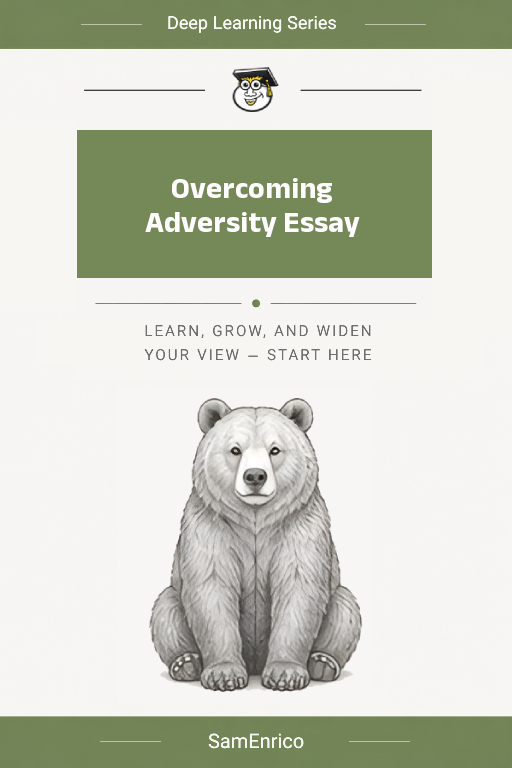
essaysAdversity GuidePersonal Narrative
Overcoming Adversity Essay eBook
Write about challenges without sounding like a vic
by Cromer Lacy
Write about challenges without sounding like a victim. Balance struggle with growth and resilience for maximum impact.
Formats
Free sample
Chapter 1: The Reframing Mirror...--Most people write about their hardest moments like they are filing a police report. Here are the facts. Here is what happened. Here is who hurt me. They list the injustice with the precision of a witness and the flatness of a martyr.
Then they wonder why the reader feels pity instead of admiration, or worse, why the reader feels nothing at all.I have read over two thousand adversity essays. As a college admissions consultant, then as a writing coach for Fortune 500 executives, and finally as the person who trains the people who train writers, I have seen the same mistake repeated with heartbreaking consistency. The writer assumes that the magnitude of their suffering will automatically translate into the power of their essay. This is false. Catastrophe does not equal catharsis.
Trauma does not equal text. The worst thing that ever happened to you is not the same thing as the best essay you could ever write.The problem is not the adversity. The problem is the frame.Consider two photographs of the same car accident. The first photograph is taken from inside the wreckage, looking out through a shattered windshield. You see broken glass, twisted metal, blood on the dashboard.
You feel trapped, disoriented, afraid. That photograph is the victim frame. The second photograph is taken from across the street, minutes later. You see the same wreckage, but now you also see the driver standing outside the car, talking to a paramedic, pointing at something in the distance. You see movement, action, the beginning of a response.
That photograph is the victor frame. The facts are identical. The meaning is entirely different.This chapter is about learning to step across the street.The Victim Frame: Why Most Adversity Essays Fail Before They Begin Let me show you what I mean. I have changed the identifying details, but the structure of this opening paragraph comes from a real essay submitted to a competitive fellowship program:"When I was twelve years old, my father lost his job. He started drinking.
My mother worked two shifts, and I barely saw her. I became responsible for my two younger siblings. I cooked dinner, helped with homework, and tried to keep the apartment clean. It was the hardest time of my life."Stop there. What do you feel when you read that?
If you are like most readers, you feel a familiar tug of sympathy. Poor kid. That is rough. But here is the problem: you do not feel anything else. You do not feel inspired.
You do not feel curious about what happens next. You do not feel like this person is particularly remarkable, because millions of people have similar stories. The essay has triggered your pity reflex, which is automatic and shallow, rather than your admiration reflex, which is earned and deep.The writer has fallen into the victim frame without realizing it. Look at the passive construction: "My father lost his job." "He started drinking." "I became responsible." The writer is a thing to which things happen. The writer is acted upon.
Even the verbs are weak. There is no decision, no turning point, no moment of choice. There is only circumstance.Now watch what happens when we apply the reframing technique. Same facts. Different lens:"My father's drinking started the year he lost his job.
I was twelve. I remember standing in the kitchen one night, listening to him argue with my mother, and making a calculation that no child should have to make. I could hide in my room and hope things got better. Or I could feed my brother and sister. I chose the kitchen.
I learned to stretch a can of soup into three bowls. I learned to check the homework before I checked my phone. I learned that waiting for an adult to save you is slower than saving yourself."Same facts. Different resonance. The writer is no longer a passive recipient of hardship.
The writer is an agent who made a choice. The reader feels something different now. Not pity. Respect. The difference between these two openings is not the difference between truth and falsehood.
It is the difference between two true stories about the same life. One story is about what was done to the writer. The other story is about what the writer did.This is the reframing mirror. When you look into it, you see the same events, but you see yourself differently.The Psychology of Self-Persuasion: Why Changing Your Frame Changes Your Life Before we go any further, I need to tell you something that might sound like mysticism but is actually neuroscience. Changing the way you write about your past does not just change how readers perceive you.
It changes how you perceive yourself.The psychologists Richard Petty and John Cacioppo spent decades studying what they called the Elaboration Likelihood Model of persuasion. Their most important finding, for our purposes, is this: the most persuasive person you will ever encounter is yourself. When you generate arguments, reframe events, and choose language that emphasizes your agency, you are not just editing a document. You are rewriting your internal narrative. And your brain believes what you write.This is called self-persuasion.
It is why journaling can reduce symptoms of depression. It is why cognitive behavioral therapy works. It is why the writer James Pennebaker found that people who wrote about traumatic events using structured, analytical language showed measurable improvements in immune function, while people who simply vented their emotions showed no improvement or sometimes got worse.Here is what that means for your essay. When you sit down to write about the hardest thing you have ever survived, you have two options. You can vent.
You can describe the injustice, the pain, the unfairness, the way the world failed you. This will feel cathartic for approximately forty-five minutes. Then you will feel worse, because you have just rehearsed your victimhood. Your brain will strengthen the neural pathways associated with helplessness. You will have convinced yourself, through the magic of self-persuasion, that you are a victim.Or you can reframe.
You can look at the same events and ask yourself a different set of questions. Not "What happened to me?" but "What did I do next?" Not "Who failed me?" but "Who helped me?" Not "Why did this happen?" but "What did this make possible?" This will feel harder at first. It requires effort, imagination, and the willingness to look at your own pain from an uncomfortable distance. But it will rewire your brain. You will convince yourself, through the exact same mechanism of self-persuasion, that you are resilient.The essay you are writing is not a report.
It is a rehearsal. You are practicing the person you want to become.The Three-Column Reframing Worksheet Let me give you a practical tool. I have used this with everyone from high school students applying to college to executives writing about career setbacks for board reviews. It works every time. It is simple.
It is brutal. It is effective.Take a piece of paper. Draw three columns. Label them: Fact, Victim Frame, Victor Frame.In the first column, write the bare fact.…
This is the end of the free sample. Get the eBook to keep going. Buy now
About this book
Details
- Author
- Cromer Lacy
- Publisher
- SamEnrico
- Language
- English
- Genre
- essays, Adversity Guide, Personal Narrative
- Released
- 2026-05-28
- Pages (approx.)
- 144
- Available as
- eBook, Audiobook

Read better in the ZLOADR app
Your eBooks on your phone or tablet. Sign in with your SamEnrico account and start reading.
More by Cromer Lacy
 Attempt Survivor Artist StoryCromer Lacy$11.99
 Mindfulness For Ankylosing SpondylitisCromer Lacy$11.99
 Forgiveness in the WorkplaceCromer Lacy$11.99
 Daily Sobriety Maintenance GuideCromer Lacy$11.99
 The Grocery Pickup Efficiency GuideCromer Lacy$11.99
 Nefertiti’s Curse: The Golden Pharaoh’s Vanished QueenCromer Lacy$11.99
 How to Become a Central-office OperatorCromer Lacy$11.99
 AI Business Retirement Planning for OwnersCromer Lacy$12.99
 Portfolio Management AssistantCromer Lacy$11.99
You may also like
 YouTube Video Essay DepthLeon Lala$11.99
 TOEFL Independent Essay GuideMintz Alex$11.99
 Music Theory Essay GuideWilkinson Maisha$11.99
 Expository Essay AI PromptsApplegate Dalia$11.99
 Exam Essay MemorizationMcgovern Johna$11.99
 Compare Contrast Essay PromptsOntiveros Marx$11.99
 College Application Essay GuideSisson Aimee$11.99College Application Essay GuideSisson Aimee$11.99
 The 100 Word Essay ChallengeAli Luciana$11.99
 Journalism Essay PromptsThatcher Williemae$11.99
 Finance Essay PromptsShrader Lamont$11.99
 Cause Effect Essay GPT GuideBland Jacelyn$11.99