
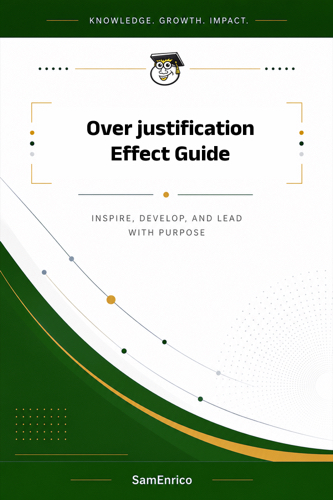
Over justification Effect Guide eBook
Reduces intrinsic motivation by adding external re
Reduces intrinsic motivation by adding external rewards.
Formats
Free sample
Chapter 1: The Ribbon That Backfired--It began with a handful of preschool children, a box of art supplies, and a simple shiny ribbon. No one in that classroom in the early 1970s could have predicted that this ordinary reward would launch a quiet revolution in psychology. The teachers saw the ribbon as encouragement. The children saw it as a prize. And the researcher watching from behind a one-way mirror, a young Stanford psychologist named Mark Lepper, saw something else entirely: the faint outline of a paradox that would challenge decades of behavioral science.The scene was unremarkable by any standard.
A group of children were drawing with markers, something they did regularly and enthusiastically without any adult prompting. They laughed as they worked, compared colors, and filled page after page with the kind of unrestrained creativity that comes naturally to young children who have not yet learned to self-edit. Then the researcher made a small change. He introduced an expected reward: a "Good Player" ribbon, complete with a shiny gold seal, that would be given to each child who participated in the drawing activity. The children were delighted.
They drew with even more energy. The ribbon worked exactly as anyone would have predicted.Then the reward was removed. And something strange happened.When the researchers later observed the children during free play, when no ribbons were available and no adults were watching, the children who had received the expected ribbon spent significantly less time drawing than they had before the experiment began. The children who had received an unexpected ribbon, given as a surprise after drawing without any prior promise, continued drawing at their original levels. And the children who had received no reward at all?
They drew just as much as ever.The expected ribbon, the one explicitly promised as a reward for participation, had somehow drained the joy out of the activity. The children had not grown tired of drawing. They had not been distracted by other toys. They had simply stopped wanting to draw for its own sake. The ribbon had backfired.This was the birth of what psychologists would come to call the overjustification effect.
It is one of the most counterintuitive findings in the history of motivation research, and it has profound implications for how we manage employees, raise children, teach students, and even design fitness apps. Yet despite decades of replication and refinement, the overjustification effect remains stubbornly unknown to most people who could benefit from understanding it. Managers still design bonus systems that crush creativity. Parents still pay for grades and then wonder why their children stop reading for fun. Teachers still hand out gold stars and then scratch their heads when students lose interest in the very subjects they once loved.This book exists to close that gap.The Puzzle That Behaviorism Could Not Solve To understand why the overjustification effect was so shocking, we need to understand the intellectual climate in which it emerged.
For much of the twentieth century, academic psychology was dominated by behaviorism, a school of thought that argued the only meaningful way to study behavior was to focus on observable stimuli and responses. Internal states like thoughts, feelings, and desires were dismissed as unscientific speculation. The behaviorists had a simple, elegant, and powerful model: reward a behavior, and that behavior will increase. Punish a behavior, and it will decrease. This was not just a theory; it was a law of learning that had been demonstrated in countless experiments with rats, pigeons, dogs, and humans.B.
F. Skinner, the most famous behaviorist of his era, had shown that operant conditioning could shape behavior with remarkable precision. Give a hungry rat a food pellet every time it presses a lever, and the rat will soon become an avid lever-presser. Put a pigeon on a variable ratio schedule of reinforcement, and it will peck a disk thousands of times without pause. The principle seemed universal.
If you wanted more of a behavior, you rewarded it. If you wanted less, you stopped rewarding it. This was the iron law of behavioral engineering.The overjustification effect appeared to violate this law. In the preschool study, rewarding drawing did not increase voluntary drawing. It decreased it.
When the reward was removed, the behavior did not return to baseline. It fell below baseline. This was not just a failure to increase behavior; it was an active suppression of pre-existing motivation. The behaviorists had no ready explanation for this. Some dismissed the findings as artifacts of poor methodology.
Others argued that the effect would disappear under more controlled conditions. But the findings persisted.What the behaviorists had overlooked was the role of intrinsic motivation–the natural, spontaneous tendency to engage in activities for their own sake, simply because they are interesting, enjoyable, or satisfying. Children do not draw because they expect a ribbon; they draw because drawing feels good. Employees do not solve puzzles because they need money; they solve puzzles because the challenge is engaging. Intrinsic motivation is the engine of creativity, learning, and persistence.
And it is surprisingly fragile.The overjustification effect occurs when external rewards shift the perceived cause of behavior from internal pleasure to external incentive. The child who once thought "I draw because I love it" begins to think "I draw to get the ribbon." When the ribbon disappears, the child no longer has a reason to draw. The external reward has crowded out the internal drive. This is the discounting principle at work: a salient extrinsic reward acts as a discounting cue, causing the brain to discount intrinsic pleasure as an explanation for action.Two Experiments That Changed Everything Let me take you through the two foundational studies in detail, because they reveal the precise conditions under which the overjustification effect emerges–and, just as importantly, the conditions under which it does not.The first study was conducted by Edward Deci in 1971 at the University of Rochester. Deci was a young psychologist interested in the puzzle of why people do things when there is no obvious external reward.
He designed an experiment using the Soma puzzle, a seven-piece plastic cube that could be assembled into dozens of different configurations. The puzzle was engaging but not frustrating; it was the kind of brain teaser that people might pick up during a coffee break and fiddle with for fifteen minutes.Deci brought college students into a lab and had them work on the Soma puzzles. Some students were paid for each puzzle they solved. Others were unpaid. The critical measure was not how many puzzles they solved during the paid period, but what they did during a free period that followed, when the experimenter left the room and told them they could do whatever they wanted.
Deci watched through a one-way mirror and recorded how much time each student spent playing with the puzzles during free choice.The results were striking. The unpaid students, who had solved puzzles just for fun, continued to play with them during free time. The paid students, however, showed a sharp decline in free-time puzzle play. They had been paid to solve puzzles, and when the payment stopped, so did they. The money had turned play into work.Deci…
This is the end of the free sample. Get the eBook to keep going. Buy now
About this book
Details
- Author
- Spivey Suellen
- Publisher
- SamEnrico
- Language
- English
- Genre
- Non-Fiction, Self-Help, Motivation
- Released
- 2026-06-09
- Pages (approx.)
- 145
- Available as
- eBook, Audiobook

Read better in the ZLOADR app
Your eBooks on your phone or tablet. Sign in with your SamEnrico account and start reading.
More by Spivey Suellen
 Stress and Parkinson's ProgressionSpivey Suellen$11.99
 Opioid Dependency Art Therapy Healing GuideSpivey Suellen$11.99
 Brain Cancer Survivor StorySpivey Suellen$11.99
 Toilet Sit to StandSpivey Suellen$11.99
 Spouse Grief JournalSpivey Suellen$11.99
 Russian Mafia in CanadaSpivey Suellen$11.99
 Developer Code Review RitualSpivey Suellen$11.99
 The Asphalt Kings: The Deadly Rivalry That Built American SpeedSpivey Suellen$11.99
 The Werewolves of Pennsylvania: Beastly Killings and Colonial JusticeSpivey Suellen$11.99
 Service Providers Guide to Shopping ServicesSpivey Suellen$11.99
 How to Start a Clothing (commission Agent) Business (Beginners Guide)Spivey Suellen$11.99
 How to Produce Weight Lifting Machines and RacksSpivey Suellen$11.99
You may also like
 Habit Formation for Low MotivationWaggoner Regenia$11.99
 Envy Transformation HandbookBeaty Leatha$11.99
 Affirmations For Motivation HandbookGamble Madelyn$11.99
 Motivation Procrastination GuideBlanchard Kathyrn$11.99
 Motivation EQ Internal Drive GuideMccracken Lavenia$11.99
 Low Motivation Burnout Recovery GuideFournier Theo$11.99
 The Sustainable Drive HandbookCantwell Elroy$11.99
 The Study Motivation GuideJacks Houston$11.99
 Effort Versus Talent GuideQuinones Valentina$11.99
 The Motivational EQ CourseHutcherson Zoraida$11.99
 Motivational Speaking GuidePate Starla$11.99
 Retention Heatmap GuideSowers Lavern$11.99