
Non-FictionInformativeEducational
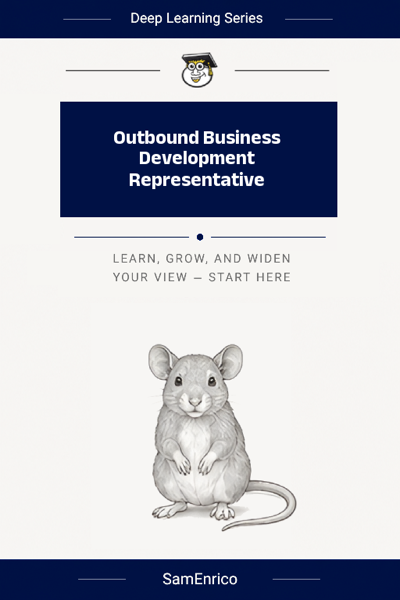
Outbound Business Development Representative eBook
A Coursebook on Outbound Business Development Repr
by Egan Rubie
A Coursebook on Outbound Business Development Representative
Formats
Free sample
Chapter 1: The Hunter’s Paradox...--–- The alarm reads 5:28 AM. Outside, the world is still dark. Your phone is quiet. No emails. No Slack messages.
No urgent requests from leadership. Just you, a cup of coffee, and a list of 50 names who have never heard of you, do not trust you, and have absolutely no reason to take your call. This is the moment where most sales careers die. And this is the moment where the best ones are born.If you are reading this book, you have likely accepted a role as an Outbound Business Development Representative (BDR), or you are considering it. You may have been told that this is an “entry-level” position.
You may have heard that it is a grind. You may have been warned that you will hear the word “no” more times in your first month than most people hear in a lifetime. All of that is true. But what nobody tells you—what this chapter will reveal—is that the Outbound BDR role is not a stepping stone. It is not a hazing ritual.
It is the single most leveraged, most learnable, and most financially powerful position in modern sales. This is the Hunter’s Paradox: the job that looks like the bottom of the ladder is actually the sharp end of the spear.The Anatomy of a Pipeline Assassin Let us begin by destroying a dangerous myth. Most companies—and most sales trainers—will tell you that the Account Executive (AE) is the hero of the story. The AE closes the deal. The AE manages the negotiation.
The AE gets the commission check and the president’s club trip. The BDR, in this telling, is simply the warm-up act. The appointment setter. The person who knocks on the door so the AE can walk through it.This is wrong. And believing it is the fastest way to fail.The Outbound BDR does not set appointments.
The Outbound BDR creates opportunities from absolutely nothing. Marketing generates inbound leads—people who have already raised their hands, filled out a form, or downloaded a whitepaper. That is farming. It is necessary, but it is not hunting. An Account Executive closes deals that already exist in the pipeline.
That is harvesting. It is valuable, but it is not creation.The Outbound BDR, by contrast, calls a person who is not expecting the call, who has never heard of the company, and who is actively trying to protect their time. That person has no stated problem. They have no budget set aside. They have no timeline.
And yet, within a single conversation, the BDR must accomplish three impossible things: first, earn the right to continue speaking; second, uncover a problem the prospect did not know they had; and third, convince that prospect to commit precious calendar time to a stranger. That is not appointment setting. That is commercial creation. It is the closest thing in business to alchemy.Consider the math for a moment. In most B2B software companies, a qualified meeting—a conversation between an AE and a prospect who has a real problem, a budget, and some authority—is worth between $5,000 and $15,000 in potential pipeline value.
That is not the deal value. That is just the meeting. One extra qualified meeting per week, over the course of a year, adds between $250,000 and $750,000 in pipeline. That number directly correlates to promotion speed, bonus attainment, and job security. One meeting.
Per week.Now ask yourself: who creates that meeting? Not marketing. Not the AE. The BDR. The person making the 5:28 AM calls.
The Hunter’s Paradox is this: the role that looks like the lowest-paid, lowest-status job in the organization is actually the one with the highest marginal leverage. One additional skill—one better script, one better question, one better moment of frame control—multiplies across every single call. That is not entry-level math. That is leverage math.The Hunting Versus Farming Mentality To understand why some BDRs thrive while others burn out, we must understand the difference between hunting and farming. These are not just metaphors.
They are distinct psychological orientations that determine every behavior, every reaction to rejection, and every outcome.Farmers work cultivated land. They plant seeds in soil that has been prepared. They water, nurture, and wait. They are essential. But farmers do not create new land.
Farmers do not venture into the wilderness. Farmers succeed when the conditions are already favorable. The inbound BDR is a farmer. They respond to leads who have already expressed interest. They nurture prospects who have already raised their hands.
The conversion rates are higher. The rejection is lower. But the ceiling is also lower because the supply of inbound leads is finite and controlled by marketing.Hunters work untamed territory. They track animals that do not want to be found. They face uncertainty, long periods of silence, and sudden moments of violent action.
Hunters succeed not because conditions are favorable, but because they create favorability through skill, persistence, and adaptability. The outbound BDR is a hunter. Every call is a new expedition. Every prospect is a wild animal that can bolt at any moment. The conversion rates are lower.
The rejection is brutal. But the ceiling is unlimited because the entire market is the hunting ground.The fatal mistake that most new BDRs make is approaching outbound with a farmer’s mindset. They wait for readiness. They wait for the perfect moment. They wait for the prospect to be “warmed up.” This is death.
Outbound does not reward patience. Outbound rewards controlled aggression. The hunter does not wait for the deer to walk into the camp. The hunter goes into the forest.Let me give you a concrete example. I have watched two BDRs start on the same day, with the same territory, the same product, and the same quota.
BDR A has a farmer’s mindset. They spend the first hour of each day reading emails, organizing their CRM, and “researching” prospects. They make 30 calls before lunch. When they get a “not interested,” they say “thank you” and move on. They follow up exactly three days later because the sequence says so.
At the end of the month, they have booked 8 meetings. They are average.BDR B has a hunter’s mindset. They spend the first hour of each day making calls. Research happens the night before or not at all. They make 60 calls before lunch.
When they get a “not interested,” they have a response ready—not to argue, but to test whether the objection is real or reflexive. They follow up when the prospect shows a signal, not when the calendar says to. At the end of the month, they have booked 22 meetings. They are top 10 percent.The difference is not intelligence. It is not charisma.
It is not the product. It is the mindset. Farmers wait for permission. Hunters create their own.Activity Metrics Are Inputs, Not Outcomes Here is a truth that will save your career: no one cares how many calls you make. No one cares how many emails you send.
No one cares how many Linked In messages you fire into the void. These are inputs. Inputs measure effort. And…
This is the end of the free sample. Get the eBook to keep going. Buy now
About this book
Details
- Author
- Egan Rubie
- Publisher
- SamEnrico
- Language
- English
- Genre
- Non-Fiction, Informative, Educational
- Released
- 2026-06-03
- Pages (approx.)
- 122
- Available as
- eBook, Audiobook

Read better in the ZLOADR app
Your eBooks on your phone or tablet. Sign in with your SamEnrico account and start reading.
More by Egan Rubie
 Marginalia Study TechniqueEgan Rubie$11.99
 HOA Financial Health Check GuideEgan Rubie$11.99
 Remote Retreats Food and BeverageEgan Rubie$11.99
 Gallbladder Surgery HistoryEgan Rubie$11.99
 Polish Underground State GuideEgan Rubie$11.99
 The Sweet Deception: How Sugar Shaped the Fall of EmpiresEgan Rubie$11.99
 The Great Emu War: A Feathered Feud Through TimeEgan Rubie$11.99
 Understanding Chondrysplasia Punctata, Humero-metacarpal TypeEgan Rubie$17.99
 Marketing Budget ROI GuideEgan Rubie$12.99
 Elder Mental Health BoardEgan Rubie$12.99
 Ultimate Handbook Guide to Palembang : (Indonesia) Travel GuideEgan Rubie$11.99
You may also like
 Hong Kong Handover 1997Dunn Johnnie$11.99
 Zumba For Postnatal Recovery CourseNeal Christian$11.99
 Zumba for BeginnersLadner Nikia$11.99
 YouTube Comment Mining GuideHumes Pandora$12.99
 Worry Box MeditationCarlin Rudy$11.99
 Workplace Stress MeditationNguyen Lynn$11.99
 Workplace Stress and Sleep RepairHawley Ivory$11.99
 Workplace Perfectionism CureDelaney Jeffry$11.99
 Workplace Injustice Anger GuideWallen Isabelle$11.99
 Work Addiction and Burnout LinkGreenwood Ester$11.99
 Women in Yoga and WellnessBeattie Galina$11.99
 Women in Stand Up ComedyChun Evangeline$11.99