
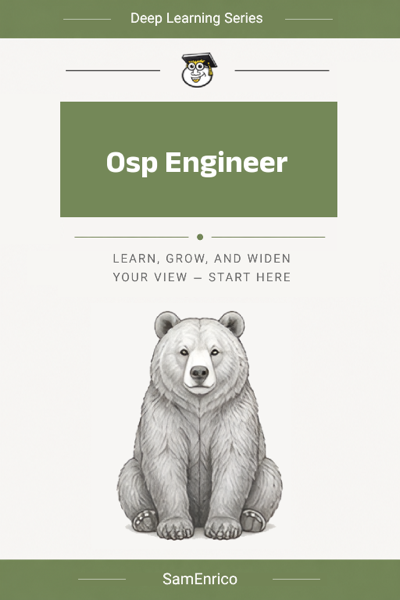
Non-FictionInformativeEducational
Osp Engineer eBook
A Coursebook on Osp Engineer
A Coursebook on Osp Engineer
Formats
Free sample
Chapter 1: The $10 Judgment...--– The first call came at 2:14 AM. A construction crew digging a water main replacement had sheared through a 432-count fiber backbone. By 2:17 AM, three cellular towers were dark. By 2:22 AM, a regional hospital lost its electronic health records link. By 2:31 AM, the county 911 dispatch center reverted to paper maps and radio backups.
The engineer on call that night—we will call her Sarah—had been in the role for eleven months. She had never managed a major cut. She had never seen a fiber optic cable pulled from a duct bank. She had never stood in a muddy trench at 3 AM while a police officer asked, "How long?" and she had no answer.Sarah had done everything right by the textbook. She had reviewed the as-builts.
She had filed the permits. She had coordinated with the utility notification center. But she had made one decision eleven months earlier, sitting at a desk, staring at a spreadsheet. She had decided to skip a field walkout on a 200-foot section of the route because the aerial imagery showed an empty field. That decision saved 500insurveycosts.Thatdecisioncost500 in survey costs.
That decision cost 500insurveycosts.Thatdecisioncost47,000 in emergency restoration, 210,000increditedservicefees,andanunknownsuminreputationaldamage.The210,000 in credited service fees, and an unknown sum in reputational damage. The 210,000increditedservicefees,andanunknownsuminreputationaldamage.The10 judgment—a small, seemingly rational choice at the design phase—had multiplied into a catastrophe.This book exists because of that night.Outside Plant engineering is not a desk job. It is not a software simulation. It is the art and science of putting telecommunications infrastructure into a hostile, unpredictable, legally entangled, and physically dangerous environment. Every cable you design will eventually be cut, flooded, chewed by rodents, melted by lightning, or dug up by a backhoe operator who was never told it was there.
Your job is not to prevent every failure—that is impossible. Your job is to ensure that when failure comes, the cost is measured in hours and dollars, not in days and lawsuits.This chapter establishes the foundation for everything that follows. It answers the question that separates junior designers from senior engineers: What do I do when the plan meets reality? You will learn the 9-Phase Framework—a mental model that turns chaos into a repeatable process. You will learn why the National Electrical Safety Code (NESC) is your primary governing standard and how to use it without being overwhelmed.
You will learn the one lesson that cannot be repeated enough: small decisions at design create massive costs in the field. And you will learn the three learning tracks of this book, so you can read it as a beginner, a technician, or a manager—each path equally valid, each leading to the same destination: the ability to build networks that last.But first, we need to understand what an OSP engineer actually is—and why the title carries weight that Inside Plant engineers rarely appreciate.The Unseen Battleground: Outside Plant vs. Inside Plant Inside Plant (ISP) engineering is a controlled environment. The temperature is regulated. The lighting is consistent.
The floors are level. The pathways are inside buildings, protected from weather, animals, and the general public. If an ISP engineer makes a mistake, they walk down a hallway and fix it. The stakes are real but contained.Outside Plant engineering is the opposite.The OSP engineer contends with weather—extreme heat that melts asphalt and softens conduit, freezing temperatures that turn duct banks into ice blocks, hurricanes that snap poles, wildfires that melt aerial cables. The OSP engineer contends with unknown underground conditions—abandoned septic tanks, uncharted utility lines, bedrock that appears six inches below topsoil, groundwater that floods trenches before they can be backfilled.
The OSP engineer contends with property laws—easements that expired thirty years ago, landowners who refuse access, railroads that require six months of review for a single crossing. The OSP engineer contends with high-stakes infrastructure—fiber cuts that shut down 911 systems, financial networks, air traffic control communications, and hospital data links.Consider this: a single 864-count fiber optic cable can carry over 800,000 simultaneous phone calls or hundreds of gigabits per second of data. When that cable is cut, every service it carries stops. There is no redundancy that can protect against a cut that severs every fiber in the bundle. The only protection is engineering that anticipates the cut and routes around it—or an emergency response that restores service before the public notices.This is the weight that OSP engineers carry.
Not every day. Not on every project. But on the day the backhoe arrives, the weight becomes real.The best-selling OSP references—Norm Lanum’s The OSP Field Manual and the BICSI Outside Plant Design Reference Manual—excel at technical depth. They tell you what to do. This book adds something they cannot: the judgment that comes from watching plans fail.
The $10 Judgment is not a metaphor. It is a mathematical reality that governs every decision you will make as an OSP engineer.The $10 Judgment: How Small Decisions Multiply Let us trace the math.A decision at the design phase costs approximately $10. You choose one route over another. You specify a different conduit material. You add an extra handhole.
You require a utility stakeout. These are paper decisions—typing, clicking, drawing.A decision at the engineering phase costs approximately $100. You revise drawings. You recalculate loadings. You re-coordinate with stakeholders.
The work is still mostly digital, but the scope is broader.A decision at the procurement phase costs approximately $1,000. You change an order. You source different materials. You negotiate with vendors. Money starts moving.A decision at the construction phase costs approximately $10,000.
You stop a trenching crew. You order a redesign. You pay for standby time. You explain to the client why the schedule slipped.A decision at the operations phase costs approximately $100,000. You restore a fiber cut.
You replace damaged equipment. You credit angry customers. You answer to regulators.The multiplier from design to operations is 10,000x. A 10judgmentbecomesa10 judgment becomes a 10judgmentbecomesa100,000 failure.This does not mean you must become paralyzed by fear. It means you must recognize which decisions at the design phase carry the highest multipliers.
A bad decision about route selection—choosing a path through a known wetland without permits—can cost millions when environmental regulators shut down the project. A bad decision about duct bank sizing—specifying insufficient conduit for future growth—can cost hundreds of thousands in re-trenching later. A bad decision about bonding and grounding—skipping a ground rod at a maintenance hole—can cost an entire electronics shelf when lightning strikes.The senior engineer does not make better decisions. The senior engineer makes conscious decisions—understanding the multiplier before applying the $10 judgment.In Chapter 2, you will learn the complete methodology for site assessment and route selection, including the utility conflict identification process that Sarah skipped when she trusted aerial imagery over a field walkout. But first, you need a framework for organizing the entire OSP lifecycle—a mental model that ensures no phase is overlooked and no multiplier is ignored.The 9-Phase Framework: A Repeatable Mental Model The 9-Phase Framework is the backbone of this book.
Every chapter maps to one of these nine phases. When you encounter a problem in the field, you will find…
This is the end of the free sample. Get the eBook to keep going. Buy now
About this book
Details
- Author
- Whitman Blair
- Publisher
- SamEnrico
- Language
- English
- Genre
- Non-Fiction, Informative, Educational
- Released
- 2026-05-11
- Pages (approx.)
- 149
- Available as
- eBook, Audiobook

Read better in the ZLOADR app
Your eBooks on your phone or tablet. Sign in with your SamEnrico account and start reading.
More by Whitman Blair
 Caregiver Stress and Pet CareWhitman Blair$11.99
 Panic Selling PreventionWhitman Blair$11.99
 Success Without Sacrifice CourseWhitman Blair$11.99
 Neighbor Resentment GuideWhitman Blair$11.99
 The Poisoned Chalice: A Mother’s Deadly Betrayal in BelgiumWhitman Blair$11.99
 How to Produce Baby and Toddler Clothing AccessoriesWhitman Blair$11.99
 UN Social Media Job DetectionWhitman Blair$12.99
 10 Ways to Use Gelatin (Recipe Book)Whitman Blair$11.99
You may also like
 Hong Kong Handover 1997Dunn Johnnie$11.99
 Zumba For Postnatal Recovery CourseNeal Christian$11.99
 Zumba for BeginnersLadner Nikia$11.99
 YouTube Comment Mining GuideHumes Pandora$12.99
 Worry Box MeditationCarlin Rudy$11.99
 Workplace Stress MeditationNguyen Lynn$11.99
 Workplace Stress and Sleep RepairHawley Ivory$11.99
 Workplace Perfectionism CureDelaney Jeffry$11.99
 Workplace Injustice Anger GuideWallen Isabelle$11.99
 Work Addiction and Burnout LinkGreenwood Ester$11.99
 Women in Yoga and WellnessBeattie Galina$11.99
 Women in Stand Up ComedyChun Evangeline$11.99