
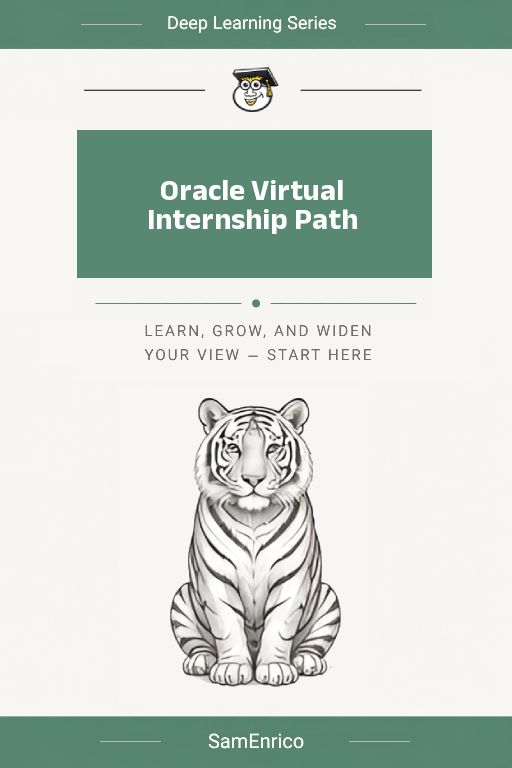
Non-FictionStudent's ShortcutDatabase InternshipOracle Careers
Oracle Virtual Internship Path eBook
Join Oracle's remote intern program for database m
Join Oracle's remote intern program for database management cloud infrastructure and enterprise software development.
Formats
Free sample
Chapter 1: The Oracle Lie--Every computer science student has heard it. Maybe a professor said it during a lecture. Maybe a friend whispered it at a hackathon. Maybe a Reddit thread screamed it into the void: "Oracle is dying. Don't bother applying.
They're a legacy database company running on 1990s technology."I heard it too. And almost believed it.Three years ago, I was a junior at a state university with an average GPA, a few half-finished side projects, and a growing anxiety about internship applications. My friends were obsessed with FAANG companies. They optimized their resumes for Amazon, studied Leet Code for Google, and practiced behavioral interviews for Meta. Oracle was never mentioned.
When I brought it up during a study session, someone laughed and said, "Isn't that the company that sues people?"I almost closed the tab.But something stopped me. I had stumbled into Oracle's career page while searching for "database internships" – a niche I actually enjoyed, unlike the generic full-stack roles everyone else was chasing. The salary range caught my eye first: 48to48 to 48to62 per hour for remote internships. That wasn't dying-company money. That was top-of-market money.Then I started digging.
And what I found completely changed the trajectory of my career – and it will change yours too.This chapter is not an overview. It is not a gentle introduction. It is the truth about Oracle that your professors won't tell you, that your friends don't know, and that Oracle's competitors desperately want to hide. After reading this chapter, you will understand why Oracle is one of the most undervalued internship opportunities in tech – and why most students are making a catastrophic mistake by ignoring it.The $48 Billion Misconception Let me start with a number that should embarrass every person who told you Oracle is irrelevant: Oracle's cloud infrastructure revenue grew over 50% year-over-year in 2024. Fifty percent.
In a market where AWS grew 12% and Azure grew 19%, Oracle's cloud business is accelerating, not stagnating.Here is the reality that gets buried under decades of "legacy Oracle" memes:Oracle employs 160,000 people globally. That is larger than Netflix, Salesforce, and Uber combined. Their market capitalization hovers around 350billion∗∗–largerthan IBM,largerthan AMD,largerthan Qualcomm.Theyhave∗∗350 billion** – larger than IBM, larger than AMD, larger than Qualcomm. They have **350billion∗∗–largerthan IBM,largerthan AMD,largerthan Qualcomm.Theyhave∗∗40 billion in annual revenue, with profit margins that would make any startup founder weep with envy.But the most important number for you is this: Oracle hires approximately 1,000 interns per year across their Cloud Infrastructure, Database Engineering, and Global Industry Units. That is not a dying program.
That is a massive, well-funded, highly competitive pipeline for full-time conversion.And yet, the average CS student applies to Oracle with lower frequency than they apply to Door Dash.This is what I call the Oracle Gap: the disconnect between Oracle's actual size and success and its perception among young engineers. This gap is your opportunity. While your peers fight for the same 200 Google internships, you can quietly walk into a less crowded field with equally impressive compensation and better job security.Why "Legacy Oracle" Is a Lie To understand why Oracle is misunderstood, you need to understand the company's history – and how that history created the misconception you've absorbed.Oracle was founded in 1977 by Larry Ellison, Bob Miner, and Ed Oates. Their original product was a relational database management system – the first commercially available SQL database. For the next three decades, Oracle dominated the database market.
Banks ran on Oracle. Governments ran on Oracle. Airlines, telecom companies, insurance firms – nearly every enterprise on the planet had Oracle databases at their core.That dominance created a reputation: Oracle was the company you called when you needed a database that never, ever failed. The software was expensive, the licensing was complicated, and the sales team was aggressive. But it worked.
When your bank needed to process millions of transactions without losing a single penny, you bought Oracle.That reputation became a liability. As cloud computing emerged in the late 2000s, companies like Amazon and Google built new systems from scratch, unencumbered by legacy requirements. They could move fast, deploy often, and charge by the hour. Oracle, meanwhile, was still selling perpetual licenses for on-premise software.The narrative wrote itself: Oracle is legacy. Oracle is slow.
Oracle missed the cloud.But here is what almost everyone gets wrong: Oracle did not miss the cloud. They were late, yes. But they arrived with a weapon that no one else has – the world's most advanced database engine, now running on their own global infrastructure.Oracle Cloud Infrastructure (OCI) launched in 2016 – five years after AWS and two years after Azure. By tech standards, that is an eternity. But OCI grew faster than any cloud in history because Oracle solved a problem that AWS and Azure could not: how to run the most demanding enterprise workloads in the cloud without rewriting them.Banks did not want to rewrite their 20-year-old PL/SQL stored procedures.
Hospitals did not want to migrate off their custom Oracle applications. They wanted a cloud that worked with what they already had. OCI delivered that. And now, OCI is the fastest-growing major cloud platform on the market.The Three Intern Tracks That Oracle Doesn't Advertise Well When you visit Oracle's careers page, you will see generic job titles: "Software Engineer Intern," "Cloud Engineering Intern," "Database Intern." These titles hide the real structure of Oracle's internship program. After interviewing former interns and reviewing dozens of job descriptions, I have reverse-engineered the three actual tracks.
You must choose one.Track 1: My SQL Heat Wave Kernel (The Hardest, Most Rewarding)What you actually do: You work on the database engine itself – the core C++ code that powers My SQL Heat Wave, Oracle's in-memory analytics engine. You will write code that runs on thousands of servers, processes petabytes of data, and never crashes. Your day might involve implementing a new query optimization algorithm, debugging a memory leak in the storage engine, or optimizing a lock-free data structure for better concurrency.Required skills: C++ is non-negotiable. You need to understand pointers, memory management (new/delete, smart pointers, RAII), templates, move semantics, and multithreading (mutexes, condition variables, atomics, lock-free programming). You also need a strong understanding of data structures (hash tables, B-trees, skip lists) and algorithms (sorting, searching, graph traversal).Who thrives here: Students who loved their operating systems class, who stay up late optimizing code, who get excited about cache misses and branch prediction.
This is the most technically demanding track – and the most impressive on a resume.Return offer rate: Approximately 80% for successful interns. Full-time starting salary: 135,000−135,000-135,000−165,000 + equity + bonus.Track 2: OCI Infrastructure (The Cloud Builder)What you actually do: You build and scale the infrastructure that runs Oracle's cloud. This could mean implementing a new load balancing algorithm, designing a distributed consensus protocol, optimizing network routing, or automating infrastructure deployment with Terraform. Your code will directly impact the performance and reliability of Oracle's global cloud platform.Required skills: Go and Rust are the primary languages (Java is also used in older services). You need distributed systems knowledge (consensus algorithms like Paxos/Raft, replication, sharding, consistent hashing).
You also need networking fundamentals (TCP/IP, DNS, HTTP/2, g RPC) and infrastructure-as-code experience (Terraform, Pulumi, or Cloud Formation).Who thrives here…
This is the end of the free sample. Get the eBook to keep going. Buy now
About this book
Details
- Author
- Maxwell Israel
- Publisher
- SamEnrico
- Language
- English
- Genre
- Non-Fiction, Student's Shortcut, Database Internship, Oracle Careers
- Released
- 2026-06-01
- Pages (approx.)
- 127
- Available as
- eBook, Audiobook

Read better in the ZLOADR app
Your eBooks on your phone or tablet. Sign in with your SamEnrico account and start reading.
More by Maxwell Israel
 Hearst Pioneer Helicopter NewsMaxwell Israel$11.99
 Academic Conference Anxiety ProtocolMaxwell Israel$11.99
 Opioid Dependency Peer Support GuideMaxwell Israel$11.99
 Child Hostage SurvivorMaxwell Israel$11.99
 Generative Fill for Video ProductionMaxwell Israel$11.99
 The First Australians: Echoes of the Ice Age PioneersMaxwell Israel$11.99
 Echoes of the Deep: The AI That Listened to WhalesMaxwell Israel$11.99
 Understanding Bowen SyndromeMaxwell Israel$17.99
 Executive Summary Storytelling FrameworkMaxwell Israel$12.99
 Cinnabar MiningMaxwell Israel$11.99
 Ultimate Handbook Guide to Qiqihaer : (China) Travel GuideMaxwell Israel$11.99
You may also like
 Hong Kong Handover 1997Dunn Johnnie$11.99
 Zumba For Postnatal Recovery CourseNeal Christian$11.99
 Zumba for BeginnersLadner Nikia$11.99
 YouTube Comment Mining GuideHumes Pandora$12.99
 Worry Box MeditationCarlin Rudy$11.99
 Workplace Stress MeditationNguyen Lynn$11.99
 Workplace Stress and Sleep RepairHawley Ivory$11.99
 Workplace Perfectionism CureDelaney Jeffry$11.99
 Workplace Injustice Anger GuideWallen Isabelle$11.99
 Work Addiction and Burnout LinkGreenwood Ester$11.99
 Women in Yoga and WellnessBeattie Galina$11.99
 Women in Stand Up ComedyChun Evangeline$11.99