
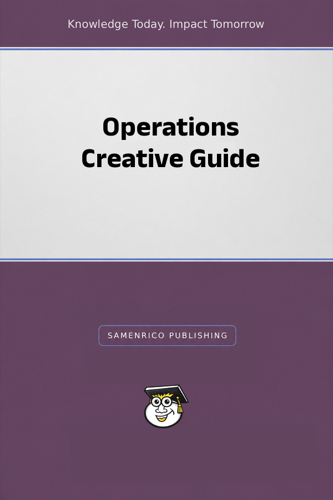
Operations Creative Guide eBook
Reimagine daily workflows and systems using this p
Reimagine daily workflows and systems using this practical creativity workbook for ops pros.
Formats
Free sample
Chapter 1: The Efficiency Trap--The most dangerous words in operations are not “we have a problem.” The most dangerous words are “it’s working perfectly.”In 2019, the most efficient meatpacking plants in the world ran like Swiss watches. Conveyor belts moved at optimized speeds. Shift schedules were calibrated to the second. Inventory turned over with mathematical precision. These plants were case studies in operational excellence—featured in Lean manufacturing conferences, written up in industry journals, held up as models for what ruthless standardization could achieve.
Then 2020 arrived. And those same plants became COVID-19 super-spreaders in a matter of weeks. Workers stood shoulder to shoulder because the line demanded it. Air circulation was designed for efficiency, not contagion control. Schedules left no room for deep cleaning because there was no slack in the system.
The very systems that made them profitable made them lethal. The same managers who had won awards for efficiency now faced federal investigations.This is the Efficiency Trap: the seductive belief that eliminating all variance, all waste, all unpredictability is always and everywhere good. It is not. Efficiency without creative slack is just fragility with a spreadsheet.The Paradox Hidden in Plain Sight Every operations professional learns the same foundational principles: standardize to reduce variation, eliminate waste, optimize for throughput, drive variance to zero. These are not wrong.
They are incomplete. The problem is not the principles themselves. The problem is what happens when they become unquestionable—when efficiency becomes a religion rather than a tool.Consider the following. A software company adopts continuous deployment. Every code change is automatically tested and pushed to production within minutes.
The system is beautiful: zero downtime, zero customer impact, zero defects. Then a single configuration file contains a typo. The automated system propagates the error across ten thousand servers in ninety seconds. Recovery takes three days. The efficiency that made the company brilliant also made it brittle.Consider a hospital supply chain.
Lean principles reduce inventory to exactly what is needed for predicted demand. Storage costs plummet. Cash flow improves. Then a once-in-a-decade flu surge hits. The hospital runs out of saline solution, then gloves, then masks.
Patients are diverted. Elective surgeries are cancelled. The just-in-time system becomes just-too-late.Consider a customer service center. Every call is timed. Every agent has a target handle time.
The metrics are crisp, measurable, and improving. Then a new product launches with unexpected complexity. Agents who take extra time to truly solve customer problems are penalized. They learn to provide fast answers, not right answers. Customer satisfaction crashes.
The metric improved. The business deteriorated.These are not stories of incompetence. They are stories of the Efficiency Trap. In each case, the operations team did exactly what they were trained to do. They optimized.
They standardized. They eliminated waste. And in doing so, they eliminated resilience.What the Efficiency Cult Gets Wrong There is a name for the worldview that treats efficiency as the highest good. Call it the Efficiency Cult. Like any cult, it has its doctrines, its high priests, and its sacred texts.
The doctrines include: any variation is waste. Any unplanned activity is failure. Any idle resource is sin. The high priests are the consultants who sell you software to measure things more precisely. The sacred texts are the spreadsheets that prove how much money you saved last quarter by cutting everything that looked like fat.The Efficiency Cult gets three things profoundly wrong.First, it mistakes measurement for value.
Just because you can measure handle time does not mean handle time is the most important thing. Just because you can measure inventory turns does not mean maximizing turns is always wise. The Efficiency Cult rewards what is easy to count, not what matters. This is the streetlight effect of operations: you look for your lost keys under the streetlight not because that’s where you dropped them, but because that’s where the light is. The Efficiency Cult has built a million streetlights, and operations professionals have been trained to stare at them while the real problems hide in the dark.Second, it treats people as obstacles to optimization rather than sources of intelligence.
The Efficiency Cult sees frontline workers as potential sources of error to be designed out of the system. Standardization means eliminating human judgment. Automation means replacing human decisions. But humans are not bugs in the system. They are the only part of the system capable of responding to situations the designers never anticipated.
When you design a process that assumes everything will go according to plan, you have designed a process that will fail exactly when you need it most.Third, it confuses stability with health. A system that never changes can appear stable. But stability without adaptation is a prelude to collapse. Biological systems that cannot adapt go extinct. Economic systems that cannot adapt get disrupted.
Operational systems that cannot adapt become the meatpacking plants of 2020: efficient, optimized, profitable, and lethal.The Hidden Waste of Predictability Standard operations theory recognizes seven wastes: transport, inventory, motion, waiting, overprocessing, overproduction, and defects. This chapter proposes an eighth waste: predictability without resilience. The waste of brittle optimization.When you optimize a system for a single predicted future, you implicitly bet against all other futures. You are saying: we know exactly what will happen tomorrow, next week, next year. We have modeled the demand, the supply, the labor, the weather, the economy.
Our predictions are correct. Therefore, we will build a system with no slack, no redundancy, no flexibility.This is not management. This is gambling.The COVID-19 pandemic was not a black swan. It was a grey rhino: a highly probable, high-impact threat that everyone saw coming and nobody prepared for because preparing would have required holding slack. Pandemic preparedness means holding extra inventory, cross-training workers, maintaining excess capacity.
These things look like waste on a spreadsheet. They look like inefficiency to the Efficiency Cult. They are actually insurance. And insurance is not waste.The same logic applies to smaller disruptions. A key employee quits.
A supplier raises prices. A software vendor changes its API. A regulation shifts. A customer changes their mind. These events are not black swans.
They are Tuesday. Yet most operational systems are designed as if Tuesday never arrives. They are designed for the average day, and they break on every day that is not average.The hidden waste of predictability is the cost of rebuilding when the predictable future does not arrive. Every hour spent firefighting a disruption that a resilient system would have absorbed is waste. Every customer lost because a brittle system broke is waste.
Every employee who burns out because they are constantly patching holes in a system that was designed without slack is waste. The Efficiency Cult counts the cost of slack. It never counts the cost of its absence.The Genchi Genbutsu Error Toyota, of all companies, provides the antidote to the Efficiency Cult. Toyota’s famous principle of genchi genbutsu means “go and see.” The idea is simple: you cannot understand a problem from a spreadsheet. You must go to the place where the work happens and see it with your own eyes.The Efficiency Cult has inverted this principle.…
This is the end of the free sample. Get the eBook to keep going. Buy now
About this book
Details
- Author
- Melendez Willodean
- Publisher
- SamEnrico
- Language
- English
- Genre
- Non-Fiction, Self-Help, Operations Innovation
- Released
- 2026-06-06
- Pages (approx.)
- 140
- Available as
- eBook, Audiobook

Read better in the ZLOADR app
Your eBooks on your phone or tablet. Sign in with your SamEnrico account and start reading.
More by Melendez Willodean
 Mindful Pause Technique WorkbookMelendez Willodean$11.99
 The Rainbow Bridge WorkbookMelendez Willodean$11.99
 Complicated Grief After SuicideMelendez Willodean$11.99
 The Cognitive Empathy GuideMelendez Willodean$11.99
 Love, Silk, and Stitches: The Secret Letters of a Wartime Fashion RevolutionMelendez Willodean$11.99
 Understanding Still's DiseaseMelendez Willodean$17.99
 Civil Engineering InternMelendez Willodean$11.99
 Data Entry AI AutomationMelendez Willodean$12.99
 Source to Pay Technology StackMelendez Willodean$12.99
 How to Become a Sheller IiMelendez Willodean$11.99