
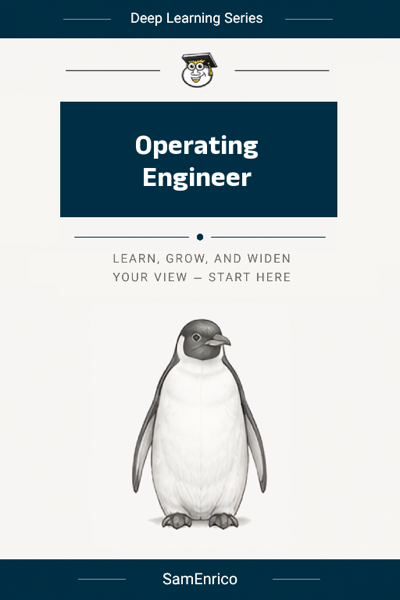
Non-FictionInformativeEducational
Operating Engineer eBook
A Coursebook on Operating Engineer
A Coursebook on Operating Engineer
Formats
Free sample
Chapter 1: The Lever That Moves Worlds--The first time you climb into the cab of a 100,000-pound excavator, something unexpected happens. Your hands find the joysticks, your feet settle on the pedals, and for a moment – just a moment – you feel the weight of everything. The machine idles beneath you, diesel rumbling through the seat frame into your spine. Outside, the site spreads out in brown and gray: piles of rock, trenches waiting for pipe, grade stakes marking a future building pad that doesn't exist yet. And you realize, in that sudden, quiet way that only happens when you're alone in a cab with the door closed, that you are about to move the earth.Not figuratively.
Literally. You are about to take a piece of ground that has been there for ten thousand years and reshape it into something else. A road. A foundation. A drainage channel that will protect a neighborhood from flooding.
A cut through a hillside that will become a highway. The lever under your right hand, connected through hydraulics to a bucket the size of a compact car, gives you the power to change the world at the scale of cubic yards per hour. That is not poetry. That is the job description of an operating engineer.But here is what no one tells you before you climb into that cab for the first time: the levers are the easy part. The real work – the work that separates a 28−per−hourapprenticefroma28-per-hour apprentice from a 28−per−hourapprenticefroma72-per-hour master operator – happens in the space between your ears.
It happens when you learn to read the language of grade stakes before you move a single yard of dirt. It happens when you feel a hydraulic circuit begin to fail through the vibration in the joystick, two hours before the warning light appears. It happens when you look at a set of civil drawings and see, not lines and symbols, but a three-dimensional puzzle of cut and fill that you will solve with tracks and a blade.This chapter is about who you become when you choose this trade. Not just what you operate, but how you think. The modern operating engineer is not a lever puller.
She is a diagnostician, a spatial reasoner, a safety professional, and increasingly, a data analyst who reads telematics the way a pilot reads an instrument panel. If you came here looking for a simple guide to pushing dirt, you have opened the wrong book. If you came here to learn how to master a machine, to earn a living that requires genuine skill, and to join a profession that builds the physical world, then stay. Pull up a chair. We have work to do.The Four Worlds of the Operating Engineer Before we go any further, let us be clear about what this book covers – and what it does not.
The title Operating Engineer can mean two very different things, and confusing them has sent many apprentices down the wrong career path.In one world, the operating engineer sits in a cab on tracks or tires. She runs an excavator digging footings for a hospital. She operates a dozer pushing spoil from a cut section to a fill section. She spends her days on construction sites, mines, quarries, or pipeline routes. The machine moves.
The site changes. Every day is different because every piece of ground is different. That is a mobile operating engineer. That is the subject of this book.In another world, the operating engineer sits in a control room. He monitors boiler pressures, logs steam temperatures, adjusts chiller setpoints, and ensures that a power plant, hospital, or university campus stays heated, cooled, and powered.
The machine does not move. The plant operates continuously, twenty-four hours a day, three hundred sixty-five days a year. That is a stationary operating engineer. It is a fine career, a necessary career, and a completely different career. If that is your goal, turn to Appendix C of this book, where you will find an introduction to stationary engineering, licensing pathways, and a reading list.
But that is not this book.This book is for the men and women who will spend their careers in cabs with windows looking out at the weather. Who will know the feel of frozen joysticks in January and the smell of hot hydraulic oil in August. Who will come home with dirt on their boots and stories about the rock that would not break and the grade that came in perfect on the last pass.We focus on mobile operating engineers across three primary sectors:Construction – This is the largest sector by number of operators. It includes site preparation (clearing, grubbing, stripping topsoil), earthmoving (cutting down high areas, filling low areas), utility installation (trenching for water, sewer, storm drain, gas, electric), fine grading (preparing subgrade for pavement or building slabs), and demolition (taking down structures, processing debris). Construction operating engineers work for general contractors, excavation subcontractors, and site development firms.
The work is seasonal in cold climates, which means sixty-hour weeks in summer and unemployment or travel in winter – unless you get on a highway project, which runs year-round.Mining – Surface mining (coal, aggregates, metals, minerals) requires the largest equipment in the industry. Dozers with blades as wide as a two-car garage. Haul trucks that carry four hundred tons per load. Excavators with buckets that hold a school bus. Mining operating engineers work in a more industrial environment than construction.
The work is often remote – you may live in a camp or commute long distances. But the pay is higher, the hours are steadier, and the equipment is newer because downtime in a mine costs tens of thousands of dollars per hour.Cranes – Crane operators are a specialized subset of mobile operating engineers. They require separate certification (NCCCO), different insurance requirements, and a different temperament. Crane work is slower, more precise, and higher stakes than earthmoving. A dropped load can kill.
A boom contacting a power line can kill. A crane tipping from overloading can kill the operator and everyone within a hundred feet. Crane operators tend to be more deliberate, more methodical, and more paperwork-oriented than dirt movers. If that sounds like you, pay close attention to Chapter 8 of this book.Each of these sectors requires a different mix of skills, a different set of certifications, and a different personality. Construction favors versatility – you might dig trenches in the morning and fine grade a parking lot in the afternoon.
Mining favors specialization – you will run one model of haul truck for years. Cranes favor precision and patience. The chapter will help you choose, but the choice is not permanent. Many operators move between sectors as their careers develop, chasing the work and the wages.The Day the Lever Changed Forever To understand what operating engineers do today, you have to understand what they used to do. Before GPS, before telematics, before laser grade control, operating was a purely analog trade.
You read the grade stakes. You watched the blade or bucket. You stopped, got out, checked your work with a hand level, climbed back in, made an adjustment, and repeated until the surveyor told you it was…
This is the end of the free sample. Get the eBook to keep going. Buy now
About this book
Details
- Author
- Carmichael Bobby
- Publisher
- SamEnrico
- Language
- English
- Genre
- Non-Fiction, Informative, Educational
- Released
- 2026-05-04
- Pages (approx.)
- 144
- Available as
- eBook, Audiobook

Read better in the ZLOADR app
Your eBooks on your phone or tablet. Sign in with your SamEnrico account and start reading.
More by Carmichael Bobby
 SMART Recovery Dual DiagnosisCarmichael Bobby$11.99
 PTSD Physical Health EffectsCarmichael Bobby$11.99
 International Franchise Consumer ProtectionCarmichael Bobby$11.99
 Anger Management for WarehouseCarmichael Bobby$11.99
 The Blank Page Paradox GuideCarmichael Bobby$11.99
 The Last Stand at Cerro de Pasco: Peru's Forgotten Mine SiegeCarmichael Bobby$11.99
 Understanding Sabinas Brittle Hair SyndromeCarmichael Bobby$17.99
 How to Start a Circuit Protection Device (electronic) Business (Beginners Guide)Carmichael Bobby$11.99
 Fintech Factoring ProvidersCarmichael Bobby$12.99
 CTA for Law Firms and TrustsCarmichael Bobby$12.99
You may also like
 Hong Kong Handover 1997Dunn Johnnie$11.99
 Zumba For Postnatal Recovery CourseNeal Christian$11.99
 Zumba for BeginnersLadner Nikia$11.99
 YouTube Comment Mining GuideHumes Pandora$12.99
 Worry Box MeditationCarlin Rudy$11.99
 Workplace Stress MeditationNguyen Lynn$11.99
 Workplace Stress and Sleep RepairHawley Ivory$11.99
 Workplace Perfectionism CureDelaney Jeffry$11.99
 Workplace Injustice Anger GuideWallen Isabelle$11.99
 Work Addiction and Burnout LinkGreenwood Ester$11.99
 Women in Yoga and WellnessBeattie Galina$11.99
 Women in Stand Up ComedyChun Evangeline$11.99