
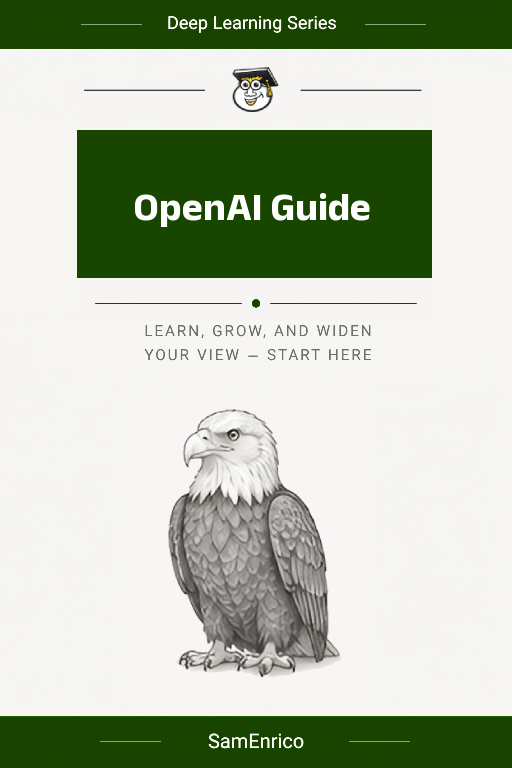
OpenAI Guide eBook
Explore elite ML researcher recruiting, frontier m
by Fay Zack
Explore elite ML researcher recruiting, frontier model publication, and founder alignment interviews.
Formats
Free sample
Chapter 1: The Parameter Golf...--For eight hours, your entire career hangs on a single number.Not your publication record. Not your Ph D advisor’s name. Not the prestigious lab where you interned. Just one number: the validation loss on a dataset you’ve never seen before, measured against a compute budget so tight that every wasted floating-point operation feels like a personal failure.This is the Parameter Golf challenge. And it is the most humbling, exhilarating, and meritocratic filter in the history of technical hiring.Open AI receives approximately 300,000 unsolicited applications per year.
Of those, a human being reads exactly zero. The Applicant Tracking System (ATS) that most companies rely on—keyword matching, degree verification, years of experience—has been thrown out entirely. Open AI replaced it with something far more brutal and far more fair: a live, code-based gauntlet where your resume doesn't matter, your pedigree doesn't matter, and your connections don't matter. Only what you can build, within strict constraints, matters.This chapter is the definitive guide to understanding, surviving, and conquering the Parameter Golf challenge. We will dissect the mechanics, decode the hidden incentives, analyze why "weird and interesting" beats polished and safe, and provide a step-by-step portfolio strategy that has worked for candidates who came from no-name universities, non-traditional backgrounds, and even entirely different industries.
By the end of this chapter, you will know exactly how to turn a compute-limited training task into a full-time offer at the world’s most influential AI lab.But first, you need to understand what Open AI is actually looking for—because it is almost certainly not what you think.The Death of the Resume The traditional tech resume is a work of fiction. Not maliciously, but structurally. It lists years of experience as if time spent equates to skill mastered. It highlights "led a team of five" as if management substitutes for engineering. It showcases Stanford and MIT as if pedigree predicts performance.Open AI realized something uncomfortable: none of these correlate particularly well with the ability to train a frontier model under extreme constraints.The lab’s internal research, conducted in 2023 and updated annually, tracked the performance of new hires against their application materials.
The correlation between Ph D prestige and first-year output was weak (r = 0.24). The correlation between years of industry experience and technical contribution was even weaker (r = 0.17). But the correlation between a candidate’s performance on a timed, compute-limited challenge and their eventual impact was strikingly high (r = 0.71).This is not an accident. The Parameter Golf challenge is designed to measure exactly what Open AI needs: the ability to extract maximum signal from limited resources, to make creative architectural decisions under pressure, and to iterate rapidly without falling in love with your own code.The resume, by contrast, measures the ability to write a resume. And so, with quiet ruthlessness, Open AI abolished it.Here is what happens when you apply.
You submit a link to your Git Hub profile and a brief form asking for your most impressive project. No cover letter. No references. No "objective statement." Within 48 hours, if your Git Hub history shows any signs of serious ML work—repositories with non-trivial Py Torch code, contributions to open-source libraries, or Kaggle competition histories—you receive an invitation to the Parameter Golf challenge.If your Git Hub is empty or contains only tutorial projects, you never hear back. No human ever sees your name.This is the first filter.
And it is already more honest than any resume screen.The Mechanics: How the Game is Played The Parameter Golf challenge follows a consistent template, though the specific dataset and performance target change every month to prevent cheating.The Compute Budget: You are allocated exactly eight hours on a single NVIDIA A100 GPU (40GB memory). In cloud computing terms, this is approximately $32 worth of compute at retail prices. Open AI provides this for free. You cannot purchase more time, and exceeding the limit—even by five minutes—automatically disqualifies your submission. The timer starts the moment your code begins its first training run.The Dataset: You receive a previously unreleased dataset, typically 10-20 billion tokens of text or 5-10 million image-text pairs.
The domain varies: one month might be biomedical abstracts, the next might be software documentation, the next might be social media conversations. You have no advance information about the domain. Your model must generalize from the training split to a held-out validation set that you never see until the final evaluation.The Performance Target (Par): Each challenge defines a "par" score—a specific loss or accuracy threshold that your model must achieve. Par is set based on internal benchmarks from Open AI’s junior researchers. If you exceed par, you advance.
If you fall short, you do not. There is no partial credit.The Starting Code: You fork a minimal repository containing a data loader, a simple training loop, and a baseline model—typically a small Transformer with default hyperparameters. This baseline achieves approximately 70% of par. Your job is to improve it within the compute budget.The Leaderboard: During the eight-hour window, your model’s performance on a public validation set (a small subset of the data) appears on a live leaderboard. You see your rank, your loss curve, and how far you are from par.
You do not see other participants’ code, only their scores. This creates a tense, gamified environment where every improvement feels like a small victory and every plateau feels like existential dread.The Submission: At the end of eight hours, your final model is evaluated on the secret held-out set. If your score meets or exceeds par, your code is saved for human review. If not, the challenge ends for you.Of the approximately 50,000 candidates who receive invitations each year, roughly 2,500 (5%) clear par. Those 2,500 advance to the interview loop described in Chapter 2.
Everyone else receives a polite rejection and, sometimes, an invitation to try again in six months.Why "Weird and Interesting" Beats Polished and Safe Here is where most candidates make a catastrophic mistake.They open the starter repository, see a standard Transformer with default hyperparameters, and think: "I will carefully tune this. I will run a grid search over learning rates. I will add a slightly larger feedforward dimension. I will be thorough and methodical."This approach fails every time.The reason is counterintuitive but logical. The baseline model already represents the "safe" configuration—the obvious choices that any competent engineer would make.
To reach par, you need to outperform that baseline by approximately 30% in loss reduction. Small, incremental improvements will not get you there. You need a discontinuous leap.Open AI’s internal analysis of winning submissions reveals a clear pattern: the top 1% of solutions are almost always "weird and interesting." They use architectures that most researchers would consider risky or even foolish. One winning solution replaced the Transformer’s self-attention with a Fourier transform, arguing that frequency-domain representations might capture long-range dependencies more efficiently. Another used a convolutional preprocessor for text, treating tokens as a one-dimensional signal.
A third abandoned the Transformer entirely, implementing a state-space model (S4) that was barely six months old at the time.Why does Open AI reward this?…
This is the end of the free sample. Get the eBook to keep going. Buy now
About this book
Details
- Author
- Fay Zack
- Publisher
- SamEnrico
- Language
- English
- Genre
- Non-Fiction, Strategic Atlas, Talent Intelligence
- Released
- 2026-06-01
- Pages (approx.)
- 126
- Available as
- eBook, Audiobook

Read better in the ZLOADR app
Your eBooks on your phone or tablet. Sign in with your SamEnrico account and start reading.
More by Fay Zack
 Geraldo Rivera Nose Broken StoryFay Zack$11.99
 Gaming and ADHD ConnectionFay Zack$11.99
 Customer Anger De escalation WorkbookFay Zack$11.99
 Chemistry Nobel AlchemistsFay Zack$11.99
 The Weekly Schedule OptimizationFay Zack$11.99
 Founder and Managing Director of The Luna CinemaFay Zack$11.99
 Bank Wire African ExportersFay Zack$12.99
 Understanding PyelonephritisFay Zack$17.99
 How to Start a Chess Instructor Business (Beginners Guide)Fay Zack$11.99
You may also like
 Zapier GuideGallardo Alica$12.99
 Toast GuidePacheco Lorina$12.99
 Stripe Early Talent GuideHendrick Santo$12.99
 SpaceX Hiring GuideObryan Kyung$12.99
 Snap GuidePeak Berenice$12.99
 Salesforce GuideCuster Cruz$12.99
 Rippling GuideMcinnis Josefine$12.99
 Reddit GuideHolton Danyelle$12.99
 Pinterest GuideLindgren Solange$12.99
 Palantir GuideBarrera Shonda$12.99
 Nvidia GuideOtero Michiko$12.99
 Instacart GuideDailey Michael$12.99