
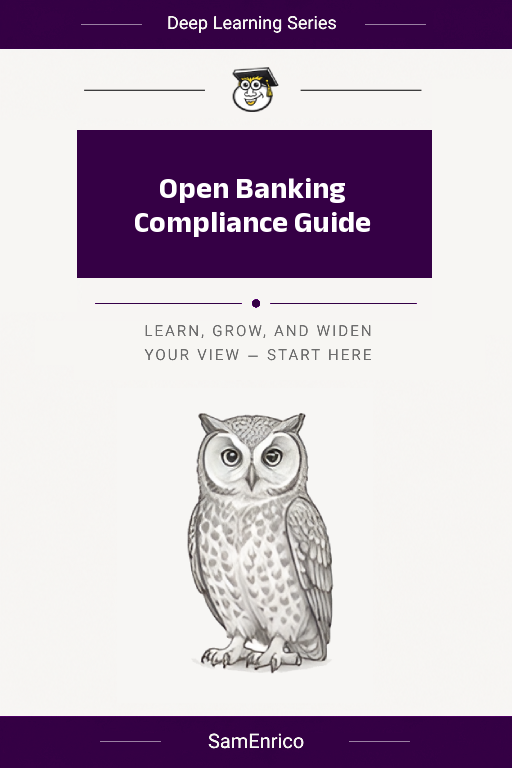
Non-FictionAnnual CheckupFintechOpen Banking
Open Banking Compliance Guide eBook
Comply with open banking regulations including con
Comply with open banking regulations including consumer data access rights and API security standards.
Formats
Free sample
Chapter 1: The Data Fire...–- It was 2:47 AM on Christmas Eve when the phone rang. Not the kind of ring that signals holiday cheer, but the kind that freezes blood. The head of information security at one of America’s largest financial aggregators watched his screen refresh to reveal something impossible: 97,842 customer credentials—usernames and passwords in plain text—were flowing out of his network and into an IP address traced to a small apartment in Eastern Europe. The attack hadn't come through a sophisticated zero-day exploit or a nation-state actor. It came through screen scraping.
An API that didn't exist. A system that had been called “legacy but fine” for seven years. By the time the sun rose on Christmas morning, those credentials had been used to drain small business accounts, redirect payroll deposits, and open fraudulent credit lines. The aggregator would later settle with regulators for $4.5 million. But the real damage wasn't the money.
It was the realization that the entire open banking ecosystem was built on a foundation that had already cracked.This chapter is not a history lesson. It is an origin story—the origin of why you, the reader, cannot afford to treat open banking compliance as a box to check. The events described above (anonymized but real, drawn from a 2019 enforcement action) triggered a chain reaction that would, over the next five years, rewrite the rules of financial data access across four continents. To understand where open banking regulation stands today—and more importantly, where it is going—you must first understand how we arrived at a place where financial institutions stored millions of customer passwords in databases that looked like honey pots to every attacker on the planet.This chapter traces the legal and political origins of open banking, beginning with a piece of legislation signed by President Barack Obama in 2010 that had almost nothing to do with banking APIs and everything to do with the collapse of the global financial system. It then follows the evolution of that law through a decade of regulatory wrangling, court battles, and technological disruption.
Along the way, we will compare the very different paths taken by the European Union, the United Kingdom, Australia, and New Zealand—each of which chose a different model for opening up financial data. And we will end with the single most important technical and legal shift in the industry: the death of screen scraping.But first, a warning. This chapter contains conditional information. If you are a compliance officer at a bank in London or Frankfurt, screen scraping is already illegal. You may skip the migration portions of this chapter and move directly to the post-sunset monitoring section at the end.
If you are a fintech founder in Lagos or a bank executive in Austin, screen scraping remains a daily reality. Pay close attention to the legal analysis that follows, because the regulatory clock is ticking, and the penalties for ignoring it are measured in seven and eight figures.The Accidental Birth of Open Banking: Dodd-Frank Section 1033On July 21, 2010, President Obama signed the Dodd-Frank Wall Street Reform and Consumer Protection Act into law. The Act ran over 2,300 pages and created dozens of new regulatory bodies, including the Consumer Financial Protection Bureau (CFPB). Buried deep within Title X, the section dealing with the newly created CFPB, was a short paragraph labeled Section 1033. It read, in part:"A covered person shall make available to a consumer, upon request, information in the control of the covered person concerning the consumer financial product or service that the consumer obtained from such covered person, including information relating to any transaction, series of transactions, or to the account including costs, charges, and usage data."At the time, almost no one noticed.
The financial industry was still reeling from the 2008 collapse, and the priority was capital requirements, stress tests, and the Volcker Rule. Section 1033 was a sleeper provision—a single sentence that would, a decade later, become the legal foundation for open banking in the United States.Why does that sentence matter? Because it enshrined a radical principle: the consumer, not the bank, owns their financial data. The bank is merely a custodian. And a custodian cannot refuse to hand over the keys when the owner asks.But Section 1033 had a flaw that would haunt the industry for years.
It did not specify how the data should be made available. Did “make available” mean a PDF statement? A CSV export button in online banking? A secure API with standardized authentication? The law was silent.
And in that silence, an entire industry of screen scraping was born.The Screen Scraping Era: A Solution That Became a Nightmare Screen scraping, in its simplest form, is the digital equivalent of handing your house keys to a stranger and asking them to make copies. The consumer provides their banking username and password to a third-party app—say, a budgeting tool or an investment tracker. The app then logs into the bank’s website as if it were the consumer, reads the screen (the HTML), extracts the data (account balances, transaction history), and stores it.For years, this was the only way to build a financial app. Plaid, Yodlee, Tink, and dozens of other aggregators built billion-dollar businesses on screen scraping. And from the consumer’s perspective, it worked beautifully.
You could see all your accounts in one place, track your spending automatically, and move money between banks with a few taps.But from a security and compliance perspective, screen scraping was a catastrophe waiting to happen.First, the credential problem. When you gave your username and password to a budgeting app, that app stored your credentials. Not a token. Not a revocable key. Your actual, plain-text (or poorly hashed) login credentials.
If the app was breached, as happened in the Christmas Eve incident that opened this chapter, the attacker had everything they needed to drain your accounts. And because consumers reuse passwords across multiple sites, those same credentials often unlocked email accounts, social media, and even corporate networks.Second, the liability problem. Under traditional banking rules, if a consumer’s account was compromised because they shared their password, the bank was not responsible for the resulting fraud. But consumers didn’t understand this. When their budgeting app got hacked and their savings account was emptied, they blamed the bank.
Regulators, sympathetic to consumers, began pressuring banks to cover the losses anyway. By 2018, the major US banks were collectively reimbursing over $100 million annually in fraud linked to screen scraping—fraud that, under a strict reading of account agreements, they did not owe.Third, the reliability problem. Screen scraping depends on the bank’s website remaining unchanged. But banks update their websites constantly—new login flows, new CAPTCHAs, new two-factor authentication requirements. Each time a bank changed its site, every aggregator relying on screen scraping broke.
In 2019, when Chase Bank updated its login page, over 200 fintech apps lost access to customer data for three days. Payroll apps couldn’t verify direct deposits. Lending apps couldn’t assess cash flow. Small businesses couldn’t reconcile accounts. The outage cost the fintech ecosystem an estimated $50 million in lost revenue and customer trust.Fourth, the regulatory problem.
Screen scraping violates multiple data protection principles. Under the GDPR, which took effect in 2018, a third party cannot process…
This is the end of the free sample. Get the eBook to keep going. Buy now
About this book
Details
- Author
- Raney Gearldine
- Publisher
- SamEnrico
- Language
- English
- Genre
- Non-Fiction, Annual Checkup, Fintech, Open Banking
- Released
- 2026-05-30
- Pages (approx.)
- 159
- Available as
- eBook, Audiobook

Read better in the ZLOADR app
Your eBooks on your phone or tablet. Sign in with your SamEnrico account and start reading.
More by Raney Gearldine
 Emotional Labor Balance WorkbookRaney Gearldine$11.99
 Affirmations for Depression HelpRaney Gearldine$11.99
 Parental Anger From Social IsolationRaney Gearldine$11.99
 Beginner Strength Training BasicsRaney Gearldine$11.99
 Mindfulness for Beginner MusiciansRaney Gearldine$11.99
 The Last Broadcast: The Night That Changed Radio ForeverRaney Gearldine$11.99
 The Silent Code: How a Forgotten Language Shaped HumanityRaney Gearldine$11.99
 Turkish Language RequirementRaney Gearldine$12.99
 Understanding Delayed EjaculationRaney Gearldine$17.99
 Media Account ManagerRaney Gearldine$11.99
 How to Become a Jet HandlerRaney Gearldine$11.99
You may also like
 Hong Kong Handover 1997Dunn Johnnie$11.99
 Zumba For Postnatal Recovery CourseNeal Christian$11.99
 Zumba for BeginnersLadner Nikia$11.99
 YouTube Comment Mining GuideHumes Pandora$12.99
 Worry Box MeditationCarlin Rudy$11.99
 Workplace Stress MeditationNguyen Lynn$11.99
 Workplace Stress and Sleep RepairHawley Ivory$11.99
 Workplace Perfectionism CureDelaney Jeffry$11.99
 Workplace Injustice Anger GuideWallen Isabelle$11.99
 Work Addiction and Burnout LinkGreenwood Ester$11.99
 Women in Yoga and WellnessBeattie Galina$11.99
 Women in Stand Up ComedyChun Evangeline$11.99