
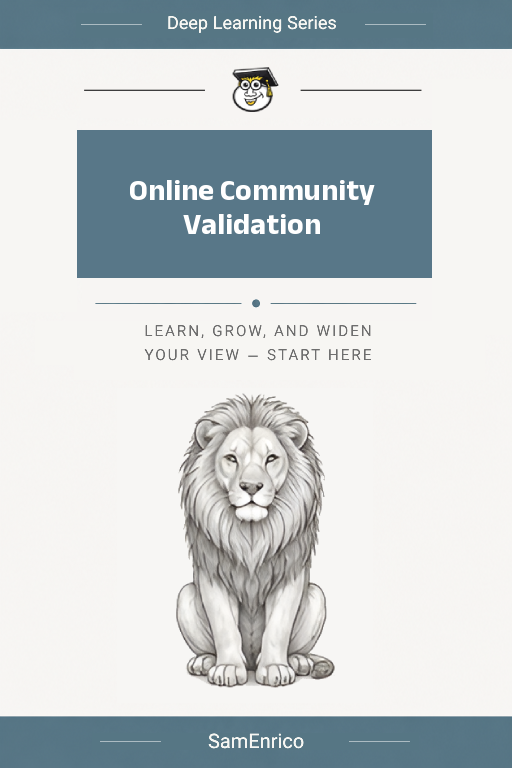
Non-FictionStartup GuideLean Methodology
Online Community Validation eBook
Test ideas in free online communities. Reddit, Fac
Test ideas in free online communities. Reddit, Facebook Groups, and Slack communities for feedback.
Formats
Free sample
Chapter 1: The Three Pillars--The first time I watched someone destroy their own startup in real time, I was sitting in a coffee shop in Austin, Texas, pretending to work on my laptop while secretly eavesdropping on the table next to me. Two founders were celebrating. They had just raised $500,000 for their "revolutionary" food delivery app. They were high-fiving. They were ordering expensive lattes.
They were absolutely, completely, and irreversibly doomed.I know this because I had spent the previous week reading the Reddit threads where their target audience—busy parents in suburban neighborhoods—had already explained, in painstaking detail, exactly why they would never use an app like this. "I don't want more screen time," one parent wrote. "I want someone to just call me when my food arrives." Another said, "I've tried three delivery apps. They all fail because my kids change their minds after the order is placed." The founders had never read those threads. They had raised half a million dollars to build a solution to a problem nobody had.Eighteen months later, the app shut down.
The money was gone. The founders went back to consulting.I tell you this story not to scare you, but to save you. The difference between those founders and the ones who succeed is not intelligence, hard work, or even funding. It is a simple, brutal, beautiful thing: validation. The ability to know, before you build anything, whether anyone actually wants what you're about to spend months of your life creating.This chapter introduces the three pillars of validation—Desirability, Viability, and Feasibility—and gives you a framework to evaluate any idea using nothing but the free online communities where your future customers are already complaining, arguing, and begging for solutions.The $100,000 Question You Must Answer Before You Build Let me ask you something uncomfortable.
Right now, somewhere in your notes app or your journal or the back of a napkin, you have an idea. You think it's good. You think it might be the one. You've told your friends, your partner, maybe your mom. They said it was great.
They said you should go for it.They are lying to you.Not because they are bad people. Because they love you. Because they want to be supportive. Because saying "that sounds risky" feels mean, and saying "I'm not sure anyone would pay for that" feels like a personal attack. So instead, they smile and nod and send you off a cliff with their blessing.The only people who will tell you the truth about your idea are strangers on the internet who have nothing to lose and no reason to be kind.
A Reddit user who spends fifteen seconds scanning your post will tell you exactly why your idea is stupid, and they will do it in public, with spelling errors, and they will be right more often than your mother.That is the core insight of this chapter—and this entire book. Validation is not about confirming you are right. It is about discovering, as cheaply as possible, whether you are wrong.The three pillars of validation are your discovery framework. Before you write a single line of code, before you sketch a single wireframe, before you spend a single dollar, you must answer three questions:Desirability: Do people actually want this? Not "would they use it if it were free and required zero effort." Do they want it enough to change their behavior?Viability: Will people pay for this?
Not "would they say they would pay." Will they actually hand over money, credit card details, or something else of value?Feasibility: Can you build this? Not "could a team of Google engineers build this in six months." Can you build it, with your skills, your budget, and your timeline?Most founders focus on feasibility first. They ask "can I build this?" and when the answer is yes, they start coding. That is exactly backwards. Feasibility is the last question you should answer, because it doesn't matter how well you can build something that nobody wants and nobody will pay for.Let me show you what happens when you get these pillars wrong.The Graveyard of Feasibility-First Thinking I have a friend—let's call him Dan—who is an excellent developer.
Dan had an idea for a project management tool specifically for remote design teams. He spent four months building a beautiful, feature-rich application with real-time collaboration, Figma integration, and a custom notification engine. He launched to crickets. He posted on Reddit. He got three upvotes and one comment that said "looks cool but we already use Asana."Dan had asked the wrong question first.
He asked "can I build this?" and the answer was yes, so he built it. He never asked "do people want this?" If he had spent one week lurking in r/projectmanagement, he would have discovered that remote design teams' biggest complaint wasn't missing features—it was that their clients never responded to requests for feedback. No project management tool could solve that. It was a human problem, not a software problem.Dan's story is not unusual. It is the default.
According to data from CB Insights, 42% of startups fail because there is "no market need" for their product. That is not a failure of execution. It is a failure of validation. They built something that should have never been built.The three pillars exist to prevent you from becoming a statistic. They force you to answer the hard questions before the expensive ones.Pillar One: Desirability (Do They Want It?)Desirability is the most misunderstood pillar.
Most founders think they are testing desirability when they ask "would you use this?" But that question is worthless. People will say yes to almost anything if there is no cost and no commitment. "Would you use this?" costs nothing. The answer is always yes.True desirability is measured by three things: emotion, behavior, and sacrifice.Emotion: Do people express genuine feeling about the problem you're solving? A comment that says "I hate when that happens" is good.
A comment that says "I have been searching for a solution to this for three years and I'm about to lose my mind" is gold. The most valuable signal is frustration—not mild annoyance, but the kind of teeth-grinding, keyboard-smashing, late-night-Googling desperation that comes from a problem that has festered for years.Behavior: What do people actually do about this problem? Have they tried to solve it themselves? Have they built spreadsheets, workarounds, or hacked-together solutions? Have they paid for competing products?
Have they written 500-word rants on Reddit at 2 AM? Behavior is always more honest than words. When someone tells you "I would love that" but has never done a single thing to address the underlying problem, they are being polite.Sacrifice: What would someone give up to solve this problem? Time is the easiest sacrifice to measure—if someone has spent ten hours researching solutions, that is evidence of desirability. Money is the hardest sacrifice, which is why it belongs in Pillar Two.
Attention is the middle ground: if someone reads your entire 1,000-word post and then writes a 200-word response, they have sacrificed attention. That…
This is the end of the free sample. Get the eBook to keep going. Buy now
About this book
Details
- Author
- Thigpen Lottie
- Publisher
- SamEnrico
- Language
- English
- Genre
- Non-Fiction, Startup Guide, Lean Methodology
- Released
- 2026-05-29
- Pages (approx.)
- 152
- Available as
- eBook, Audiobook

Read better in the ZLOADR app
Your eBooks on your phone or tablet. Sign in with your SamEnrico account and start reading.
More by Thigpen Lottie
 Confidence After Imposter SyndromeThigpen Lottie$11.99
 Incubation For Jealousy WorkbookThigpen Lottie$11.99
 The IBS Recovery Story GuideThigpen Lottie$11.99
 Grandparents and Parental AngerThigpen Lottie$11.99
 The Values And Mission Alignment CrisisThigpen Lottie$11.99
 The Vaccine Gambit: How a Gambler’s Bet Saved MillionsThigpen Lottie$11.99
 Payment Platform ComparisonThigpen Lottie$12.99
 Understanding Thrombocytopenia Multiple Congenital AnomalyThigpen Lottie$17.99
 Resident DirectorThigpen Lottie$11.99
 How to Start a Dosing Plant for Water Treatment Business (Beginners Guide)Thigpen Lottie$11.99
You may also like
 Hong Kong Handover 1997Dunn Johnnie$11.99
 Zumba For Postnatal Recovery CourseNeal Christian$11.99
 Zumba for BeginnersLadner Nikia$11.99
 YouTube Comment Mining GuideHumes Pandora$12.99
 Worry Box MeditationCarlin Rudy$11.99
 Workplace Stress MeditationNguyen Lynn$11.99
 Workplace Stress and Sleep RepairHawley Ivory$11.99
 Workplace Perfectionism CureDelaney Jeffry$11.99
 Workplace Injustice Anger GuideWallen Isabelle$11.99
 Work Addiction and Burnout LinkGreenwood Ester$11.99
 Women in Yoga and WellnessBeattie Galina$11.99
 Women in Stand Up ComedyChun Evangeline$11.99