
Non-FictionBusiness BriefReferral MarketingViral Strategy
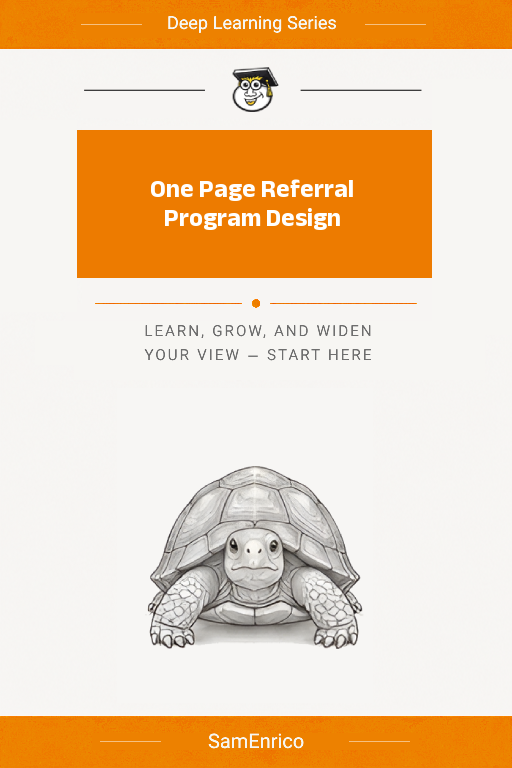
One Page Referral Program Design eBook
Launch a customer referral program using a single
Launch a customer referral program using a single planning page that structures incentives tracking and promotion for viral growth.
Formats
Free sample
Chapter 1: The $500,000 Mistake--I once spent fifty thousand dollars and six months of engineering time to build a referral program that generated exactly zero customers.Let me say that again so the humiliation sinks in properly. Zero. Not a single signup. Not one click on a referral link. After half a year of meetings, wireframes, sprint planning, and a twenty-three-page strategy deck that I presented to the CEO with genuine pride, the only thing we launched was a monument to my own over-engineering.The CEO called me into his office on a Tuesday morning.
He didn't yell. He didn't even look angry. He just slid a piece of paper across the desk—a single-page printout of our referral dashboard, every metric showing a flat line—and asked, quietly, "What did we just pay for?"I had no answer. I had fourteen reward tiers. I had seven trigger points.
I had a beautiful multi-step email sequence, a custom-built tracking system, and a dashboard that would have made a data scientist weep with joy. What I did not have was a single customer who gave a damn.That moment—the paper sliding across the desk, the silence, the realization that I had confused activity with progress—is why I am writing this book. Not because I figured out the secret to viral growth on my first try. Because I failed so spectacularly that I was forced to figure out what actually works.The Paradox of More Here is a truth that most marketing books will not tell you: when it comes to referral programs, more is almost always worse.More reward tiers mean more confusion. More trigger points mean more paralysis.
More tracking means more noise. More pages of strategy mean more places to hide from the one question that actually matters: What, exactly, are we asking our customers to do?I have now analyzed over two hundred failed referral programs. Some were run by solo founders working from coffee shops. Some were run by Fortune 500 companies with seven-figure budgets. The failed programs came from different industries, different customer bases, different price points.
But they shared one common thread: every single one had a planning document longer than one page.Not longer than fifty pages. Longer than one page.Think about what that means. These were smart people—smarter than me, certainly—who spent weeks or months building elaborate systems. They created spreadsheets with color-coded tabs. They built dashboards with real-time graphs.
They wrote memos that required executive approval from three different departments. And every time, the result was the same: nothing.The teams that succeeded? They started with a blank sheet of paper. Not a template. Not a framework they found on a blog.
Just a blank page and a pen. And they filled that page in under an hour.Why Complexity Feels Like Progress There is a psychological trap that explains why so many of us fall into the complexity trap. It is called the Paradox of Choice, and it was first described by psychologist Barry Schwartz. The idea is simple: when people face too many options, they do not make better decisions. They freeze.Schwartz studied grocery store shoppers.
When shoppers were offered a display of six jams, 30 percent of them made a purchase. When the same shoppers were offered a display of twenty-four jams, only 3 percent made a purchase. The larger selection did not create more sales. It created paralysis.The same thing happens when you design a referral program. Present a team with two reward options, and they will pick one and move forward.
Present them with ten reward options, and they will schedule another meeting to "align on incentives." Present them with a twenty-three-page deck, and they will spend three months debating the font on the confirmation email.We tell ourselves that complexity is sophistication. We say, "We need to consider all the edge cases" and "We should build for scale from day one" and "Let's make sure we have a dashboard that can track everything." But what we are really doing is procrastinating. We are building spreadsheets instead of asking customers. We are designing dashboards instead of testing links. We are hiding in complexity because simplicity is terrifying.Simplicity means committing.
It means choosing one reward and one trigger and one ask. It means being wrong, visibly and immediately, instead of being vaguely right in a spreadsheet that no one will ever read.The One-Page Constraint The solution is not better planning. The solution is less planning.I call it the One-Page Constraint. The rule is simple: your entire referral strategy must fit on a single page. Not a front-and-back page.
Not a legal-size page with eight-point font. A single, standard, 8.5-by-11-inch page. If it takes more than one page to explain what you are doing, you do not understand it well enough to execute it.This constraint is not arbitrary. It is a forcing function. When you only have one page, you cannot include fourteen reward tiers.
You cannot map out seven trigger points. You cannot design a multi-step email sequence with branching logic. You have room for exactly what matters—and nothing else.The one-page constraint forces you to answer five questions, and only five questions:The Audience: Who is referring, and who are they referring to?The Trigger: When do we ask?The Asset: What do they share?The Reward: What do they get?The Recursive Loop: How does this start again?That is it. Five questions. One page.
If you can answer those five questions clearly and completely, you have a referral program. If you cannot, no amount of dashboards or spreadsheets or executive alignment meetings will save you.The OPRP Canvas Let me introduce you to the tool that will replace your twenty-three-page deck. I call it the OPRP Canvas—the One Page Referral Program Canvas.Here is what it looks like. On a blank sheet of paper, draw five boxes arranged like a plus sign, with one box in the center and four boxes around it. Or, if you prefer, just draw five boxes in a row.
The arrangement does not matter. What matters is what goes inside them.Box One: The Audience. This is where you define two groups. First, the Advocate—the customer you are asking to share. Be specific.
"Happy customers" is not specific. "Customers who have made three purchases in the last sixty days" is specific. "Customers who have logged in at least ten times" is specific. "Anyone who has given us a Net Promoter Score of 9 or 10" is specific. Second, the Ideal Referee—the person you want the Advocate to share with.
Again, be specific. "Friends who would also love our product" is not specific. "Friends who work in the same industry as the Advocate" is specific. "Friends who have previously shown interest in competing products" is specific.Box Two: The Trigger. This is when you ask.
The most common mistake here is asking too early or too generically. Do not put a popup on your homepage and ask every visitor to refer a friend. That is like proposing marriage on a first date. Instead, identify a specific moment of success or delight. For…
This is the end of the free sample. Get the eBook to keep going. Buy now
About this book
Details
- Author
- Lester Lilian
- Publisher
- SamEnrico
- Language
- English
- Genre
- Non-Fiction, Business Brief, Referral Marketing, Viral Strategy
- Released
- 2026-05-30
- Pages (approx.)
- 129
- Available as
- eBook, Audiobook

Read better in the ZLOADR app
Your eBooks on your phone or tablet. Sign in with your SamEnrico account and start reading.
More by Lester Lilian
 Gambling Addiction and Legal Issues WorkbookLester Lilian$11.99
 Curie Radiation Sickness DeathLester Lilian$11.99
 Figure Skater Flexibility EssentialsLester Lilian$11.99
 Remote Insurance Adjusting CommunicationLester Lilian$11.99
 The Sibling Grief CompanionLester Lilian$11.99
 The Visionary and the Void: How James Cameron Conquered the DeepLester Lilian$11.99
 The Velvet Trap: How a Fake Princess Scammed the EliteLester Lilian$11.99
 Understanding BalantidiasisLester Lilian$17.99
 Back End Value Protection GuideLester Lilian$12.99
 How to Start a Potatoes (retail) Business (Beginners Guide)Lester Lilian$11.99
 Facial Recognition System MonitorLester Lilian$11.99
You may also like
 Hong Kong Handover 1997Dunn Johnnie$11.99
 Zumba For Postnatal Recovery CourseNeal Christian$11.99
 Zumba for BeginnersLadner Nikia$11.99
 YouTube Comment Mining GuideHumes Pandora$12.99
 Worry Box MeditationCarlin Rudy$11.99
 Workplace Stress MeditationNguyen Lynn$11.99
 Workplace Stress and Sleep RepairHawley Ivory$11.99
 Workplace Perfectionism CureDelaney Jeffry$11.99
 Workplace Injustice Anger GuideWallen Isabelle$11.99
 Work Addiction and Burnout LinkGreenwood Ester$11.99
 Women in Yoga and WellnessBeattie Galina$11.99
 Women in Stand Up ComedyChun Evangeline$11.99