
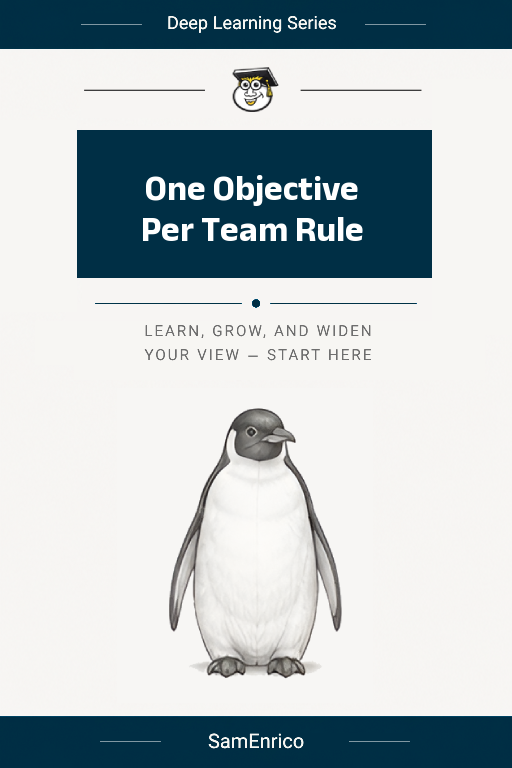
Non-FictionProfessional's Cheat SheetObjective LimitFocus Strategy
One Objective Per Team Rule eBook
Set a single quarterly objective for teams under f
Set a single quarterly objective for teams under five people instead of three to five.
Formats
Free sample
Chapter 1: The Five-Person Trap--–- In 2019, a four-person marketing team at a mid-sized Saa S company did everything right.They read Measure What Matters. They attended OKR training. They wrote three quarterly objectives, carefully calibrated across acquisition, retention, and brand. They aligned with leadership. They cascaded their goals to individual contributors.
They worked nights and weekends.At the end of the quarter, they had achieved exactly zero of their three objectives.Their CEO was baffled. "You worked harder than anyone," he said. "What happened?"The team couldn't answer. They only knew they felt exhausted, scattered, and vaguely ashamed. They had done everything the books told them to do.
And they had failed.Meanwhile, a different four-person team at the same company—same size, same resources, same quarter—had done something almost heretical. They had ignored the OKR training. They had set only one objective. They had said no to their CEO three times when he asked them to "also look at" side projects.They achieved their single objective in week eight. Then they used the remaining two weeks to start on next quarter's goal.Over twelve months, the "one objective" team delivered $2.3 million in new revenue.
The "three objective" team delivered nothing.This book is the story of why that happens—and why the standard goal-setting playbook, written for large departments, quietly destroys small teams.The Invisible Ceiling There is a hidden failure mode in modern management that no one talks about. You can read Radical Focus, Traction, The Four Disciplines of Execution, and a dozen other bestselling goal-setting books, and you will find the same assumption buried in every one of them:Teams should pursue three to five objectives per quarter.This number appears so consistently that it has become gospel. John Doerr, in Measure What Matters, shows team after team running three to five OKRs. Christina Wodtke, in Radical Focus, advocates for "a small number of objectives—three to five." The Rockefeller Habits, popularized in Traction, suggest three to seven "Rocks" per quarter.These are brilliant frameworks. They have helped organizations around the world achieve remarkable things.
But they share a silent assumption that no one has examined closely enough:They were designed for teams of seven to twelve people.When you shrink the team to five people or fewer, the math changes. The psychology changes. The coordination costs change. And the "three to five objectives" rule stops working—not because the frameworks are wrong, but because they were never built for teams this small.This chapter introduces the central argument of this book: For teams of three to five people, the optimal number of quarterly objectives is exactly one.Not two. Not three.
One.Defining the Territory: Who This Book Is For Before we go further, let me be precise about the teams this book addresses.This book is for teams of three to five people.Why not smaller? A team of one or two people has trivial coordination costs. A solo founder with one objective is simply "working." A duo can coordinate implicitly, often with a shared glance or a quick text message. The One Objective rule still applies in theory, but the pain it solves is minimal, and the techniques in this book are overkill.Why not larger? A team of six or more people crosses a threshold.
At six people, you have enough slack for someone to context switch without derailing the whole team. More importantly, at six people, you can afford to split into two teams of three—and Chapter 11 of this book will show you exactly how to do that. For now, know that the One Objective rule is optimized for the smallest viable team size where coordination costs become non-trivial: three to five people.If your team has six or more people, you have two choices. First, you can read this book as a diagnostic—many of the principles still apply. Second, and better, you can split your team and apply the rule to each sub-team.
We'll cover that in Chapter 11.But if you lead or work on a team of three, four, or five people, this book is your playbook. Keep reading.The Cognitive Load Problem Why does three to five objectives break small teams?The answer lies in a concept called cognitive load—the total amount of mental effort required to hold information in working memory. Cognitive load has been studied extensively in fields ranging from education to aviation to software engineering. The findings are consistent: human working memory can hold approximately four to seven discrete chunks of information at once. Beyond that, performance degrades rapidly.Now consider what it means for a team of four people to pursue three objectives.Each objective has its own narrative: why it matters, what success looks like, what tasks are in flight, what blockers exist, who is responsible for what.
That's three distinct narratives. Each narrative has sub-components: key results, dependencies, deadlines, stakeholder expectations. Even conservatively, each objective represents two to three "chunks" of information.That gives us roughly six to nine chunks of information per team member.Within the limits of working memory. Barely.But here's the killer: small teams have no slack.In a department of twelve people, you can afford specialists. One person holds Objective A in their head.
Another holds Objective B. A third holds Objective C. They coordinate at weekly meetings. When someone drops a ball, someone else catches it because there is redundancy.In a team of four people, everyone must hold everything.If the team has three objectives, every single team member must hold all three narratives simultaneously. Because at any moment, any team member might need to make a decision that affects any objective.
The developer needs to know whether a bug fix belongs to Objective A or Objective C. The designer needs to know whether the new wireframe serves Objective B or conflicts with it. The manager needs to know which objective to prioritize when a stakeholder demands an answer by 2 PM.This is the Five-Person Tipping Point. It is the size at which cognitive load becomes unbearable—not because people aren't smart enough, but because human working memory has hard biological limits.The Priority Dilution Effect There is a second, even more deceptive problem with multiple objectives on small teams.Imagine you have a team of four people with one objective. How much attention does that objective receive?
One hundred percent. Every decision, every meeting, every task is evaluated against that single goal. The team may not always be perfectly aligned, but they are at least asking the same question: Does this serve our objective?Now imagine the same team with two objectives. How much attention does each objective receive? In theory, fifty percent each.
But in practice, it's worse. Because humans are bad at switching attention without loss. Every time you switch from Objective A to Objective B, you lose about twenty minutes of context recovery time, according to research cited in The Phoenix Project and validated by dozens of subsequent studies.So the real attention split is not 50/50. It's more like 40/40, with twenty percent lost to switching costs.Now add a third objective. Now the attention split is roughly 25/25/25…
This is the end of the free sample. Get the eBook to keep going. Buy now
About this book
Details
- Author
- Mccall Saundra
- Publisher
- SamEnrico
- Language
- English
- Genre
- Non-Fiction, Professional's Cheat Sheet, Objective Limit, Focus Strategy
- Released
- 2026-05-30
- Pages (approx.)
- 142
- Available as
- eBook, Audiobook

Read better in the ZLOADR app
Your eBooks on your phone or tablet. Sign in with your SamEnrico account and start reading.
More by Mccall Saundra
 Immigrant Education Tutoring Business GuideMccall Saundra$11.99
 Teaching Active Listening GuideMccall Saundra$11.99
 Creative Constraint GuideMccall Saundra$11.99
 The Broken GuitarMccall Saundra$11.99
 Sensitive Information PenaltiesMccall Saundra$11.99
 Huston Dynasty - Anjelica HustonMccall Saundra$11.99
 Soccer Injury Prevention GuideMccall Saundra$11.99
 Peer Mentorship CirclesMccall Saundra$11.99
 Assertiveness For Family ConversationsMccall Saundra$11.99
 Ticking Toward Tomorrow: The Timekeepers Who Built the Modern WorldMccall Saundra$11.99
 Midnight in the Mediterranean: The Vanishing of the Emerald EmpressMccall Saundra$11.99
 Blood Moon Conspiracy: The Jaguar Priest’s GambitMccall Saundra$11.99
You may also like
 Hong Kong Handover 1997Dunn Johnnie$11.99
 Zumba For Postnatal Recovery CourseNeal Christian$11.99
 Zumba for BeginnersLadner Nikia$11.99
 YouTube Comment Mining GuideHumes Pandora$12.99
 Worry Box MeditationCarlin Rudy$11.99
 Workplace Stress MeditationNguyen Lynn$11.99
 Workplace Stress and Sleep RepairHawley Ivory$11.99
 Workplace Perfectionism CureDelaney Jeffry$11.99
 Workplace Injustice Anger GuideWallen Isabelle$11.99
 Work Addiction and Burnout LinkGreenwood Ester$11.99
 Women in Yoga and WellnessBeattie Galina$11.99
 Women in Stand Up ComedyChun Evangeline$11.99