
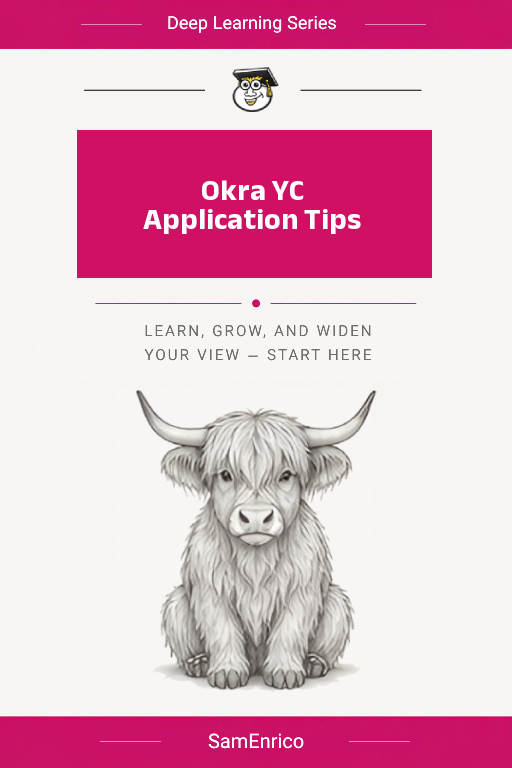
Non-FictionStartup GuideAccelerator PrepOpen Finance
Okra YC Application Tips eBook
Apply Okra Y Combinator open finance API applicati
Apply Okra Y Combinator open finance API application to position your African fintech infrastructure startup.
Formats
Free sample
Chapter 1: The Graveyard Unicorns--The first time I heard the name Okra, I was sitting in a cramped coffee shop in Lagos, across from a fintech founder who had just lost three months of transaction data. He wasn't angry. He was confused. “They raised ninety-two million dollars,” he said, stirring his tea long after the sugar had dissolved. “They had Interswitch.
They had MTN. How do you raise that much and just… disappear?”I didn't have an answer for him then. But over the next two years, I interviewed forty-seven founders, twelve former Okra employees, three Y Combinator partners, and two Nigerian bank CTOs. I read every available pitch deck, every leaked internal memo, every Hacker News thread, and every regulatory filing. What I found was not a simple story of failure.
It was a story about the gap between what investors want to hear and what African banks can actually deliver. It was a story about the difference between a Demo Day-ready product and a bank-ready product. And most importantly for you, sitting here with your Y Combinator application half-finished, it was a story about how to build something that survives.This book is not a eulogy for Okra. This book is a resurrection manual.If you are applying to Y Combinator with an African fintech infrastructure startup—an API, an open finance platform, a banking-as-a-service layer—you are walking into a graveyard. The graves have names like Okra, like Pivo, like Chaka, like Bamba.
Each one raised millions. Each one had a moment where they were the future. Each one collapsed not because the vision was wrong, but because the execution could not survive the friction of the real world.This chapter is the funeral. And funerals, if you pay attention, teach you how not to die.The Rise of the Super-Connector Okra launched in 2019, at the peak of what investors called “Africa's open banking moment.” The thesis was simple and seductive: Plaid had succeeded in the United States by building an API layer between banks and fintechs. Africa had no Plaid.
Africa had dozens of banks, each with its own proprietary systems, each speaking a different technical language. If you could build a single API that connected to all of them, you would own the plumbing for an entire continent's financial revolution.The founders were charismatic. The pitch was polished. And the timing seemed perfect. Nigeria's fintech scene was exploding—Flutterwave and Paystack had just raised massive rounds, and every venture capitalist in San Francisco wanted exposure to “the next big Africa story.” Okra raised 1millionpre−seedin2019,then1 million pre-seed in 2019, then 1millionpre−seedin2019,then4.5 million seed in 2020, then a 10million Series Ain2021thatvaluedthecompanyat10 million Series A in 2021 that valued the company at 10million Series Ain2021thatvaluedthecompanyat92 million.
Investors included Susa Ventures, Accel, and a roster of Silicon Valley luminaries who had missed Plaid and did not want to miss it again.The pitch deck from that era is a masterclass in narrative construction. Slide three: “Banking in Africa is broken.” Slide four: “42 commercial banks in Nigeria, 0 interoperability.” Slide five: “Okra = the API layer that fixes everything.” Slide six: logos—Interswitch, MTN, Access Bank, GTBank. The deck never mentioned screen scraping. The deck never mentioned the word “HTML.” The deck never showed a diagram of a bank's legacy mainframe system circa 1987.Instead, the deck showed beautiful blue flows: data moving seamlessly from bank to fintech to consumer. It showed a future where any fintech could integrate with any bank in under an hour.
It showed the revenue projections that every investor wants to see: hockey stick curves, millions of API calls, profitability by year three.None of it was technically false. But none of it was technically true in the way investors assumed.The Fatal Flaw That No One Spoke About Here is the secret that Okra's pitch deck buried, that the investors never asked about, and that the founders learned too late: Nigerian banks do not have modern APIs.I do not mean they have bad APIs. I mean for the most part, they do not have APIs at all. What they have are web portals—HTML pages designed for human customers to log in, click buttons, and download PDF statements. If you want to access a customer's bank data programmatically, you have two options.
The first is to negotiate a direct integration with the bank's core banking provider (a company like Finacle or T24), which requires months of legal review, millions of naira in compliance fees, and a bank CTO willing to take a risk on you. The second is screen scraping.Screen scraping is the ugly stepchild of the API world. You write a script that pretends to be a human. It logs into the bank's website using the customer's credentials. It navigates the DOM—the underlying structure of the webpage—clicks the right buttons, and extracts the data.
It works perfectly until the bank updates its website. Then it breaks. Then you fix it. Then it breaks again. It is a whack-a-mole game against every bank's front-end team, who have no idea you exist and no incentive to keep their HTML stable.Okra knew this.
Every engineer at Okra knew this. But the pitch deck called it “proprietary integration technology,” and investors did not ask follow-up questions. In the world of venture capital, there is a powerful incentive to believe your own story. Once you have told investors you are building the Plaid for Africa, you cannot turn around and say, “Actually, we're just scraping websites like a script kiddie from 2005.” The story becomes a cage.So Okra's Go-To-Market team—a military unit of former bankers and consultants—signed contracts with banks. They promised true API integration.
They promised bank-signed certificates. They promised uptime guarantees. The engineers, meanwhile, were building scrapers. The leadership team knew. The investors did not ask.
And the customers—the fintechs building on top of Okra—did not find out until the first time a bank updated its login page and every single API call started failing.The $92 Million Mirage By early 2022, Okra had signed contracts with over 500 fintechs. They announced $1 million in annual recurring revenue. The press called them a unicorn in waiting. But something was wrong.The problem was not the contracts. The problem was what happened after the contracts were signed.
Fintechs would integrate Okra's API—which worked beautifully in the sandbox environment that Okra controlled—and then move to production. In production, the scrapers would break. Not always. Not for every bank. But often enough that fintechs lost trust.
They would keep the integration active but never actually use it. They would pay their monthly subscription fee for a month or two, realize they were getting nothing, and downgrade to the free tier. They would leave Okra's API in their codebase, commented out, a monument to a promise that could not be kept.The $1 million ARR was not an illusion in the sense that it did not exist. It existed. The money was in the bank.
But it was money that came with a hidden cost: every dollar of revenue required ten dollars of engineering support to keep the scrapers alive. The unit economics were backward.…
This is the end of the free sample. Get the eBook to keep going. Buy now
About this book
Details
- Author
- Valerio Christena
- Publisher
- SamEnrico
- Language
- English
- Genre
- Non-Fiction, Startup Guide, Accelerator Prep, Open Finance
- Released
- 2026-06-01
- Pages (approx.)
- 125
- Available as
- eBook, Audiobook

Read better in the ZLOADR app
Your eBooks on your phone or tablet. Sign in with your SamEnrico account and start reading.
More by Valerio Christena
 Digital Burnout PreventionValerio Christena$11.99
 Meeting Minutes Template HandbookValerio Christena$11.99
 Governor of the Prison StateValerio Christena$11.99
 Charl Schwartzel Masters BirdiesValerio Christena$11.99
 Data Leak Law Enforcement NotificationValerio Christena$11.99
 The Last Voyage of the Mary Celeste: Ghost Ship or Greatest Maritime Mystery?Valerio Christena$11.99
 The Eyes of the Cosmos: Southeast Asia’s Telescopes and the Dawn of a New AstronomyValerio Christena$11.99
 Production Schedule CommunicationValerio Christena$12.99
 Understanding Coal Workers' PneumoconiosisValerio Christena$17.99
 How to Become a Irradiated-fuel HandlerValerio Christena$11.99
 Amateur Rocket BuilderValerio Christena$11.99
You may also like
 Hong Kong Handover 1997Dunn Johnnie$11.99
 Zumba For Postnatal Recovery CourseNeal Christian$11.99
 Zumba for BeginnersLadner Nikia$11.99
 YouTube Comment Mining GuideHumes Pandora$12.99
 Worry Box MeditationCarlin Rudy$11.99
 Workplace Stress MeditationNguyen Lynn$11.99
 Workplace Stress and Sleep RepairHawley Ivory$11.99
 Workplace Perfectionism CureDelaney Jeffry$11.99
 Workplace Injustice Anger GuideWallen Isabelle$11.99
 Work Addiction and Burnout LinkGreenwood Ester$11.99
 Women in Yoga and WellnessBeattie Galina$11.99
 Women in Stand Up ComedyChun Evangeline$11.99