
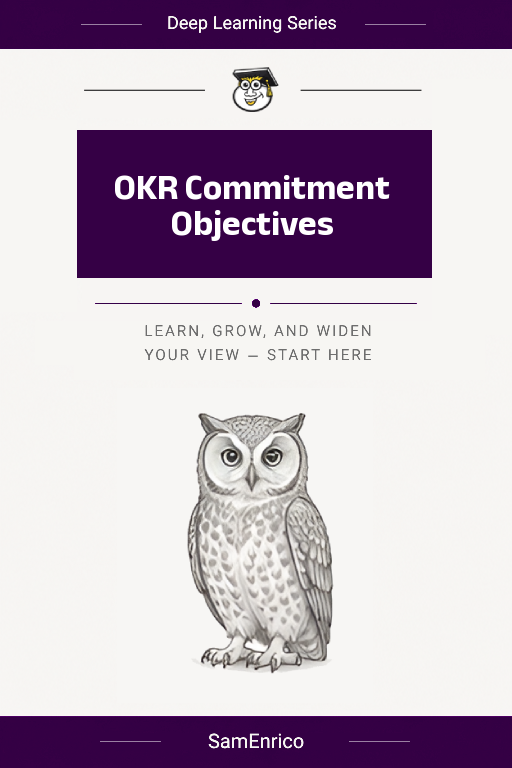
OKR Commitment Objectives eBook
Set must-achieve objectives for operational stabil
by Squires Elva
Set must-achieve objectives for operational stability and predictable deliverables.
Formats
Free sample
Chapter 1: The Roofshot Mandate--The most dangerous sentence in business is not “We’re going bankrupt.” It is not “We’ve lost our biggest customer.” It is a sentence spoken every day in boardrooms, stand-ups, and strategy offsites, often with pride and enthusiasm: “Let’s shoot for the moon.”This sentence has launched a thousand successful ventures. It has also quietly destroyed hundreds more.For the past decade, the business world has been intoxicated by the philosophy of the Moonshot. We have been told that greatness requires audacity, that comfort zones are cemeteries, and that if you are not failing sometimes, you are not trying hard enough. The best-selling OKR literature has championed this view, celebrating stretch goals designed to fail thirty percent of the time as the engine of innovation. Andy Grove taught us that objectives should be difficult.
John Doerr told us to reach for the stars. The message has been consistent and intoxicating: dream bigger.There is nothing wrong with dreaming bigger. But there is everything wrong with dreaming bigger while the house is on fire.This book makes a counterintuitive argument that will, for some readers, feel like a betrayal of everything they have learned about OKRs. Here it is: the most important OKRs you will ever write are not the ambitious ones. They are the boring ones.
The unsexy ones. The ones that nobody celebrates at the all-hands meeting. They are the OKRs that promise nothing more exciting than this: the system will stay up, the payroll will run, the security patch will be applied, the deliverable will arrive on the date promised.These are not Moonshots. They are Roofshots.And without them, your Moonshots are not ambitious. They are merely delusional.The Twenty Minutes That Cost Five Million Dollars Let us begin with a story.
It is a Tuesday afternoon in November. A major e-commerce retailer—let us call them Retail X—is preparing for Black Friday. The product team has been working for six months on a revolutionary new recommendation engine. The chief executive has staked the quarter on an Aspirational OKR: “Achieve thirty percent year-over-year growth in average order value through AI-driven personalization.” The team is excited. The board is excited.
The press release has been drafted.At 2:17 PM on that Tuesday, a routine database migration goes wrong. Not because of negligence, but because the infrastructure team has been under-resourced for three quarters. Every time they asked for headcount, they were told to “stretch” and “innovate.” Every time they proposed a Commitment OKR around uptime, they were told that “stable is table stakes” and the real value was in growth features.The database crashes. The site goes down.For twenty minutes, nothing works. Twenty minutes does not sound like a long time.
But in e-commerce, twenty minutes during the peak shopping season is an eternity. By the time the site is restored, Retail X has lost five million dollars in direct revenue. That is two hundred and fifty thousand dollars per minute. But the direct revenue is only the beginning. Customer trust erodes.
The social media backlash is brutal. Three months later, the company’s valuation has dropped by twelve percent.Here is the cruel irony: the recommendation engine worked beautifully. It launched on schedule. It increased average order value by thirty-two percent, beating the Moonshot OKR. Nobody cared.
Because customers could not access it.The product team hit their Aspirational OKR. The operations team had no Commitment OKR to protect them. And the company paid the price.This is not an isolated incident. Across industries, the pattern repeats. A fintech startup fails a regulatory audit because compliance was treated as a “blocker” rather than a commitment.
A software company loses its largest client when a promised delivery date slips for the third time, because “predictability” was never an objective. A hospital’s billing system goes down for a day because the infrastructure team was told to focus on “innovation projects” instead of “maintenance.”These are not failures of effort. They are failures of taxonomy. These organizations did not know the difference between a Commitment and an Aspiration. And they paid for that confusion in cash, reputation, and customer trust.The Great Confusion: Why Most OKRs Fail Before They Start The OKR framework, as originally conceived by Andy Grove at Intel and popularized by John Doerr, contains within it a distinction that most practitioners overlook.
Grove distinguished between what he called “commitment objectives” and “stretch objectives.” Commitment objectives were those that the organization absolutely must achieve—the non-negotiables, the operational must-haves. Stretch objectives were the aspirational goals—the ones where achieving seventy percent was still a victory.Over time, this distinction eroded. The sexy part of the framework—the stretch—ate the boring part. Books were written about Moonshots. Conferences celebrated ten-times thinking.
The word “commitment” began to sound like a synonym for “ordinary.” And ordinary was not cool.This book is the corrective.Let us be precise about definitions, because precision is the first requirement of any Commitment OKR.Aspirational OKRs (also called Stretch Goals or Moonshots) are designed to push the boundaries of what an organization believes is possible. They are ambitious, often uncomfortable, and deliberately set at a level where failure is a likely outcome. When you achieve seventy percent of an Aspirational OKR, you have succeeded—you have stretched further than you thought you could. These OKRs drive innovation, growth, and transformation. They answer the question: What could we become?Committed OKRs (also called Roofshots) are fundamentally different.
They are designed to be achieved at one hundred percent. They are not ambitious in the sense of being difficult to reach; they are non-negotiable in the sense that missing them constitutes a clear failure. These OKRs drive stability, predictability, and trust. They answer the question: What must we absolutely do to keep our promises?The critical insight—the one that will save you millions of dollars and countless sleepless nights—is this: You cannot mix these two types of OKRs on the same scorecard.When you do, two terrible things happen.First, the Commitments get lost. In a scorecard filled with exciting Moonshots, the boring Roofshot about uptime or delivery dates looks like an afterthought.
It gets deprioritized. Resources flow to the sexy goals. The lights flicker.Second, the Aspirations become impossible. When your infrastructure is unstable, when your delivery dates are unreliable, when your basic operations are shaky—you cannot innovate. You cannot stretch.
You spend all your energy firefighting. The Moonshot becomes a cruel joke.This is the Roofshot Mandate: Keep the lights on first, then change the world.A Taxonomy of Failure: Three Organizations That Got It Wrong To understand the Roofshot Mandate, let us examine three common failure patterns. Each represents a different way that organizations confuse Commitment and Aspiration.The Heroic Failure Pattern In this organization, everything is a stretch goal. The chief executive declares that “we don’t do ordinary.” Every quarter, every team is expected to set ambitious, uncomfortable objectives. The culture celebrates risk-taking and treats missed targets as learning opportunities.
There are no non-negotiables because everything is negotiable in the service of ambition.For a while, this works. The organization innovates. It grows.…
This is the end of the free sample. Get the eBook to keep going. Buy now
About this book
Details
- Author
- Squires Elva
- Publisher
- SamEnrico
- Language
- English
- Genre
- Non-Fiction, Professional's Cheat Sheet, Commit
- Released
- 2026-06-01
- Pages (approx.)
- 137
- Available as
- eBook, Audiobook

Read better in the ZLOADR app
Your eBooks on your phone or tablet. Sign in with your SamEnrico account and start reading.
More by Squires Elva
 Jumping Over PuddleSquires Elva$11.99
 Ghee vs Butter GuideSquires Elva$11.99
 Outbreak Cash Flow Survival GuideSquires Elva$11.99
 Six Homes Before TwelveSquires Elva$11.99
 Opposite Action Skill GuideSquires Elva$11.99
 Social Media Weekly ReviewSquires Elva$11.99
 Morning Procrastination BreakthroughSquires Elva$11.99
 Grief and Anger After SpouseSquires Elva$11.99
 The Velvet Noose: A Serial Killer’s Silent SymphonySquires Elva$11.99
 The Golden Age of Aksum: Africa's Forgotten SuperpowerSquires Elva$11.99
 Service Providers Guide to Tool Rental ServicesSquires Elva$11.99
 How to Produce Wheel CleanerSquires Elva$11.99