
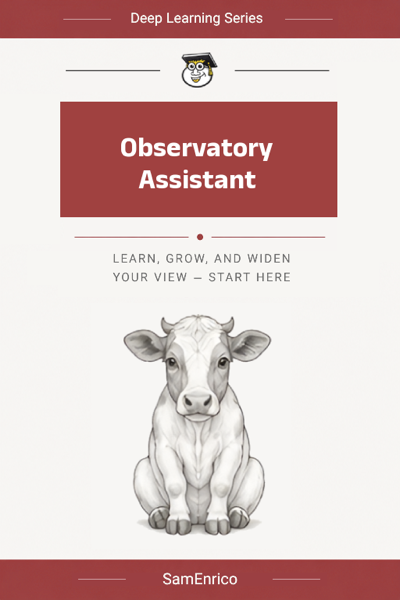
Non-FictionInformativeEducational
Observatory Assistant eBook
A Coursebook on Observatory Assistant
A Coursebook on Observatory Assistant
Formats
Free sample
Chapter 1: The Last Button-Pusher...--–- The phone rang at 11:47 PM, which was never a good sign. I was three sips into my first coffee of the night, the summit wind was gusting past 25 knots, and the all‑sky camera showed a line of clouds creeping in from the west like a slow‑motion car crash. The astronomer on the other end of the line—a tenured professor with three decades of observing under his belt—said exactly four words: "I can't find it." Not "the target," not "the guide star," just "it." And in that moment, I realized something that no job description had ever prepared me for: the most expensive telescope on the mountain, a decade of research funding, and a grown man's emotional stability were all resting on my ability to ask one question in exactly the right tone of voice.–- This is not a story about astronomy. Not really. It is a story about what happens when brilliant people build machines that are too complex for any single human to understand, and then leave those machines in the hands of a small tribe of night‑shift generalists who learn to speak six different technical languages before breakfast—none of which is their native tongue.
The observatory assistant exists because telescopes have outgrown the people who design them. We are the translators, the troubleshooters, the night watchmen, and sometimes, the therapists. And if you are reading this book, you are either planning to join our ranks, you have already been thrown into the deep end without a life preserver, or you are simply curious about how the universe gets photographed while the rest of the world sleeps. Welcome to all three.–- Let me tell you what no textbook will ever admit: most of what an OA does cannot be learned in a classroom. The math is straightforward—anyone with high school algebra can calculate an hour angle or estimate a signal‑to‑noise ratio.
The hardware manuals are thick but finite. The software interfaces, however poorly designed, eventually become muscle memory. What they do not teach you is how to listen to a telescope. Not metaphorically. Literally.
The drives have a sound when they are happy—a low, consistent hum like a contented cat. When that hum changes pitch, you have maybe thirty seconds to figure out whether it is a harmless temperature fluctuation or the beginning of a six‑figure repair bill. I learned that sound during my third week, when a more experienced OA grabbed my shoulder in the middle of a slew and said, "Shh. Hear that? That's the sound of a bearing about to fail." I heard nothing.
He heard a catastrophe. Six months later, I heard it too.–- This chapter is about the role you are about to step into—not the sanitized job description, but the real one. It is about the evolution of a profession that barely existed thirty years ago, the strange middle ground you will occupy between scientist and technician, and the soft skills that will save your sanity long after you have memorized every button in the control room. By the end of this chapter, you will understand why the best OAs are not the ones with the most degrees, but the ones who know when to trust their ears over the readout.The Great Disappearing Astronomer–- To understand what an observatory assistant does today, you first have to understand what observing used to look like—because the ghosts of that old world still haunt every control room. In the classical era of astronomy, roughly from Galileo until the 1980s, the observer was the operator.
A astronomer would travel to the observatory, climb into the dome (often literally sleeping in a cot next to the telescope), and spend the entire night manually guiding the telescope, changing photographic plates, and recording observations in a paper log. If something broke, they fixed it—or they went home empty‑handed. The romantic version of this history involves pipe smoke, tweed jackets, and the noble solitude of a single mind wrestling with the cosmos. The reality involved frostbite, exhaustion, and a lot of bad data taken by people who had been awake for thirty hours.–- That model worked—barely—when telescopes were small enough to be operated by one person, when detectors were photographic plates that took hours to expose, and when the number of active research astronomers could fit in a medium‑sized auditorium. But telescopes grew.
The 5‑meter Hale Telescope on Palomar Mountain (1949) was already pushing the limits of what a single human could manage. By the time the 10‑meter Keck telescopes came online in the 1990s, the classical observer was functionally extinct. No single person can simultaneously manage a segmented mirror active optics system, a cryogenic infrared spectrograph, a queue of fifty competing science programs, and the weather station—while also remembering to eat dinner. Something had to give. What gave was the astronomer's direct control.–- The first response was the Telescope Operator—a dedicated staff member whose job was to handle the hardware so the astronomer could focus on science.
This worked for a while. The operator slewed, focused, and tracked; the astronomer chose targets and calibrated instruments. But then remote observing arrived. Suddenly, astronomers didn't even need to travel to the mountain. They could sit at a terminal in Cambridge or Tokyo and pretend they were in the dome.
The operator stayed on the summit, now serving two masters: the telescope itself and a disembodied voice on the speakerphone. This arrangement exposed a fundamental problem: the operator knew the hardware, and the astronomer knew the science, but no one was looking at the whole picture. Who decides to abort an observation when a cloud rolls in? Who notices that the guide star is drifting because the operator is focused on the astronomer's endless questions? Who says "no" to a distinguished professor whose target is about to crash into a tree?–- Enter the Observatory Assistant.
The OA emerged in the late 1990s and early 2000s as a hybrid role, designed to fill the gap that neither the classical observer nor the pure operator could bridge. The OA is not a scientist—you will not be designing experiments or publishing papers (usually). But you are not a technician either—you will not be rebuilding motors or soldering circuit boards. You are the integrator. You stand at the intersection of the telescope, the instruments, the weather, the queue, and the astronomer.
You see the whole system, and you are responsible for keeping it running smoothly. The astronomer worries about signal‑to‑noise ratios. You worry about whether the dome shutter will freeze open. Both matter, but only one of them will end the night early.–- The job title itself tells you something important. "Assistant" implies a subordinate role, and in the formal hierarchy of science, you are.
The Principal Investigator wrote the grant. The astronomer has the Ph D. Your name will not appear on the paper unless someone is unusually generous. But on the mountain, at three in the morning, when the instrument is returning errors and the guide star…
This is the end of the free sample. Get the eBook to keep going. Buy now
About this book
Details
- Author
- Martins Wilburn
- Publisher
- SamEnrico
- Language
- English
- Genre
- Non-Fiction, Informative, Educational
- Released
- 2026-06-03
- Pages (approx.)
- 137
- Available as
- eBook, Audiobook

Read better in the ZLOADR app
Your eBooks on your phone or tablet. Sign in with your SamEnrico account and start reading.
More by Martins Wilburn
 Scent Anchoring For CalmMartins Wilburn$11.99
 The Remote Communication GuideMartins Wilburn$11.99
 Twitch Live Stream ObsessionMartins Wilburn$11.99
 FODMAP Diet For IBDMartins Wilburn$11.99
 Blood and Ivory: The Zulu War That Defied the Empire (1879)Martins Wilburn$11.99
 How to Become a Highway-maintenance SupervisorMartins Wilburn$11.99
 Landslide and Erosion Business InsuranceMartins Wilburn$12.99
 How to Produce a Caterpillar 777Martins Wilburn$11.99
You may also like
 Hong Kong Handover 1997Dunn Johnnie$11.99
 Zumba For Postnatal Recovery CourseNeal Christian$11.99
 Zumba for BeginnersLadner Nikia$11.99
 YouTube Comment Mining GuideHumes Pandora$12.99
 Worry Box MeditationCarlin Rudy$11.99
 Workplace Stress MeditationNguyen Lynn$11.99
 Workplace Stress and Sleep RepairHawley Ivory$11.99
 Workplace Perfectionism CureDelaney Jeffry$11.99
 Workplace Injustice Anger GuideWallen Isabelle$11.99
 Work Addiction and Burnout LinkGreenwood Ester$11.99
 Women in Yoga and WellnessBeattie Galina$11.99
 Women in Stand Up ComedyChun Evangeline$11.99