
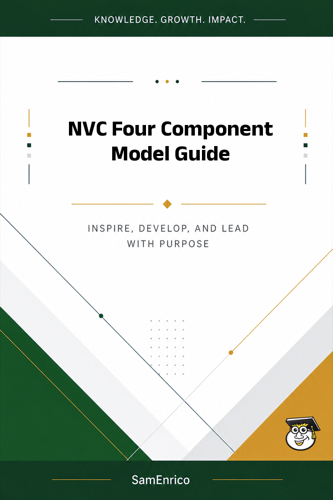
Non-FictionSelf-HelpCommunication Skills
NVC Four Component Model Guide eBook
Teaches observations, feelings, needs, and request
Teaches observations, feelings, needs, and requests as core Nonviolent Communication framework.
Formats
Free sample
Chapter 1: The Seven-Second Breakdown--–- It takes about seven seconds for a relationship to go from calm to conflict. In that sliver of time, something shifts. Voices change. Bodies tense. A door slams.
A phone gets thrown on the couch. Two people who care about each other suddenly feel like enemies. And neither of them saw it coming.This chapter is about those seven seconds. It is about the gap between what you intend to say and what the other person actually hears. It is about the invisible machinery of everyday conversation that turns harmless words into weapons.
Most people believe they know how to communicate. After all, you have been talking your entire life. But the truth is that most of what we call "communication" is actually a sophisticated system of blame, diagnosis, and defense disguised as dialogue. And it is destroying your relationships one seven-second breakdown at a time.Consider a scene that happens in thousands of homes every evening. A parent walks into the kitchen and sees dishes piled in the sink.
The parent is tired, having worked a full day, and now faces the prospect of cleaning up after someone else. The child or partner who left the dishes is sitting on the couch, scrolling through a phone. The parent opens their mouth and says something like: "You are so lazy. You never help around here."Seven seconds. Maybe less.The person on the couch did not wake up intending to hurt anyone.
The parent did not wake up intending to start a fight. But now everyone is angry, defensive, and disconnected. The person on the couch will likely respond with something like: "You always complain. I was going to do them later." And now what could have been a simple request has become a full-scale argument about character, history, and respect.This is not a failure of love. It is a failure of language.The Intention-Impact Gap Every human being has a fundamental need to matter, to be seen, and to contribute to the well-being of others.
When you speak, you almost always intend to connect, to solve a problem, or to express something real. You do not wake up in the morning thinking, "I cannot wait to make my partner feel small and defensive today." And yet, that is exactly what happens. Over and over.The gap between intention and impact is the single greatest source of unnecessary suffering in human relationships. You intend to ask for help. The other person hears criticism.
You intend to express hurt. The other person hears an attack. You intend to set a boundary. The other person hears rejection. And because you never see the gap, you assume the other person is being unreasonable, defensive, or manipulative.
They are not. They are simply hearing your words through a filter you do not even know exists.That filter is what Marshall Rosenberg, the creator of Nonviolent Communication, called life-alienated language. It is the set of speech patterns that separate us from our natural capacity for compassion. These patterns include moralistic judgments ("You are wrong"), comparisons ("Why can't you be more like..."), denial of responsibility ("I had to"), and demands ("You should"). These forms of language are so common, so woven into the fabric of everyday speech, that most people do not even notice them.
They are the water in which we swim.The tragedy is that life-alienated language is completely unnecessary. It does not actually solve problems. It does not motivate people to change. It does not build trust or intimacy. What it does is trigger a predictable neurological response that makes productive conversation impossible.The Neuroscience of Defensiveness To understand why your well-intentioned words so often backfire, you need to understand what happens inside the human brain when someone hears a judgment.
This is not psychology or philosophy. This is biology.The amygdala is a small, almond-shaped cluster of neurons deep inside the brain. Its job is to scan the environment for threats. It operates below the level of conscious awareness, about a hundred times faster than your rational thinking brain. When the amygdala detects a threat, it triggers what neuroscientists call the "fight-flight-freeze" response.
Blood flows away from the prefrontal cortex, the part of the brain responsible for empathy, reasoning, and impulse control. It flows toward the muscles, the heart, and the survival centers of the brain.Here is what matters for communication: The human brain processes a moralistic judgment as a physical threat.When someone says "You are lazy," your amygdala does not distinguish between that sentence and a tiger charging at you. It triggers the same cascade of stress hormones. Your heart rate increases. Your breathing becomes shallow.
Your hearing narrows. And crucially, your ability to listen, to empathize, and to problem-solve drops by more than half within seconds.This is not a character flaw. This is not someone being "too sensitive." This is hardwired human biology. Your ancestors who ignored threats did not survive to pass on their genes. Your brain is doing exactly what evolution designed it to do.The problem is that modern life is full of threats that are not physical.
A critical comment from a partner. A dismissive email from a boss. A judgmental remark from a parent. These events trigger the same biological response as a predator. And once that response is triggered, no amount of logic, evidence, or repetition will get through.
You cannot reason someone out of a defensive state that reason did not create.This explains why arguments escalate so quickly and resolve so slowly. Each person says something that triggers the other person's amygdala. The triggered person responds defensively, which triggers the first person's amygdala. Within a few exchanges, both people are operating from their survival brain, saying things they will regret, and unable to access the empathy and creativity needed to find a solution.The seven-second breakdown is not a failure of love. It is a failure to understand how your words land inside another person's nervous system.The Jackal Voice: How We Learned to Attack Rosenberg used the metaphor of the jackal to describe life-alienated language.
Jackals are scavengers. They hunt close to the ground. They attack and defend. When you speak from the jackal voice, you are speaking from a mindset of right and wrong, good and bad, deserving and undeserving. The jackal voice asks questions like: "Who is to blame?" "What punishment do they deserve?" "How can I prove I am right?"The jackal voice has specific linguistic signatures that you can learn to recognize.First, there are moralistic judgments.
These are statements that imply someone is bad, wrong, or flawed because their actions do not match your values. Examples include: "You are so selfish." "That was an irresponsible thing to do." "She is incompetent." "They are dishonest." Moralistic judgments feel like statements of fact, but they are actually interpretations. The action is "You left your dirty plate on the table." The judgment is "You are lazy." The judgment adds nothing except accusation.Second, there are comparisons. Comparisons are judgments dressed up as observations. "Why can't you be more like your sister?" "My last assistant never made this mistake." "Other companies manage…
This is the end of the free sample. Get the eBook to keep going. Buy now
About this book
Details
- Author
- Calloway Mina
- Publisher
- SamEnrico
- Language
- English
- Genre
- Non-Fiction, Self-Help, Communication Skills
- Released
- 2026-06-07
- Pages (approx.)
- 138
- Available as
- eBook, Audiobook

Read better in the ZLOADR app
Your eBooks on your phone or tablet. Sign in with your SamEnrico account and start reading.
More by Calloway Mina
 LBO Senior Debt TrancheCalloway Mina$11.99
 Supply Chain Resilience ForecastCalloway Mina$11.99
 The Streaming Watching AddictionCalloway Mina$11.99
 Decision Fatigue Morning GuideCalloway Mina$11.99
 The Inventor Who Armed a Nation: Qiu Faren and the Battlefield RevolutionCalloway Mina$11.99
 Understanding Sillence SyndromeCalloway Mina$17.99
 Friday Weekend Sales PlanningCalloway Mina$12.99
 Competitor Pricing Fear BusterCalloway Mina$12.99
 Staff Devops EngineerCalloway Mina$11.99
 How to Become a Liaison EngineerCalloway Mina$11.99
You may also like
 Hong Kong Handover 1997Dunn Johnnie$11.99
 Zumba For Postnatal Recovery CourseNeal Christian$11.99
 Zumba for BeginnersLadner Nikia$11.99
 YouTube Comment Mining GuideHumes Pandora$12.99
 Worry Box MeditationCarlin Rudy$11.99
 Workplace Stress MeditationNguyen Lynn$11.99
 Workplace Stress and Sleep RepairHawley Ivory$11.99
 Workplace Perfectionism CureDelaney Jeffry$11.99
 Workplace Injustice Anger GuideWallen Isabelle$11.99
 Work Addiction and Burnout LinkGreenwood Ester$11.99
 Women in Yoga and WellnessBeattie Galina$11.99
 Women in Stand Up ComedyChun Evangeline$11.99