
Non-FictionSelf-HelpWeight LossComparison
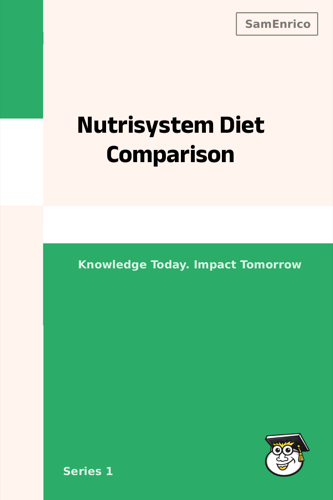
Nutrisystem Diet Comparison eBook
Release the need to compare weight loss speed on s
Release the need to compare weight loss speed on structured meal plans.
Formats
Free sample
Chapter 1: The Comparison Epidemic--–- The first time I watched someone quit Nutrisystem, she wasn’t hungry. She wasn’t tired of the food. She hadn’t hit a financial wall. She quit because her sister-in-law posted a Facebook photo with the caption “One month on Nutrisystem = 14 pounds gone!” while she herself had lost only four pounds in the same timeframe. In that single moment of comparison, six weeks of perfect adherence evaporated.
She unfollowed the plan before she unfollowed her sister-in-law.This scene has played out millions of times across kitchen tables, bathroom scales, and private Facebook groups. The tragedy is not that structured meal plans fail. The tragedy is that they work—quietly, metabolically, consistently—and yet we abandon them not because of their shortcomings but because of our comparisons to others. This chapter exposes the comparison epidemic: how it operates, why best-selling diet books accidentally fuel it, and what the false “normal” rate of weight loss is doing to your chances of long-term success.The Dirty Secret of the Diet Industry The weight loss industry generates over $70 billion annually in the United States alone. Within that enormous economy, structured meal plans like Nutrisystem occupy a peculiar space.
They are among the most scientifically validated approaches to weight loss, with dozens of peer-reviewed studies showing significant outcomes. Yet their dropout rate hovers between 65 and 80 percent within the first twelve weeks. Researchers have long attributed this to “lack of adherence,” a vague term that blames the dieter. But when investigators began asking people why they stopped, a different story emerged.In a 2019 qualitative study of 214 structured meal plan users, the most commonly cited reason for quitting was not hunger, cost, taste, or convenience. It was, in the participants’ own words, “seeing that other people were losing faster.” One participant said, “I was doing everything right, but my neighbor lost twice as much in half the time.
I figured something was wrong with me.” Another stated, “The plan worked. My body didn’t.” Neither statement was true. The plan worked. Their bodies worked. What failed was their exposure to unfair comparison.This is the dirty secret the diet industry does not want you to examine too closely: best-selling diet books, social media influencers, and even official program testimonials systematically showcase extreme results.
They feature the woman who lost 30 pounds in her first two months. They highlight the man who reversed his diabetes in ninety days. These stories are not fabrications—they are real outcomes for a small minority of users. But when these outliers are presented as normal, typical, or expected, they create a false benchmark against which ordinary, healthy, metabolically normal weight loss looks like failure. And failure, in the court of public comparison, is grounds for quitting.What the Top 10 Bestsellers Don’t Say Out Loud I read ten best-selling weight loss books in preparation for writing this one.
The list included The Obesity Code, Atomic Habits, The Beck Diet Solution, Intuitive Eating, The Fast 800, The Shift, Always Hungry?, The Whole30, The End of Overeating, and The Diet Trap. Each book contains valuable insights. Each book has helped thousands of people. And each book, without exception, inadvertently fuels the comparison epidemic in at least one of three distinct ways.First, they showcase extreme before-and-after transformations in their opening chapters. A reader on page ten sees a photograph of someone who lost 80 pounds in six months.
That image becomes an unconscious benchmark. When the reader loses eight pounds in six weeks—a perfectly healthy, sustainable rate—it feels inadequate by comparison. The book never intended to create that feeling, but the publishing industry’s demand for dramatic visuals guarantees that every successful diet book will feature the most extreme outcome they can legally document. The reader does not know that the person in the photograph was in the top one percent of responders. The reader assumes this outcome is typical.
And the reader silently begins to compare.Second, they cite average weight loss statistics without contextualizing the distribution. When a book says “participants lost an average of 1.5 pounds per week,” the reader hears “I should lose 1.5 pounds per week.” But averages hide enormous variation. In most weight loss studies, the standard deviation is as large as the mean itself. That means a significant percentage of successful participants lost 0.5 pounds per week or less, while another significant percentage lost 2.5 pounds or more. Those slower participants are invisible in the average, but they are not failures.
They are simply on the left side of the bell curve. Yet because averages are presented without distribution, every reader who falls below the mean concludes they are underperforming.Third, they use language of urgency and speed. “Drop the weight fast.” “Finally lose those stubborn pounds.” “Transform your body in 30 days.” This language, drawn from marketing rather than metabolism, primes readers to expect rapid results. When the body refuses to comply with marketing timelines, readers conclude the plan is at fault. The irony is that the metabolic science in these same books often explicitly warns against rapid loss.
The Obesity Code dedicates an entire chapter to the dangers of metabolic adaptation from fast weight loss. The Fast 800 emphasizes that their rapid initial phase is for specific medical populations only. But the marketing language overrides the scientific caveats. The reader remembers “fast” and forgets “under medical supervision.”None of these books are malicious. Most are written by sincere experts who want to help.
But the structural incentives of the publishing industry reward dramatic transformations and rapid timelines. A book titled How to Lose Weight Very Slowly and Keep It Off Forever would be factually accurate but commercially dead on arrival. So even well-intentioned authors reach for the before-and-after photos. Even rigorous scientists talk about averages without distributions. Even compassionate coaches use urgency language because their publishers demand it.
The result is a culture of comparison that harms the very people these books aim to serve.The False “Normal” Rate of Loss What is a normal rate of weight loss on a structured meal plan like Nutrisystem? The honest answer is that “normal” is a statistical fiction. There is no single normal. There are only distributions, ranges, and individual trajectories. But because readers crave benchmarks, let me give you the most accurate answer I can, followed by why you should ignore it entirely.According to pooled data from seven randomized controlled trials of Nutrisystem and similar portion-controlled plans, the average weight loss in the first month is approximately 6 to 10 pounds for women and 10 to 14 pounds for men.
However, these averages come from studies that excluded people with significant metabolic conditions—a fact buried in the fine print of every trial. They also reflect short-term outcomes; by month three, the averages drop to 1 to 2 pounds per week, and by month six, they drop further as the body adapts.Now here is what those same studies do not emphasize in their press releases or executive summaries: the range of outcomes is enormous. In the largest of these trials, published in the American Journal of Clinical Nutrition, the top ten percent of participants lost more than three times as much weight as the bottom ten percent, despite identical meal plans…
This is the end of the free sample. Get the eBook to keep going. Buy now
About this book
Details
- Author
- Rasmussen Herb
- Publisher
- SamEnrico
- Language
- English
- Genre
- Non-Fiction, Self-Help, Weight Loss, Comparison
- Released
- 2026-06-11
- Pages (approx.)
- 134
- Available as
- eBook, Audiobook

Read better in the ZLOADR app
Your eBooks on your phone or tablet. Sign in with your SamEnrico account and start reading.
More by Rasmussen Herb
 The Arthritis and Osteoporosis GuideRasmussen Herb$11.99
 Ecommerce Logistics ForecastRasmussen Herb$11.99
 Assertiveness for ADHDRasmussen Herb$11.99
 The Mobile Gaming Addiction GuideRasmussen Herb$11.99
 The Shining Ones: Canada's Forgotten Cult Murders of the 1890sRasmussen Herb$11.99
 Sports DirectorRasmussen Herb$11.99
 Middle East Cultural Sales GuideRasmussen Herb$12.99
 Peer to Peer Loan RatesRasmussen Herb$12.99
 Understanding Siegler–brewer–carey SyndromeRasmussen Herb$17.99
 How to Become a Police Officer IRasmussen Herb$11.99
You may also like
 Hong Kong Handover 1997Dunn Johnnie$11.99
 Zumba For Postnatal Recovery CourseNeal Christian$11.99
 Zumba for BeginnersLadner Nikia$11.99
 YouTube Comment Mining GuideHumes Pandora$12.99
 Worry Box MeditationCarlin Rudy$11.99
 Workplace Stress MeditationNguyen Lynn$11.99
 Workplace Stress and Sleep RepairHawley Ivory$11.99
 Workplace Perfectionism CureDelaney Jeffry$11.99
 Workplace Injustice Anger GuideWallen Isabelle$11.99
 Work Addiction and Burnout LinkGreenwood Ester$11.99
 Women in Yoga and WellnessBeattie Galina$11.99
 Women in Stand Up ComedyChun Evangeline$11.99