
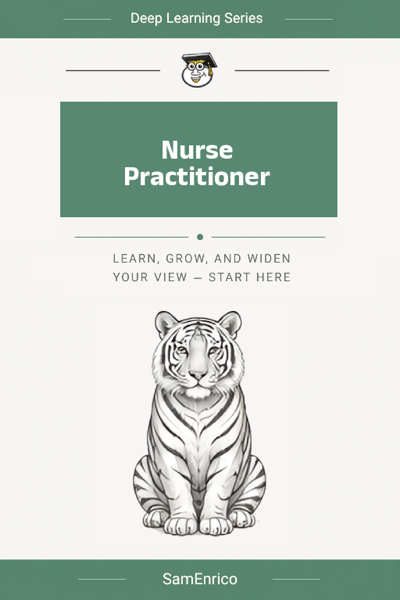
Non-FictionInformativeEducational
Nurse Practitioner eBook
A Coursebook on Nurse Practitioner
A Coursebook on Nurse Practitioner
Formats
Free sample
Chapter 1: The Birth of a Movement...--–- The year is 1965. Dr. Henry Silver, a pediatrician at the University of Colorado, watches a seasoned public health nurse named Loretta Ford examine a child with a persistent cough. The nurse does something remarkable: she listens to the mother's story about the family's eviction notice, notices the child's borderline fever, checks the immunization record, and adjusts the antibiotic dose—all without consulting a physician. Silver later tells Ford, "That was better care than most of my residents provide.
Why aren't you doing this full-time?" Ford replies, "Because no one has given me permission."This book is about what happened after Ford decided she did not need permission. It is about the hundreds of thousands of nurses who followed her into a new profession, one they had to invent as they went. And it is about you, the reader, who will inherit a role that remains unfinished, contested, and more necessary than ever.The nurse practitioner (NP) role did not emerge from a committee or a white paper. It came from a crisis. In the mid-1960s, the United States faced a severe shortage of primary care physicians, particularly in rural and underserved urban communities.
Children were going without well-child checks. Elderly patients with chronic diseases were cycling through emergency rooms because no clinic would see them. The federal government declared a health workforce crisis, but the solutions on offer were slow and expensive: build more medical schools, train more physicians over the course of a decade.Loretta Ford, then a faculty member at the University of Colorado School of Nursing, had a different idea. What if experienced nurses—already educated, already licensed, already trusted by patients—could be trained to perform parts of the physical exam, diagnose common conditions, and prescribe treatments? What if nursing did not have to stay in the waiting room, handing the patient off to a physician at the door of the exam room?The idea was heresy to some.
The American Medical Association initially opposed expanded nursing roles, arguing that only physicians could diagnose and treat. Hospital administrators worried about liability. Some nurses themselves resisted, fearful that taking on "medical" tasks would erode the distinctive identity of nursing as a caring, holistic profession. Ford and Silver pressed forward anyway. In 1965, they launched the first pediatric nurse practitioner program at the University of Colorado.
The curriculum was four months of intensive classroom instruction followed by a supervised preceptorship. The first graduates entered clinics in rural Colorado and proved, within two years, that they could provide high-quality primary care at lower cost than physicians, with equal or better outcomes on measures like patient satisfaction and preventive care delivery.That was the birth. What followed was a movement.The First Decade: Spreading the Flame (1965-1975)Within five years of the Colorado program, the federal government began funding NP training through the Nurse Training Act of 1971. Schools across the country launched their own programs: the University of Washington in family practice, Boston College in geriatrics, Vanderbilt in pediatrics. Most programs targeted specific populations because the NP role was not yet a generalized "advanced practice" degree but rather a set of specialized certificates.
A pediatric NP could not easily transition to adult care, and a family NP certificate barely existed.The early NP pioneers faced three immediate battles. First, legal scope: most state nurse practice acts defined nursing as "assisting under the direction of a physician." Prescribing medication was explicitly illegal for nurses in almost every state. Early NPs had to practice under "standing orders" or "delegation" protocols, where a physician signed off on every chart after the fact—a workaround that satisfied the letter of the law but not the spirit of autonomous practice.Second, reimbursement: Medicare and Medicaid, the nation's largest payers, did not recognize NPs as providers. If an NP saw a patient, the clinic could bill only for "incident to" physician services, meaning the physician had to be physically present in the office suite. This made NP practices financially precarious.Third, professional identity: Were NPs "physician extenders" (a term many detested) or "advanced practice nurses" (a term that implied continuity with nursing's values)?
The distinction mattered because it shaped education. If NPs were physician extenders, they should be trained by physicians in medical schools. If they were advanced nurses, they should be trained by nurses in nursing schools. The University of Colorado model kept programs in nursing schools, a decision that would define NP education for the next half-century.By 1975, an estimated 10,000 NPs practiced in the United States. Most worked in rural clinics, community health centers, and children's hospitals.
They were predominantly women (over 95 percent) and predominantly white (over 90 percent)—a demographic profile that would take decades to shift. They were also underpaid, often earning less than experienced staff nurses despite having advanced training and greater responsibility. But they stayed, because they believed in what they were building.The Formative Years: Standardization and Struggle (1975-1990)The late 1970s brought a crucial organizational milestone: the founding of the National Organization of Nurse Practitioner Faculties (NONPF) in 1974 and the American Academy of Nurse Practitioners (AANP) in 1985. These organizations did two things. First, they created standards: a core curriculum that all NP programs should teach, regardless of specialty.
Second, they created certification examinations: voluntary tests that allowed NPs to prove their competence to employers, state regulators, and the public.The first certification exam for family NPs was offered in 1976 through the American Nurses Credentialing Center (ANCC). A second certifying body, the American Academy of Nurse Practitioners Certification Board (AANPCB), followed in the 1990s. These exams covered four domains: advanced health assessment, advanced pathophysiology, advanced pharmacology, and clinical management of common conditions. Passing the exam signaled to the world that an NP knew what she needed to know—even if the law had not yet caught up.The 1980s were a decade of regulatory patchwork. Some states, like Washington and Oregon, passed laws granting NPs prescriptive authority.
Others, like Alabama and Florida, kept tight restrictions, requiring direct physician supervision for every prescription. The federal government took a small but symbolically important step in 1983 when Congress authorized direct reimbursement for NPs under Medicaid (but not Medicare). In 1990, the Omnibus Budget Reconciliation Act extended direct Medicare reimbursement to NPs in rural areas—but not yet in cities or suburbs.During these same years, the NP role expanded internationally. Canada launched its first NP programs in the 1970s, but uptake was slow until the 1990s, when provinces began standardizing education and expanding scope. Today, Canadian NPs have full practice authority in most provinces, work within a publicly funded health system, and are particularly active in northern and Indigenous communities.
The United Kingdom developed a different model: the Advanced Practitioner role, which requires a master's degree but shares many functions with US NPs. UK advanced practitioners work in the National Health Service, often in emergency departments and urgent care centers. Australia took yet another path, requiring national registration through AHPRA (Australian Health Practitioner Regulation Agency) and offering endorsement for NP practice after a master's degree and 5,000 hours of advanced practice experience. Australian NPs have prescribing authority and can refer for diagnostic imaging, but they cannot…
This is the end of the free sample. Get the eBook to keep going. Buy now
About this book
Details
- Author
- Asbury Freida
- Publisher
- SamEnrico
- Language
- English
- Genre
- Non-Fiction, Informative, Educational
- Released
- 2026-05-11
- Pages (approx.)
- 159
- Available as
- eBook, Audiobook

Read better in the ZLOADR app
Your eBooks on your phone or tablet. Sign in with your SamEnrico account and start reading.
More by Asbury Freida
 Dealing With Spiritual DisappointmentAsbury Freida$11.99
 TM Writer CreativityAsbury Freida$11.99
 Night Stalker Witness TestimonyAsbury Freida$11.99
 Imposter Syndrome in TeachingAsbury Freida$11.99
 Hamstring Flexibility PlanAsbury Freida$11.99
 Einstein at the Edge of the World: Relativity, Revolution, and the Pacific Voyage of 1922Asbury Freida$11.99
 The Pillars of Power: How the Sackler Family Built an Empire on OpioidsAsbury Freida$11.99
 UN Legal Affairs CareerAsbury Freida$12.99
 Provisional Patent ConversionAsbury Freida$12.99
 Understanding Craniosynostosis Synostoses Hypertensive NephropathyAsbury Freida$17.99
 How to Start a Casein Production Business (Beginners Guide)Asbury Freida$11.99
You may also like
 Hong Kong Handover 1997Dunn Johnnie$11.99
 Zumba For Postnatal Recovery CourseNeal Christian$11.99
 Zumba for BeginnersLadner Nikia$11.99
 YouTube Comment Mining GuideHumes Pandora$12.99
 Worry Box MeditationCarlin Rudy$11.99
 Workplace Stress MeditationNguyen Lynn$11.99
 Workplace Stress and Sleep RepairHawley Ivory$11.99
 Workplace Perfectionism CureDelaney Jeffry$11.99
 Workplace Injustice Anger GuideWallen Isabelle$11.99
 Work Addiction and Burnout LinkGreenwood Ester$11.99
 Women in Yoga and WellnessBeattie Galina$11.99
 Women in Stand Up ComedyChun Evangeline$11.99