
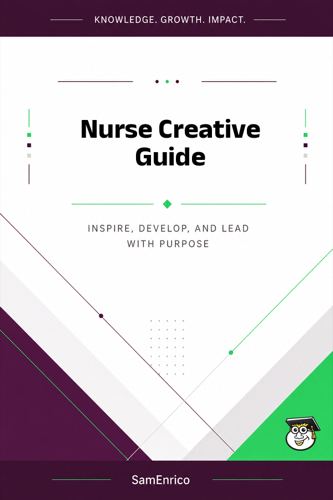
Non-FictionSelf-HelpNursing Creativity
Nurse Creative Guide eBook
Innovate patient comfort and workflow using this p
Innovate patient comfort and workflow using this practical creativity workbook for nursing.
Formats
Free sample
Chapter 1: The Protocol Paradox...–- Sarah had followed every protocol perfectly. The medication was correct, the dosage was precise, the timing was exact, and the patient was still miserable. Not because of pain, not because of a complication, but because the thin hospital pillow slid off the bed rail every time she tried to rest, and the call light button was just out of reach, and the overhead light buzzed directly into her eyes. None of these problems had a protocol. None of them would appear on a quality measure.
And none of them were Sarah’s fault. Yet when she walked out of that room at 7:30 AM, she felt like she had failed.This is the quiet crisis of modern nursing. You have been trained to be brilliant at responding to the predictable—the cardiac arrest, the medication interaction, the wound that isn't healing. But the daily, grinding, soul-draining exhaustion of shift work rarely comes from the emergencies. It comes from the thousand small frictions that no protocol can fix.
The patient who cannot reach the water. The confused elder who will not stop pulling at the IV. The supply cart that is missing the one thing you need. The ten minutes wasted walking back and forth because someone rearranged the linen closet.You have been told that competence means following the rules. You have been told that excellence means catching errors before they happen.
Both are true. But they are not the whole truth. The whole truth is that protocols are necessary and insufficient. They keep patients alive. They do not keep patients comfortable.
They prevent harm. They do not create healing. And in the gap between what protocols require and what human beings need, there is a space where creativity lives. This book is about claiming that space.The Untold Story of Nursing Excellence For decades, nursing literature has celebrated two kinds of thinking. The first is critical thinking—the ability to assess a situation, identify what is wrong, and apply the correct protocol or intervention.
This is the backbone of safe care. The second is clinical judgment—the wisdom that comes from experience, the gut feeling that something is off, the pattern recognition that allows an experienced nurse to see what a new graduate misses. Both are essential. Both are taught in every nursing program in the country.But there is a third kind of thinking that is almost never named, almost never taught, and almost never celebrated in annual reviews. That is creative thinking—the ability to see a gap between what is and what could be, and to build a bridge using whatever materials are at hand.
Creative thinking is what allows a nurse to turn a blue isolation gown into a calm-inducing visual screen for an agitated patient. It is what allows a nurse to realize that the medication cart can be rearranged to save twelve steps per hour, which adds up to an hour per week, which adds up to a week per year. It is what allows a nurse to look at a patient who cannot speak English and realize that a set of hand-drawn icons on the whiteboard will communicate more than a thousand words of discharge instructions.Creative thinking is not mysterious. It is not reserved for artists or inventors or people with "creative" in their job titles. It is a teachable, repeatable, trainable skill.
And it is the single most underleveraged asset in nursing today.Why Protocols Matter (And Why They Are Not Enough)Let us be absolutely clear. This chapter is not an argument against protocols. Protocols save lives. They reduce variation. They ensure that a patient in Room 203 receives the same evidence-based care as a patient in Room 204.
They protect nurses from liability. They provide a shared language across shifts and disciplines. Without protocols, healthcare would be chaos.But protocols have limits. They are designed for the average patient in the average situation. No patient is average.
Every patient arrives with a unique body, a unique history, a unique set of fears and preferences and limitations. The protocol for preventing pressure ulcers tells you to turn the patient every two hours. It does not tell you how to convince a terrified, demented elder to allow the turn. The protocol for medication administration tells you to confirm identity and check for allergies. It does not tell you how to help a patient who cannot swallow the pill.
The protocol for fall prevention tells you to keep the bed low and the call light within reach. It does not tell you what to do when the patient is too confused to remember that the call light exists.This is the Protocol Paradox: the more we rely on protocols to standardize care, the more we encounter situations that fall between the protocols. And in those gaps, patients suffer, nurses frustrate, and time is wasted.Consider the work of Sharon Hudacek, whose book Making a Difference collected the stories of nurses who transformed patient care through what she called "aesthetic knowing"—the kind of knowledge that cannot be written in a procedure manual. One nurse described caring for a young woman dying of cancer who could no longer tolerate the smell of hospital food. The protocol said to offer the prescribed diet.
The nurse ignored the protocol, went to the cafeteria, and brought back the patient's grandmother's soup recipe, made by the kitchen staff. The patient ate. The patient smiled. The patient died three days later, having tasted something familiar. No protocol could have produced that moment.That is creative thinking.
Not reckless. Not dangerous. But deeply, fiercely human.The Three Faces of Nurse Creativity Not all creative nurses solve problems the same way. Through years of observing and interviewing innovative nurses, researchers have identified three distinct creative styles that appear again and again. You will likely recognize yourself in one or two of them.
None is better than the others. Each is valuable. And each requires a different kind of support to flourish.The Tinkerer The Tinkerer sees the physical environment as a set of raw materials waiting to be repurposed. When something doesn't work, the Tinkerer's first instinct is to take it apart, turn it around, or combine it with something else. Tinkerers are the nurses who figure out that the plastic ring from a saline lock can hold a drainage tube in place.
They are the nurses who realize that a blood pressure cuff can be repurposed as a gentle restraint for a confused patient who keeps pulling at lines. They are the nurses who look at a standard hospital gown and see a dozen different ways to tie it for patients with different mobility limitations.The Tinkerer's gift is resourcefulness. The Tinkerer's blind spot is a tendency to focus on the immediate physical fix rather than the systemic pattern. A Tinkerer might solve the same supply cart problem twenty times without realizing that the solution is to change the supply ordering system.If you are a Tinkerer, your creativity warm-up is to spend five minutes observing a single routine task—any task—and ask yourself: What could be rearranged, replaced, or removed to make this task faster, easier, or more…
This is the end of the free sample. Get the eBook to keep going. Buy now
About this book
Details
- Author
- Otero Angelia
- Publisher
- SamEnrico
- Language
- English
- Genre
- Non-Fiction, Self-Help, Nursing Creativity
- Released
- 2026-06-06
- Pages (approx.)
- 139
- Available as
- eBook, Audiobook

Read better in the ZLOADR app
Your eBooks on your phone or tablet. Sign in with your SamEnrico account and start reading.
More by Otero Angelia
 Mindful Commute HandbookOtero Angelia$11.99
 Goodbye Dear Friend GuideOtero Angelia$11.99
 The Anticipatory Complicated Grief GuideOtero Angelia$11.99
 The Empathy for Partners GuideOtero Angelia$11.99
 Blood and Blossoms: The Forbidden Love of Empress Wu ZetianOtero Angelia$11.99
 Understanding Stickler Syndrome, Type 2Otero Angelia$17.99
 How to Become a Pipe StripperOtero Angelia$11.99
 Contract Lifecycle AutomationOtero Angelia$12.99
 Time Tracking AI GuideOtero Angelia$12.99
 Chantecler Chicken BreedingOtero Angelia$11.99
You may also like
 Hong Kong Handover 1997Dunn Johnnie$11.99
 Zumba For Postnatal Recovery CourseNeal Christian$11.99
 Zumba for BeginnersLadner Nikia$11.99
 YouTube Comment Mining GuideHumes Pandora$12.99
 Worry Box MeditationCarlin Rudy$11.99
 Workplace Stress MeditationNguyen Lynn$11.99
 Workplace Stress and Sleep RepairHawley Ivory$11.99
 Workplace Perfectionism CureDelaney Jeffry$11.99
 Workplace Injustice Anger GuideWallen Isabelle$11.99
 Work Addiction and Burnout LinkGreenwood Ester$11.99
 Women in Yoga and WellnessBeattie Galina$11.99
 Women in Stand Up ComedyChun Evangeline$11.99