
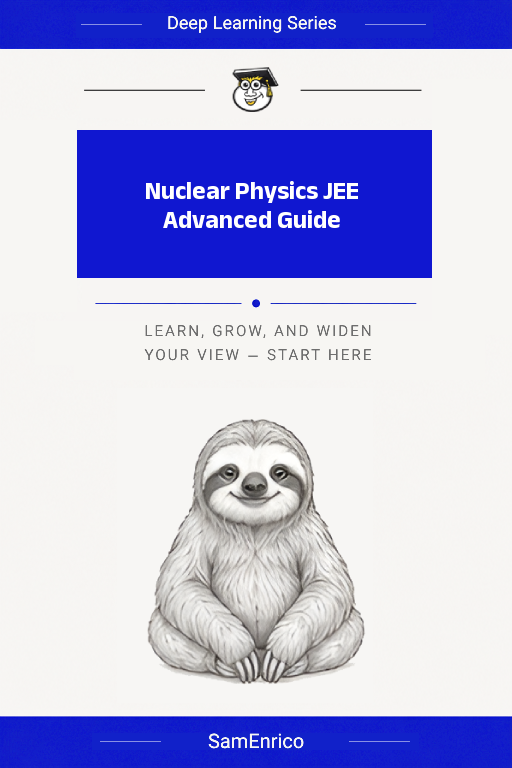
Nuclear Physics JEE Advanced Guide eBook
Solve binding energy decay law and fission fusion
by Adame Liz
Solve binding energy decay law and fission fusion problems using mass defect concepts.
Formats
Free sample
Chapter 1: The Currency of Creation–- In the entire universe, from the blazing core of a star to the silent, sterile laboratory of a JEE aspirant, there exists one immutable law that governs all nuclear reactions: mass is never lost; it is merely exchanged for energy at an exchange rate of 931.5 Me V per atomic mass unit. This chapter is not an introduction—it is a declaration of independence from rote memorization. You will not be told to remember that 1 u equals 931.5 Me V/c²; you will derive it, understand it, and wield it as your primary weapon in every nuclear physics problem you will face in JEE Advanced. By the time you finish these pages, the number 931.5 will be as natural to you as 3.14 is for circles.The Problem with Rote Learning Most JEE preparation books present the mass-energy equivalence as a fait accompli: "1 u = 931.5 Me V/c². Memorize it." This approach is not merely lazy—it is dangerous.
When you memorize without understanding, you become brittle. Change the units, alter the context, or present the data in a slightly different format, and the memorized student crumbles. The JEE Advanced examination is explicitly designed to punish such brittleness.Consider what happens when you simply memorize the conversion factor. You cannot derive it under stress. You cannot check if your answer is reasonable because you do not know where the number came from.
You cannot adapt when the problem gives masses in kilograms or energies in joules. You become dependent on the crutch of memory rather than the strength of understanding.This chapter takes the opposite approach. We will build the conversion factor from first principles, brick by brick, using only the definition of the atomic mass unit, the speed of light, and the conversion between electron volts and joules. By the end, you will not need to remember 931.5—you will be able to produce it on demand, and more importantly, you will understand what it truly means.The Absolute Anchor: Carbon-12All of nuclear mass measurement begins with a single, carefully chosen reference point: the carbon-12 atom. In 1961, the international scientific community agreed that the atomic mass unit (symbolized as u) would be defined as exactly one-twelfth of the mass of a neutral carbon-12 atom in its ground state.Why carbon-12?
The choice was not arbitrary. Carbon-12 has six protons and six neutrons, making it conveniently symmetric. Its nucleus is stable, abundant in nature, and can be studied with high precision in mass spectrometers. By defining the unit in terms of a specific isotope, scientists created an absolute, reproducible standard that does not depend on any particular measurement device.Let us write this definition mathematically:1 u=112×m(12C)1 \text{ u} = \frac{1}{12} \times m(^{12}\text{C})1 u=121×m(12C)Where m(12C)m(^{12}\text{C})m(12C) is the mass of a neutral carbon-12 atom, including its six electrons. This definition is the foundation upon which every nuclear mass measurement rests.
When you see a table of atomic masses (like "H-1: 1.007825 u" or "He-4: 4.002603 u"), each value is expressed relative to this carbon-12 standard.Here is the critical insight that most students miss: the atomic mass unit is not a fundamental constant of nature like the speed of light or Planck's constant. It is a human-defined convenience. We chose carbon-12 as our ruler. We could have chosen oxygen-16 (as was done historically) or any other stable nucleus. The physics does not care about our choice of units—only the numbers change.This means you should never feel intimidated by the atomic mass unit.
It is just a ruler. And like any ruler, you can convert it to other units using the laws of physics. That conversion is exactly what we will do next.From Atomic Mass Units to Energy: The Derivation The journey from mass to energy begins with Einstein's most famous equation, but we must understand what this equation actually says. E=mc2E = mc^2E=mc2 does not mean "mass can be turned into energy" in the way that water can be turned into steam. Rather, it states that mass and energy are two manifestations of the same underlying quantity.
Any object with mass has an associated rest energy. Any process that changes the mass of a system must release or absorb the corresponding amount of energy.For nuclear reactions, the change in mass is tiny—typically a fraction of an atomic mass unit. But because c2c^2c2 is enormous (9×10¹⁶ m2/s29 \times 10^{16} \text{ m}^2/\text{s}^29×1016 m2/s2), even a tiny mass change corresponds to a substantial energy release. This is why nuclear reactions are millions of times more energetic than chemical reactions.Our goal is to find the energy equivalent of 1 atomic mass unit. That is, if we could convert 1 u entirely into energy, how many electron volts would we obtain?
The calculation proceeds in three clear steps: convert mass to kilograms, compute energy in joules using E=mc2E = mc^2E=mc2, and then convert joules to electron volts.Step 1: Determine the mass of 1 atomic mass unit in kilograms.We start with the definition of the mole. One mole of carbon-12 atoms has a mass of exactly 12 grams (0.012 kg) by definition. And one mole contains Avogadro's number of atoms, NA=6.02214076×10²³ mol−1N_A = 6.02214076 \times 10^{23} \text{ mol}^{-1}NA=6.02214076×10²³ mol−1.Therefore, the mass of a single carbon-12 atom is:m(12C)=0.012 kg NA=0.0126.02214076×1023 kgm(^{12}\text{C}) = \frac{0.012 \text{ kg}}{N_A} = \frac{0.012}{6.02214076 \times 10^{23}} \text{ kg}m(12C)=NA0.012 kg=6.02214076×10230.012 kg Performing this division:m(12C)=1.992646×10⁻²⁶ kgm(^{12}\text{C}) = 1.992646 \times 10^{-26} \text{ kg}m(12C)=1.992646×10⁻²⁶ kg Now, by definition, 1 atomic mass unit is one-twelfth of this mass:1 u=112×1.992646×10−26 kg1 \text{ u} = \frac{1}{12} \times 1.992646 \times 10^{-26} \text{ kg}1 u=121×1.992646×10−26 kg1 u=1.660539×10⁻²⁷ kg1 \text{ u} = 1.660539 \times 10^{-27} \text{ kg}1 u=1.660539×10⁻²⁷ kg This number—1.660539×10−271.660539 \times 10^{-27}1.660539×10⁻²⁷ kg—is the mass of 1 u in SI units. Commit it to memory if you wish, but more importantly, remember how we obtained it. It came from the definition of the mole and Avogadro's number, nothing more mysterious than that.Step 2: Convert this mass to energy in joules using E=mc2E = mc^2E=mc2.The speed of light in vacuum is c=2.99792458×10⁸ m/sc = 2.99792458 \times 10^8 \text{ m/s}c=2.99792458×108 m/s (exactly, by definition since 1983).
Therefore:E=(1.660539×10⁻²⁷ kg)×(2.99792458×10⁸ m/s)2E = (1.660539 \times 10^{-27} \text{ kg}) \times (2.99792458 \times 10^8 \text{ m/s})^2E=(1.660539×10−27 kg)×(2.99792458×10⁸ m/s)2First compute c2c^2c2:c2=(2.99792458×10⁸)2=8.987551787×10¹⁶ m2/s2c^2 = (2.99792458 \times 10^8)^2 = 8.987551787 \times 10^{16} \text{ m}^2/\text{s}^2c2=(2.99792458×108)2=8.987551787×1016 m2/s2Now multiply:E=1.660539×10−27×8.987551787×1016E = 1.660539 \times 10^{-27} \times 8.987551787 \times 10^{16}E=1.660539×10−27×8.987551787×1016E=1.492418×10⁻¹⁰ JE = 1.492418 \times 10^{-10} \text{ J}E=1.492418×10⁻¹⁰ JThis is the rest energy of 1 atomic mass unit, expressed in joules. It is a small number in human terms—about the energy of a single bacterium falling one millimeter—but remember, we are dealing with individual nuclei. For a macroscopic sample containing trillions of nuclei, the energy becomes enormous.Step 3: Convert joules to electron volts.An electron volt (e V) is defined as the kinetic energy gained by a single electron when accelerated through a potential difference of 1 volt. Since the electron charge is e=1.60217662×10⁻¹⁹e = 1.60217662 \times 10^{-19}e=1.60217662×10⁻¹⁹ coulombs:1 e V=1.60217662×10⁻¹⁹ J1 \text{ e V} = 1.60217662 \times 10^{-19} \text{ J}1 e V=1.60217662×10⁻¹⁹ JTherefore, to convert our energy from joules to electron volts, we divide:E=1.492418×10⁻¹⁰ J1.60217662×10−19 J/e VE = \frac{1.492418 \times 10^{-10} \text{…
This is the end of the free sample. Get the eBook to keep going. Buy now
About this book
Details
- Author
- Adame Liz
- Publisher
- SamEnrico
- Language
- English
- Genre
- Non-Fiction, Student's Shortcut
- Released
- 2026-05-30
- Pages (approx.)
- 157
- Available as
- eBook, Audiobook

Read better in the ZLOADR app
Your eBooks on your phone or tablet. Sign in with your SamEnrico account and start reading.
More by Adame Liz
 The Nobel Laureate CompetitionsAdame Liz$11.99
 Body Image After Weight Change GuideAdame Liz$11.99
 Nobel Laureates In Blue LED InventionAdame Liz$11.99
 Work Addiction Therapy GuideAdame Liz$11.99
 Probate Avoidance GuideAdame Liz$11.99
 Finger Pointing as AggressionAdame Liz$11.99
 Badlands Missing CasesAdame Liz$11.99
 Mindful Tea DrinkingAdame Liz$11.99
 Filarete's Vision: The Unseen Genius Behind Renaissance ArchitectureAdame Liz$11.99
 The Marble and the Machine: Rome's Lost Engineering SecretsAdame Liz$11.99
 Growing CotoneasterAdame Liz$11.99
 CTA for Accounting FirmsAdame Liz$12.99
You may also like
 Hong Kong Handover 1997Dunn Johnnie$11.99
 Zumba For Postnatal Recovery CourseNeal Christian$11.99
 Zumba for BeginnersLadner Nikia$11.99
 YouTube Comment Mining GuideHumes Pandora$12.99
 Worry Box MeditationCarlin Rudy$11.99
 Workplace Stress MeditationNguyen Lynn$11.99
 Workplace Stress and Sleep RepairHawley Ivory$11.99
 Workplace Perfectionism CureDelaney Jeffry$11.99
 Workplace Injustice Anger GuideWallen Isabelle$11.99
 Work Addiction and Burnout LinkGreenwood Ester$11.99
 Women in Yoga and WellnessBeattie Galina$11.99
 Women in Stand Up ComedyChun Evangeline$11.99