
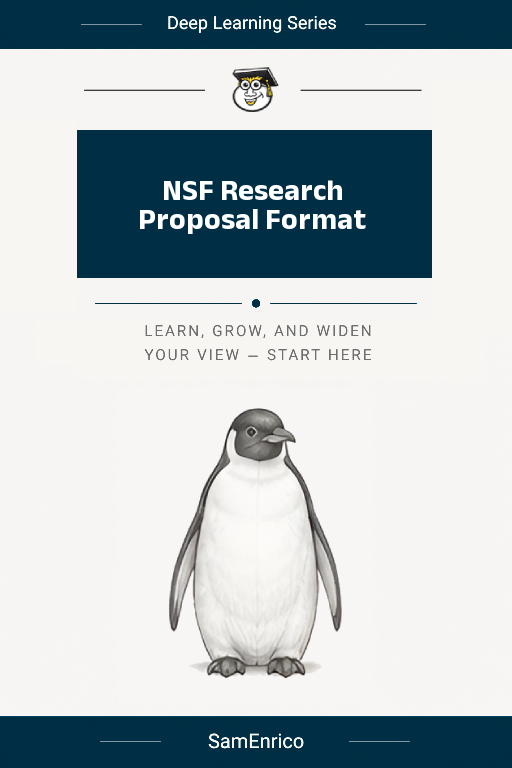
NSF Research Proposal Format
Format proposals for NSF including project summary
Format proposals for NSF including project summary description and references with strict page limits and sections.
Formats
About this book
Free sample
Chapter 1: The PAPPG Decoder--–- Most researchers treat the NSF Proposal & Award Policies & Procedures Guide (PAPPG) as a doorstop. It is 400+ pages of dense, single-spaced federal prose that changes every year. They print it, place it on a shelf, and never open it again. Instead, they ask a senior colleague, “What’s the font again?” or search online for “NSF proposal template.” This is the first and most expensive mistake a grant seeker can make.The PAPPG is not merely a rulebook. It is your primary strategic weapon.
Within its pages lie the exact instructions for every section, every page limit, and every compliance trigger that separates funded proposals from those that are returned without review (RWR). Yet less than 5% of principal investigators (PIs) read the PAPPG cover to cover. Those who do—who treat it as the first technical document in their proposal development—have an enormous competitive advantage.This chapter decodes the PAPPG. It strips away the bureaucratic jargon and reveals how to use the guide as a living document, not a static manual. You will learn the difference between the standing PAPPG and program-specific solicitations, why RAPID and EAGER proposals are fundamentally different from standard research proposals, and how the transition from Fast Lane to Research.gov changes your submission workflow.
Most importantly, you will understand the single most misunderstood rule in federal grant making: the absolute prohibition on voluntary committed cost sharing.By the end of this chapter, you will never look at the PAPPG as a doorstop again. You will see it for what it is: a roadmap to funding.The PAPPG Is Not a Suggestion Let us begin with a hard truth. The NSF does not publish the PAPPG for your convenience. It publishes it for legal and procedural compliance. Every word, every bullet point, every seemingly arbitrary rule exists because somewhere in the past two decades, a PI tried to exploit a loophole, or an award led to a congressional inquiry, or a reviewer complained about illegible fonts.The PAPPG is incorporated by reference into every NSF grant award.
That means when you sign the proposal submission form, you are legally attesting that you have followed every applicable instruction.…
This is the end of the free sample. Get the eBook to keep going. Buy now
Contents
- Chapter 1
- Chapter 2
- Chapter 3
- Chapter 4
- Chapter 5
- Chapter 6
- Chapter 7
- Chapter 8
- Chapter 9
- Chapter 10
- Chapter 11
- Chapter 12
Details
- Author
- Babcock Ursula
- Publisher
- SamEnrico
- Language
- English
- Genre
- research, Student's Shortcut, NSF Guide, Federal Funding
- Released
- 2026-06-01
- Pages (approx.)
- 157
- Available as
- eBook, Audiobook

Read better in the ZLOADR app
Your eBooks on your phone or tablet. Sign in with your SamEnrico account and start reading.
More by Babcock Ursula
 World Diamond Council ResponseBabcock Ursula$11.99
 Parental Addiction and StrengthBabcock Ursula$11.99
 LBO CapEx RequirementsBabcock Ursula$11.99
 Bariatric Surgery Hair Loss PreventionBabcock Ursula$11.99
 FODMAP Friendly Packaged Foods GuideBabcock Ursula$11.99
 The Last Monarch: Queen Victoria’s Secret War DiariesBabcock Ursula$11.99
 Love in the Lab: The Quinine Quest and the Unlikely Romance That Saved MillionsBabcock Ursula$11.99
 Business Credit for Women FoundersBabcock Ursula$12.99
 Understanding Cataract Congenital Volkmann TypeBabcock Ursula$17.99
 On Call Massage TherapistBabcock Ursula$11.99
 How to Become a DetackerBabcock Ursula$11.99