
Non-FictionProfessional's Cheat SheetPM Tools
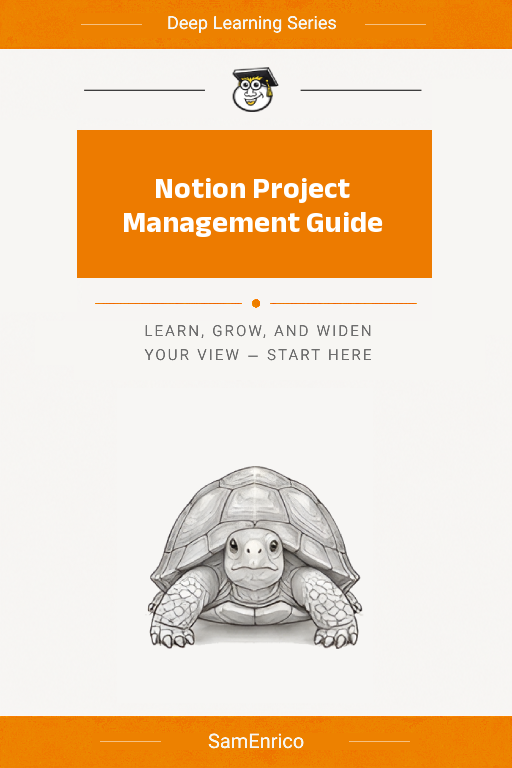
Notion Project Management Guide eBook
Build custom project management systems in Notion.
Build custom project management systems in Notion. Databases, relations, and templates for any workflow.
Formats
Free sample
Chapter 1: The $10,000 To-Do List--–- Sarah had forty-seven tabs open. Trello showed her client tasks. Asana held her agency’s internal projects. Slack contained 1,200 unread messages, three of which contained urgent client requests she’d already forgotten. Her notebook—physical, paper—held a list she’d titled “Things I Keep Forgetting to Put in Trello.” And somewhere in her email inbox, a customer was about to fire her.She didn’t know it yet, but that customer’s email was already twenty-three minutes old.The project was simple: redesign a landing page for a software startup.
The client had paid $4,500 upfront. Sarah had four weeks. She had the skills. She had the team. What she didn’t have was a system.The task lived in Trello, but the deadline lived in her Google Calendar.
The feedback lived in Slack, but the revision checklist lived on a sticky note attached to her monitor. The final assets lived in Dropbox, but the approval lived in an email chain with subject line “Fwd: Fwd: Final (real this time).”On day seventeen, the client asked, “Where are we on the mobile responsiveness fixes?”Sarah had forgotten those fixes entirely.She lost the client. She refunded $4,500. She almost quit freelancing.Sarah’s problem wasn’t talent, work ethic, or even time. Her problem was tool fragmentation.
She wasn’t disorganized because she was lazy. She was disorganized because she was using four different tools to do one job, and none of them talked to each other.This book exists because Sarah’s story happens every day—to freelancers, to startups, to teams of fifty. And the solution isn’t another tool. It’s a different philosophy of tools entirely.The Hidden Cost of “Good Enough” Software Most project management tools are built on a dangerous assumption: that your workflow is predictable enough to fit inside their pre-defined boxes.Trello assumes you work in linear stages. Asana assumes you care about subtasks and portfolios.
Jira assumes you’re a software team with sprints, epics, and a burning desire to customize workflows that still somehow feel rigid. Monday.com assumes you love bright colors and want to pay per seat forever.These tools aren’t bad. They’re just limited. Every feature they include is a feature you can’t change. Every workflow they presuppose is a workflow you must adapt to—or abandon.Here’s what the software industry doesn’t tell you: the average knowledge worker switches between ten different apps every hour.
Each switch costs about twenty-three seconds of “context recovery time.” Do that forty times a day, and you’ve lost fifteen minutes. Do that for a year, and you’ve lost four full workweeks.Four weeks. Every year. Just switching between tools that don’t integrate.But the real cost isn’t time. It’s cognitive load.
Every time you wonder “Where did I put that client approval?” or “Did I already move that task to In Progress?” you’re burning mental energy that should be going to actual work. The bestselling book The Organized Mind calls this “attentional residue”—the碎片 of previous tasks that linger in your brain, reducing your performance on whatever you’re doing right now.Sarah wasn’t bad at her job. She was drowning in attentional residue.The Notion Difference: From User to Builder Notion looks like a note-taking app. That’s its first deception.Open Notion for the first time, and you see a blank page with a slash. Type / and a menu appears: database, table, board, list, calendar.
These aren’t features. They’re invitations. Notion doesn’t say “here’s how you manage a project.” It says “here’s how you build a project management system.”This is the fundamental shift that separates Notion from every other tool on the market.With Trello, you ask: “How do I use Trello for my workflow?”With Asana, you ask: “Which Asana features should I enable?”With Notion, you ask: “What do I want my system to do?” And then you build exactly that.This book will teach you to build. But before we build, we need to understand the architecture. Because the most common reason people fail at Notion isn’t lack of effort—it’s building on a faulty foundation.The Database as a Lego Brick Here’s the metaphor that will guide us through every chapter of this book:Imagine a box of Lego bricks.
Each brick is a simple thing: a rectangle with studs. Alone, it’s useless. But when you connect bricks, you can build anything—a house, a spaceship, a working gear mechanism, a scale model of the Golden Gate Bridge. The power isn’t in any single brick. It’s in the connection system.In Notion, each database is a Lego brick.A database is just a collection of pages with consistent properties.
A “Tasks” database has a “Due Date” property, an “Assignee” property, and a “Status” property. A “Projects” database has a “Budget” property, an “Owner” property, and a “Deadline” property. Alone, each database is useful. But when you connect them—when you tell Notion that each Task belongs to a Project—you create something neither database could do alone.That connection is called a Relation. It’s the stud on top of the Lego brick.
And it’s the single most important feature in this entire book.Most Notion tutorials teach you features: here’s how to make a calendar view, here’s how to write a formula, here’s how to change the color of a page icon. Those are useful. But they’re like teaching someone to hold a hammer without explaining that they’re building a house.This book teaches architecture. By the end of Chapter 4, you will have built the foundational two-database system (Projects and Tasks) that powers ninety percent of custom Notion project management systems. By Chapter 9, you will have automated the repetitive work that currently eats your Mondays.
By Chapter 12, you will have a system that audits itself, scales with your team, and survives your departure for a two-week vacation without breaking.But first, we need to diagnose your current pain.The Workflow Autopsy Before you build anything new, you need to understand what’s broken about your current system. Not because you’re doing something wrong, but because every successful system is a reaction to a specific failure.I want you to perform a Workflow Autopsy. This will take fifteen minutes. Do not skip it. The readers who skip this exercise are the ones who message me six months later saying “I built your system but it doesn’t feel right.” That’s because they built a solution to someone else’s problem.Here’s what you’ll do:Step 1: List every tool you currently use for project management.
Include everything: Trello, Asana, Jira, Monday, Click Up, Basecamp, Airtable, Smartsheet, Google Sheets, paper notebooks, sticky notes, whiteboards, Slack reminders, email flags, calendar events, text messages to yourself. Be honest. I once worked with a client who admitted to using seventeen different task storage locations. Seventeen.Step 2: For each tool, write down one thing it does well and one thing it does…
This is the end of the free sample. Get the eBook to keep going. Buy now
About this book
Details
- Author
- Bethel Trenton
- Publisher
- SamEnrico
- Language
- English
- Genre
- Non-Fiction, Professional's Cheat Sheet, PM Tools
- Released
- 2026-05-29
- Pages (approx.)
- 128
- Available as
- eBook, Audiobook

Read better in the ZLOADR app
Your eBooks on your phone or tablet. Sign in with your SamEnrico account and start reading.
More by Bethel Trenton
 British Pub Chain OwnerBethel Trenton$11.99
 Emotional Regulation For ShameBethel Trenton$11.99
 Addicted Partner BoundariesBethel Trenton$11.99
 Sexual Addiction Relapse PreventionBethel Trenton$11.99
 The Whistleblower: How a Japanese Journalist Exposed Asia's Darkest Sports ScandalBethel Trenton$11.99
 Laravel DeveloperBethel Trenton$11.99
 Learn to Play the FusetarBethel Trenton$11.99
 How to Start a Activity Centre (sports) Business (Beginners Guide)Bethel Trenton$11.99
You may also like
 Hong Kong Handover 1997Dunn Johnnie$11.99
 Zumba For Postnatal Recovery CourseNeal Christian$11.99
 Zumba for BeginnersLadner Nikia$11.99
 YouTube Comment Mining GuideHumes Pandora$12.99
 Worry Box MeditationCarlin Rudy$11.99
 Workplace Stress MeditationNguyen Lynn$11.99
 Workplace Stress and Sleep RepairHawley Ivory$11.99
 Workplace Perfectionism CureDelaney Jeffry$11.99
 Workplace Injustice Anger GuideWallen Isabelle$11.99
 Work Addiction and Burnout LinkGreenwood Ester$11.99
 Women in Yoga and WellnessBeattie Galina$11.99
 Women in Stand Up ComedyChun Evangeline$11.99