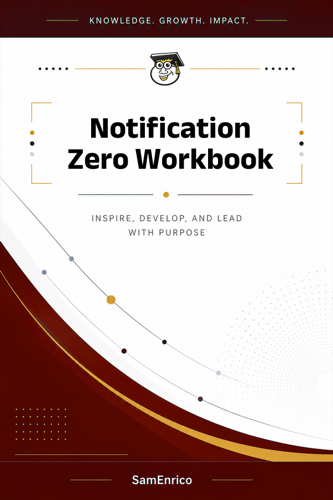
Notification Zero Workbook eBook
Guides users to achieve zero unnecessary notificat
by Jenson Cyrus
Guides users to achieve zero unnecessary notifications per hour through systematic app permission reviews and focus modes.
Formats
Free sample
Chapter 1: The 25-Minute Heist--–- Your phone buzzes. You glance down. A notification. You swipe it away in less than two seconds and return to what you were doing. No harm, right?
That single ping just cost you twenty-five minutes of your life. Not the two seconds you saw on the screen—twenty-five minutes. This is not an exaggeration. This is the most expensive, least understood tax of the digital age. And you have been paying it hundreds of times per day without ever receiving a receipt.The silence after that statement is uncomfortable.
Let it sit. Because everything you believe about your phone's interruptions is wrong. You think each notification is a minor nuisance, a small crack in your focus that you can quickly seal. The research says otherwise. Every time your brain shifts from a deep task to a notification and back again, you lose momentum, working memory, and creative flow.
The switch itself—not the notification, but the act of switching—costs up to twenty-five minutes of cognitive recovery. That means if you receive four notifications in an hour, you may have just lost your entire productive window. Not because you were distracted for long, but because you never truly returned.This chapter is not here to make you feel guilty. Guilt is useless. This chapter is here to show you the true price of the ping so that you can make an informed decision about whether you want to keep paying it.
Most people, once they see the math, decide they do not.The Attention Economy Does Not Want You to Read This Chapter You are not lazy. You are not undisciplined. You are not addicted because you have a character flaw. You are caught in an environment that has been deliberately engineered to capture and hold your attention for profit. This is not conspiracy theory.
This is the business model of nearly every free app on your phone.The "attention economy" is a term coined by Nobel Prize-winning economist Herbert Simon in 1971, long before smartphones existed. Simon observed that in an information-rich world, the scarce resource is not information—it is the attention required to process that information. Fast forward fifty years, and tech companies have turned this observation into a trillion-dollar industry. Your attention is the product. Your time is the inventory.
And notifications are the primary extraction tool.Every time you see a "like," a breaking news alert, a sale notification, or a "your friend posted" ping, you are watching an AI that has been trained on millions of users' behavior to know exactly when you are most vulnerable. The notification arrives during a moment of boredom, right after you finished a difficult task, or late at night when your willpower reserves are depleted. This is not coincidence. This is machine learning.The Lopsided Arms Race Here is what most people do not understand: you are fighting a lopsided arms race. On one side is your human brain, which evolved in an environment without screens, without alerts, without infinite scrolling.
Your brain is ancient hardware running on prehistoric software. On the other side are thousands of engineers, behavioral psychologists, and AI systems whose full-time job is to defeat your attention. They run millions of A/B tests to determine whether a red notification badge gets more clicks than a blue one. They know that variable rewards (sometimes you get a like, sometimes you do not) are more addictive than predictable ones. They have studied your swiping patterns and know exactly how much friction to add or remove to keep you engaged.You are not supposed to win this arms race by willpower alone.
No one could. The people who design these systems do not rely on willpower to avoid their own products—they rely on environmental controls. They put their phones in another room. They use grayscale mode. They have assistants who handle their notifications.
They know that the only way to beat the machine is to stop fighting it directly and instead change the rules of engagement.This book is your rulebook. And it starts with a single, unavoidable truth: you cannot fix what you do not measure.The Hourly Log: Your Baseline Betrayal Before you change a single setting on your phone, you must know what you are up against. The Hourly Log is the single most important exercise in this entire workbook. Every subsequent chapter builds on the data you collect here. Skip this exercise, and you are building a house on sand.For three consecutive days, you will record every single time your phone makes a sound, vibrates, or lights up.
You will not try to change your behavior during these three days. You will not silence notifications or put your phone away. You will act exactly as you normally do, because the goal is to capture your natural baseline—the true, unfiltered chaos of your current notification environment.You will need a notebook, a notes app, or the printable log sheet at the end of this chapter. Each time your phone alerts you, record the following:The time of the notification (to the nearest minute)The app that sent it (Messages, Instagram, Email, Calendar, etc.)Whether you looked at it immediately, looked at it later, or ignored it A one-word description of what you were doing when it arrived (working, eating, talking, scrolling, sleeping, driving)That is it. Do not judge yourself.
Do not try to hide bad data. Do not skip logging because you are embarrassed about how many notifications you receive. The data is not a reflection of your worth—it is a reflection of the environment you have been placed in.After three days, you will calculate your Ping Rate. This is the book's central metric, and you will track it throughout the thirty-day program. Ping Rate is simply the total number of notifications you received divided by the number of waking hours you logged.
For example, if you received 180 notifications over three sixteen-hour days (forty-eight waking hours total), your Ping Rate is 180 divided by 48, which equals 3.75 notifications per hour. That number may sound low, but remember: each notification costs up to twenty-five minutes of cognitive recovery. At a Ping Rate of 4, you are losing nearly two hours of deep focus every single day.The typical user in the workbook's testing phase had a Ping Rate between fifteen and forty notifications per hour. If your number falls in that range, you are normal. You are also losing between six and sixteen hours of cognitive focus per day.
Not time—focus. The difference matters.The Switch Cost: Why Two Seconds Is Never Two Seconds You need to understand the neuroscience behind the number, or you will not believe it. The "switch cost" effect has been studied for decades, long before smartphones existed. The foundational research comes from Dr. Gloria Mark at the University of California, Irvine, who has spent over twenty years studying how interruptions affect knowledge workers.Here is what Dr.
Mark discovered: when you are interrupted, it takes an average of twenty-three minutes and fifteen seconds to return to the original task with the same level of focus. Not to return to the task—that…
This is the end of the free sample. Get the eBook to keep going. Buy now
About this book
Details
- Author
- Jenson Cyrus
- Publisher
- SamEnrico
- Language
- English
- Genre
- Non-Fiction, Self-Help, Notification Management
- Released
- 2026-06-09
- Pages (approx.)
- 137
- Available as
- eBook, Audiobook

Read better in the ZLOADR app
Your eBooks on your phone or tablet. Sign in with your SamEnrico account and start reading.
More by Jenson Cyrus
 Metta for Self Compassion FirstJenson Cyrus$11.99
 Self Hypnosis for SurfingJenson Cyrus$11.99
 Houseparty Video Chat AddictionJenson Cyrus$11.99
 The Carnival of Shadows: Havana’s Secret Battle for Freedom Through MusicJenson Cyrus$11.99The Carnival of Shadows: Havana’s Secret Battle for Freedom Through MusicJenson Cyrus$11.99
 Multi Currency Account HandbookJenson Cyrus$12.99
 How to Produce Air Conditioner AccessoriesJenson Cyrus$11.99
 Seligmannite MiningJenson Cyrus$11.99
 A Beginners Guide to Kho kho (Volume 1)Jenson Cyrus$11.99