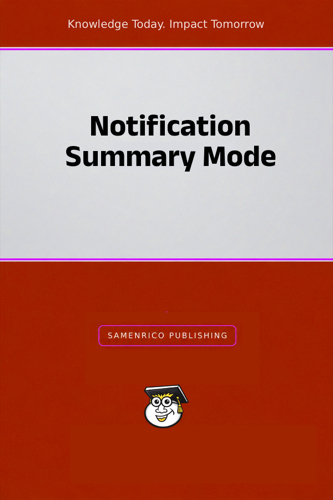
Notification Summary Mode eBook
Bundles all notifications into digest delivered at
by Seal Romaine
Bundles all notifications into digest delivered at designated times only.
Formats
Free sample
Chapter 1: The 23-Minute Heist--–- Anna had been staring at the same paragraph for forty-seven minutes. It was a simple paragraph, really—just eight lines in a technical report she needed to review before her 2 PM meeting. She had read it, reread it, and then read it again. The words were English. The sentences were grammatical.
And yet, nothing was landing.Her phone sat face-up on the corner of her desk, screen dark. It had buzzed twice in the past hour: once for a Slack message from her manager asking if she had seen the updated sales deck, and once for a news alert about a stock market dip she didn't care about. She had glanced at both, dismissed them, and returned to her report. Or rather, she had returned to her chair, her hands on her keyboard, her eyes on the screen. But her brain?
Her brain had taken a much longer route back.This is not a story about Anna's lack of discipline. Anna is a senior marketing director at a mid-sized tech firm. She wakes at 5:30 AM to exercise before her children wake up. She has completed two marathons and a graduate degree while working full-time. By any reasonable measure, Anna has extraordinary self-control.
And yet, on this Tuesday morning, a single Slack message and a stock alert had stolen nearly an hour of her cognitive capacity without her permission.Anna is not the problem. The notification is the problem. More specifically, the architecture of interruption is the problem—a system designed to capture human attention, fragment it into sand, and sell the grains to the highest bidder. This book is the manual for taking those grains back.The Math of Interruption That No One Talks About Let us begin with a number that will change how you think about every buzz, ding, and vibration you experience today: twenty-three minutes.That is not the time it takes to glance at a notification. You already know that takes three to five seconds.
Twenty-three minutes is the average time required to return to a state of deep focus after an interruption. This finding comes from research conducted at the University of California, Irvine, and has been replicated in studies on software developers, radiologists, and office workers across multiple industries. When you switch your attention from a primary task to a secondary stimulus—a phone buzz, an email pop-up, a colleague tapping your shoulder—your brain does not simply pause one activity and resume another. It leaves a residue behind.Attention residue is the term coined by Professor Sophie Leroy at the University of Washington. When you are working on Task A and you switch to Task B, a portion of your cognitive resources remains stuck on Task A.
You are not fully present for Task B, and when you return to Task A, you are not fully present there either. You have effectively reduced your mental processing power by spreading it across two tasks simultaneously, even though you are only performing one at a time.Here is what this means in practice. Anna spent five seconds reading the Slack message from her manager. She spent another four seconds reading the stock alert. Nine seconds total.
But the cost of those nine seconds was not nine seconds. It was the twenty-three minutes required to fully re-engage with her technical report—twenty-three minutes during which her brain was still partially processing the Slack message (Should I respond now? Does my manager expect an answer? Did she see that I read it?) and the stock alert (Should I check my portfolio? Is this the start of a downturn?).Nine seconds of interruption.
Twenty-three minutes of residue. That is a 153-to-1 ratio of cost to trigger time. Every notification you receive is not a five-second inconvenience. It is a potential twenty-three-minute cognitive tax.The Phantom IQ Drop If attention residue were the only cost, that would be bad enough. But there is a second cost, more insidious because it operates even when no notification arrives at all.
Researchers at the University of Texas at Austin conducted a now-famous experiment in which they asked participants to perform a series of cognitive tasks requiring working memory and fluid intelligence—the kind of mental processing you use for problem-solving, analysis, and creative thinking. Before the tasks began, the researchers asked participants to place their smartphones in one of three locations: on the desk face-up, in a pocket or bag, or in another room entirely.The results were stark. Participants who left their phones on the desk performed significantly worse than those who put their phones in another room. But here is the twist: participants who put their phones in their pockets or bags—out of sight but still within reach—performed just as poorly as those who left them on the desk. The only condition that restored full cognitive function was physical separation: the phone had to be in a different room.The researchers called this the brain drain hypothesis.
The mere presence of your smartphone, even when it is silent, even when it is face-down, even when you swear you are ignoring it, consumes a portion of your limited attentional budget. Your brain is constantly, unconsciously monitoring the phone for potential interruptions. It reserves cognitive resources for the task of "being ready to be interrupted," resources that could otherwise be used for deep thought, memory encoding, or creative problem-solving.The effect size is equivalent to a full night of sleep loss. If you pulled an all-nighter and then took an IQ test, your score would drop by roughly the same amount as if you sat down to take that test with your phone on the desk. Your phone does not need to ring to steal your intelligence.
It only needs to exist in your peripheral awareness.The Switch Count: Measuring What You Cannot See Before we go further, you need a baseline. Most people have no idea how many times their attention fragments in a typical work session because the fragmentation has become invisible—background noise, like the hum of a refrigerator or the traffic outside a city apartment. You cannot fix what you cannot measure, so let us measure.For the next two hours of your typical workday, I want you to make a tally mark every time your attention shifts away from your primary task. This includes:Checking your phone for any reason (notifications, time, weather, nothing at all)Glancing at an email that popped up Switching browser tabs to check news, social media, or a different work document Answering a non-urgent chat message Any interruption from a colleague that is not genuinely time-sensitive Any self-interruption—that moment when you think, "I should just quickly check..."You do not need to stop working. You do not need to change your behavior.
You simply need to observe and count. Keep a small piece of paper next to your keyboard or use a tally app that does not itself become a distraction. At the end of two hours, look at your number.Most knowledge workers score between 30 and 60 switches in two hours. A switch every two to four minutes. The highest recorded switch count…
This is the end of the free sample. Get the eBook to keep going. Buy now
About this book
Details
- Author
- Seal Romaine
- Publisher
- SamEnrico
- Language
- English
- Genre
- Non-Fiction, Self-Help, Notification Management
- Released
- 2026-06-11
- Pages (approx.)
- 153
- Available as
- eBook, Audiobook

Read better in the ZLOADR app
Your eBooks on your phone or tablet. Sign in with your SamEnrico account and start reading.
More by Seal Romaine
 Recurring Dreams of AliensSeal Romaine$11.99
 Chiropractic Insurance GuideSeal Romaine$11.99
 The EQ for Dentists GuideSeal Romaine$11.99
 Relapse Prevention WorkbookSeal Romaine$11.99
 Everest Hillary Tenzing AscentSeal Romaine$11.99
 Moses Mendelssohn Enlightenment FightSeal Romaine$11.99
 Creative Constraint RitualSeal Romaine$11.99
 Trance For JealousySeal Romaine$11.99
 The Velvet Underground: How a Secret NYC Club Shaped Rock & RollSeal Romaine$11.99
 The Golden Voices: Black Opera's Triumph Over TimeSeal Romaine$11.99
 The Persian Star Catcher: Nasir al-Din Shah and the First Modern Observatory in IranSeal Romaine$11.99
 Growing Nuphar (Spatterdock)Seal Romaine$11.99