
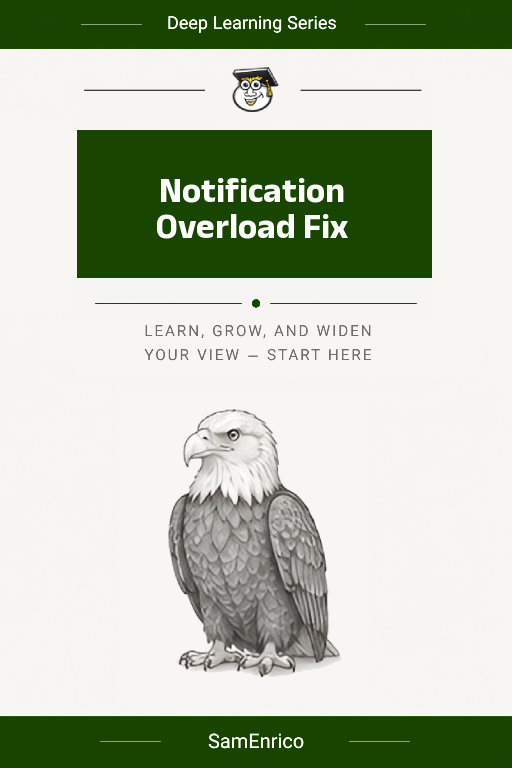
Non-FictionMental WealthFocus RecoveryProductivity Guide
Notification Overload Fix eBook
Reclaim hours lost to email, Slack, and calendar a
Reclaim hours lost to email, Slack, and calendar alerts with batch processing and do-not-disturb modes. Covers notification audit worksheets, VIP contact lists, and emergency-only settings.
Formats
Free sample
Chapter 1: The 23-Minute Thief--The average knowledge worker will lose over 1,200 hours to notification recovery this year. That is not a typo. Based on the 23-minute refocusing penalty and a conservative estimate of fifty interruptions per week, the math is brutal and unforgiving: more than an entire month of waking life vanished into the gap between one ping and the next moment of clarity.You have felt this thief at work. You have sat down to write a report, only to glance at a Slack message that arrived mid-sentence. You have been deep in a spreadsheet, solving a problem that required real concentration, when an email banner dropped down from the top of your screen.
You told yourself it would take only ten seconds to check. That was a lie you believed because the alternative—admitting that your attention is no longer your own—was too painful to accept.This book exists because that lie has become the single greatest drag on professional and personal productivity in the modern era. Not laziness. Not poor time management. Not a lack of willpower.
The problem is structural. The tools you use every day—email, Slack, Outlook, Gmail, calendar alerts—were designed by companies that profit from your distraction. Every ping is a revenue event. Every badge notification is a behavioral conditioning tool. And every time you reflexively check your phone, you are not being productive.
You are being mined.The Quiet Catastrophe of Fragmented Attention Let us begin with a question that most productivity books are afraid to ask: What if you are not the problem? What if your brain is working exactly as it should, and the environment you are operating in has been deliberately engineered to sabotage you?The answer changes everything.For the past fifteen years, neuroscientists and cognitive psychologists have been studying what happens when the human brain switches between tasks. The results are devastating. The human mind is not a computer processor capable of parallel operations. It is a single-threaded machine that does one thing well at a time.
When you force it to switch—from writing to email to Slack and back to writing—you pay a penalty each time.That penalty is called attention residue.When you stop working on Task A to glance at a notification, a portion of your cognitive resources remain stuck on Task A. You cannot fully engage with the notification, and you cannot fully return to Task A afterward. You are in a limbo of half-attention, and you stay there for an average of twenty-three minutes before your brain fully reorients.Twenty-three minutes.Let that number sit with you for a moment. Most people read that statistic and think, Surely that does not apply to me. I am good at multitasking.
But the research is unambiguous. In study after study, from Gloria Mark at the University of California to Sophie Leroy at the University of Washington, the same finding emerges: the human brain does not multitask. It task-switches. And task-switching carries a recovery cost that most people dramatically underestimate.The most shocking part of the research is not the 23-minute figure itself. It is what happens when people are asked to estimate their own recovery time.
The average person believes they can refocus in under two minutes. The gap between perception and reality is the gap between feeling busy and being productive.Your Attention Is Not Free Here is something that no notification setting will ever tell you: You are paying for Gmail, Slack, and Outlook with something far more valuable than a subscription fee. You are paying with your attention.The business model of the modern attention economy is straightforward but rarely stated aloud. Tech companies give you free tools that feel useful. In exchange, they capture your focus and sell it to advertisers, or in the case of workplace tools like Slack, they sell your team's engagement metrics to investors.
Every time you check a notification, you generate value for someone else. Every time you break focus to respond to a non-urgent message, you transfer a small unit of your cognitive bandwidth to a system designed to extract more of the same.This is not a conspiracy theory. This is the public business model of every major communication platform. The only way these companies grow is by increasing the number of times you check their applications. They do not make more money when you are deeply focused on your own work.
They make more money when you are distracted, reactive, and constantly returning to their interfaces.The most successful companies in the world have built entire engineering divisions dedicated to one goal: making their notifications impossible to ignore. Red badges, push alerts, vibration patterns, banner previews, unread counts, typing indicators, read receipts—every single feature has been A/B tested to maximize your engagement. Not your productivity. Your engagement.There is a profound difference between those two words. Engagement means you are using the tool.
Productivity means you are accomplishing your own goals. The tool makers care about the first. You should care about the second.The Dopamine Loop That Owns You To understand why notifications feel impossible to ignore, you need to understand a small but powerful molecule in your brain: dopamine.Popular culture has reduced dopamine to the "pleasure chemical," but that is incomplete. Dopamine is not primarily about pleasure. It is about anticipation.
It is the molecule that drives you to seek rewards, to check for updates, to wonder what you might be missing. The most potent dopamine triggers are not guaranteed rewards. They are variable, unpredictable rewards—the same mechanism that makes slot machines addictive.Your phone is a slot machine.Every time you pull it out of your pocket, you do not know what you will find. Maybe a nice message from a friend. Maybe an angry email from your boss.
Maybe nothing at all. That uncertainty is what keeps you checking. Your brain releases a small pulse of dopamine the moment you reach for your phone, before you have even unlocked it. The anticipation of a potential reward is more neurologically powerful than the reward itself.This is not a weakness in your character. It is a weakness in your ancient brain trying to navigate a modern environment.
The dopamine loop evolved to help you find food, water, and social connection in a resource-scarce world. That same loop is now being hijacked by every application that uses red badges, push notifications, and unread counts.The designers of these tools know exactly what they are doing. They have studied the neuroscience. They have run thousands of experiments. And they have built products that are deliberately, scientifically, provably difficult to resist.You are not losing a battle of willpower.
You are fighting against billions of dollars of engineering designed to make you lose.The True Cost of a Single Interruption Let us move from the abstract to the concrete. What does a 23-minute recovery cost actually look like in a real workday?Imagine you arrive at your desk at 9:00 AM with a clear plan. You have three important tasks to complete before lunch. You open your document, take a deep breath, and begin writing.At 9:12 AM…
This is the end of the free sample. Get the eBook to keep going. Buy now
About this book
Details
- Author
- Simone Mirtha
- Publisher
- SamEnrico
- Language
- English
- Genre
- Non-Fiction, Mental Wealth, Focus Recovery, Productivity Guide
- Released
- 2026-05-27
- Pages (approx.)
- 140
- Available as
- eBook, Audiobook

Read better in the ZLOADR app
Your eBooks on your phone or tablet. Sign in with your SamEnrico account and start reading.
More by Simone Mirtha
 Global Influencer Disclosure LawsSimone Mirtha$11.99
 Car Wash Operation Portuguese TwistSimone Mirtha$11.99
 From Statehouse to SenateSimone Mirtha$11.99
 Writing Goal Action PlanSimone Mirtha$11.99
 The Multigenerational Housing SolutionSimone Mirtha$11.99
 Dot-Bomb: The Rise and Fall of WebvanSimone Mirtha$11.99
 A Beginners Guide to Bocce Ball (Volume 1)Simone Mirtha$11.99
 B2B Payment Terms Evolution GuideSimone Mirtha$12.99
 Digital Media ManagerSimone Mirtha$11.99
 Understanding IntoeingSimone Mirtha$17.99
You may also like
 Hong Kong Handover 1997Dunn Johnnie$11.99
 Zumba For Postnatal Recovery CourseNeal Christian$11.99
 Zumba for BeginnersLadner Nikia$11.99
 YouTube Comment Mining GuideHumes Pandora$12.99
 Worry Box MeditationCarlin Rudy$11.99
 Workplace Stress MeditationNguyen Lynn$11.99
 Workplace Stress and Sleep RepairHawley Ivory$11.99
 Workplace Perfectionism CureDelaney Jeffry$11.99
 Workplace Injustice Anger GuideWallen Isabelle$11.99
 Work Addiction and Burnout LinkGreenwood Ester$11.99
 Women in Yoga and WellnessBeattie Galina$11.99
 Women in Stand Up ComedyChun Evangeline$11.99