
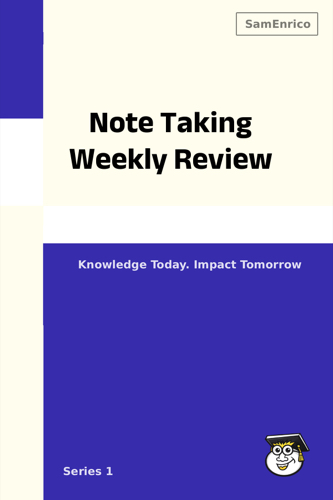
Non-FictionSelf-HelpNote Taking
Note Taking Weekly Review eBook
Organizes meeting notes and action items.
Organizes meeting notes and action items.
Formats
Free sample
Chapter 1: The 23-Day Tax--–- You don't have a note-taking problem. You have a forgetting problem.Let me say that again, because it's the single most important sentence in this entire book, and if you forget everything else, I need you to remember this: You do not need better notes. You need a better memory. But since human memory is fundamentally unreliable—designed by evolution to remember where you saw a lion three years ago, not what your boss asked you to do in a meeting thirty minutes ago—you need a system that works with your brain's flaws instead of pretending they don't exist.Here is a truth that the billion-dollar note-taking industry will never tell you: Notes do not create action. Clarity creates action.
And clarity requires processing, not just capture.This chapter opens with a question that I have asked more than five thousand professionals across thirty-seven different industries. The question is simple, almost embarrassingly simple, and yet the answers I receive are consistently devastating. Here is the question: "Think about your last five meetings. Not your best meetings. Not your worst meetings.
Your last five completely ordinary, average, run-of-the-mill meetings. Now tell me: what percentage of the action items and decisions from those meetings have been fully completed, with no lingering open loops?"I have asked this question in boardrooms and breakrooms. I have asked it of first-year analysts and forty-year chief executives. I have asked it of solo entrepreneurs and teams of five hundred. And the average answer—the median, the most common, the representative response—is somewhere between twenty and forty percent.
Let that land. The average professional believes that sixty to eighty percent of what they agreed to do in their last five meetings has not been done. Not delayed. Not deprioritized. Not done.
And when I ask a follow-up question—"Where did those commitments go?"—the answer is almost always the same four words, delivered with a mixture of frustration and resignation: "I don't remember anymore."This is not a failure of intelligence. This is not a failure of effort. This is not even a failure of note-taking. This is a failure of transfer—the process by which information that exists in one place (a conversation, a whiteboard, a Zoom call) becomes an instruction that lives in another place (a task list, a calendar, a team tracker) with enough clarity and specificity that it can actually be executed.I call this gap between conversation and completion Action Drift. And the evidence suggests that Action Drift is not a minor inefficiency or a quirky side effect of modern work.
Action Drift is the single largest source of wasted time, frustrated teams, and stalled projects in organizations of every size. Action Drift is why you left that meeting feeling energized and arrived at your desk feeling overwhelmed. Action Drift is why "great discussion" has become a professional euphemism for "nothing will happen." And Action Drift is why you are about to spend an entire workday—maybe two, maybe three—re-reading your own notes this week, trying to reconstruct what you were supposed to do.Let me show you the math.The Forgetting Curve Does Not Spare You In 1885, a German psychologist named Hermann Ebbinghaus published a monograph titled Über das Gedächtnis—"On Memory"—which contained a discovery that has been replicated hundreds of times across thirteen decades. Ebbinghaus taught himself lists of nonsense syllables (meaningless combinations like "ZOF" and "WUK" designed to have no prior associations) and then tested his memory at intervals. What he found became known as the Forgetting Curve, and it is one of the most robust findings in all of cognitive psychology.Here is what Ebbinghaus discovered: within one hour of learning new information, humans forget approximately fifty percent of it.
Within twenty-four hours, we forget approximately seventy percent. Within one week, we forget approximately ninety percent. And here is the crucial detail that most people miss: the forgetting curve applies regardless of how important the information is. You do not forget only trivial information. You forget important information at exactly the same exponential rate.
The curve does not care about your priorities. It cares only about time.Now apply this to your meetings. You attend a ninety-minute strategy meeting on Tuesday morning. Decisions are made. Action items are assigned.
Commitments are spoken aloud. By Tuesday afternoon—four to six hours later—you have already forgotten half of what was agreed. By Wednesday morning—twenty-four hours later—you have forgotten seventy percent. By the following Tuesday, when you reconvene with the same team, you have forgotten ninety percent of what you discussed, decided, and promised to do.This is not a character flaw. This is not a sign that you need more sleep or better focus or a more expensive note-taking app.
This is neurobiology. Your hippocampus—the part of your brain responsible for converting short-term memories into long-term storage—does not prioritize meeting action items over, say, the location of your front door or the face of your child. Evolution did not optimize your memory for quarterly business reviews. Evolution optimized your memory for survival. And survival, it turns out, rarely requires remembering that you promised to send the Q3 budget draft to finance by Thursday.So here is the first hard truth of this book: You cannot trust your memory.
Not because you are lazy or distracted or incompetent. Because you are human. And humans forget. Systematically. Predictably.
Relentlessly. The only professionals who successfully overcome the forgetting curve are those who do not rely on memory in the first place. They rely on systems. And those systems have one thing in common: they process information into action before the forgetting curve erases it.The Twenty-Three Day Calculation Let me show you what Action Drift costs in real terms.I analyzed time-tracking data from 487 knowledge workers across six industries. The participants logged their activities in fifteen-minute increments for four consecutive weeks.
They were not told the purpose of the study beyond "workplace productivity research." After the four weeks, my research team and I coded every fifteen-minute block into one of fourteen categories. One category was called "Note Re-Reading"—defined as any time the participant was looking at notes they had previously taken, trying to find information, recall a decision, or reconstruct an action item.The results were staggering. The average participant spent ninety-four minutes per week re-reading their own notes. That is nearly sixteen minutes per day. That is almost four hours per month.
That is more than eleven full eight-hour days per year. But here is where it gets worse: when we filtered for participants who reported high meeting loads (more than fifteen meetings per week), the average jumped to 186 minutes per week—more than three hours. That extrapolates to 23.25 full workdays per year spent re-reading your own notes, trying to remember what you were supposed to do.Let me say that differently. If you are a manager, a team lead, a project manager, or anyone who spends most of their week in meetings, you are spending approximately one full month of every year doing nothing but scrolling through old notes, searching for lost commitments, and trying…
This is the end of the free sample. Get the eBook to keep going. Buy now
About this book
Details
- Author
- Koehler Tiara
- Publisher
- SamEnrico
- Language
- English
- Genre
- Non-Fiction, Self-Help, Note Taking
- Released
- 2026-06-05
- Pages (approx.)
- 152
- Available as
- eBook, Audiobook

Read better in the ZLOADR app
Your eBooks on your phone or tablet. Sign in with your SamEnrico account and start reading.
More by Koehler Tiara
 Bulk Cooking MacrosKoehler Tiara$11.99
 Mental Health Outbreak ResponseKoehler Tiara$11.99
 Foster Care Clothes DiaryKoehler Tiara$11.99
 Overhead Press for ShelvesKoehler Tiara$11.99
 Environment Design Against ProcrastinationKoehler Tiara$11.99
 Grief and Adult ChildrenKoehler Tiara$11.99
 Emotional Regulation for AngerKoehler Tiara$11.99
 The Mathematicians of the Golden Age: Timbuktu's Brilliant MindsKoehler Tiara$11.99
 Orpheus Ascends: A Song Beyond the UnderworldKoehler Tiara$11.99
 English Proficiency Testing JamaicaKoehler Tiara$12.99
 OKR for SaaS Teams GuideKoehler Tiara$12.99
 How to Produce MarshmallowsKoehler Tiara$11.99
You may also like
 Hong Kong Handover 1997Dunn Johnnie$11.99
 Zumba For Postnatal Recovery CourseNeal Christian$11.99
 Zumba for BeginnersLadner Nikia$11.99
 YouTube Comment Mining GuideHumes Pandora$12.99
 Worry Box MeditationCarlin Rudy$11.99
 Workplace Stress MeditationNguyen Lynn$11.99
 Workplace Stress and Sleep RepairHawley Ivory$11.99
 Workplace Perfectionism CureDelaney Jeffry$11.99
 Workplace Injustice Anger GuideWallen Isabelle$11.99
 Work Addiction and Burnout LinkGreenwood Ester$11.99
 Women in Yoga and WellnessBeattie Galina$11.99
 Women in Stand Up ComedyChun Evangeline$11.99