
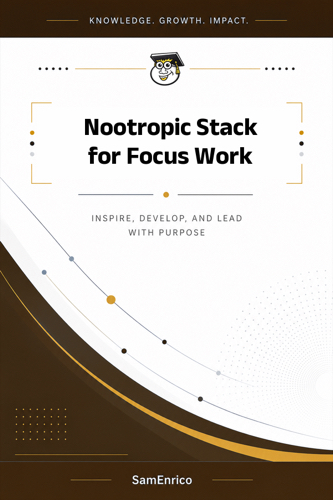
Nootropic Stack for Focus Work Audiobook
Research cognitive enhancers that support sustaine
by Lacey Zita
Research cognitive enhancers that support sustained attention without side effects.
Formats
Free sample
Chapter 1: The Caffeine Paradox--–- Sarah had done everything right. She woke at 6:00 AM, skipped breakfast for intermittent fasting, and brewed her first mug of specialty-grade dark roast by 6:15. By 7:30 AM, she had answered forty-seven emails, revised a client proposal, and felt like a productivity deity. Then 2:00 PM arrived. The fog descended like a physical weight.
Her third coffee sat half-finished, cold and bitter. Her heart raced, but her brain refused to cooperate. By 3:30 PM, she was scrolling Instagram with no memory of opening the app. At 5:00 PM, she snapped at her partner over a minor question. At 11:00 PM, she lay awake, exhausted but wired, dreading the next day's repeat performance.Sarah is not a cautionary tale.
She is the norm.Ninety percent of the global adult population consumes caffeine daily. In the United States, the average coffee drinker consumes three cups per day, often more. Add in energy drinks, pre-workout powders, caffeinated teas, and the proliferating category of "functional" sodas, and the picture becomes clear: we are a civilization running on stimulants. Yet the same population reports epidemic levels of afternoon crashes, sleep disturbances, generalized anxiety, and a pervasive sense of cognitive fog. The National Sleep Foundation found that sixty-five percent of adults report poor sleep quality at least several nights per week.
The American Psychological Association notes that anxiety levels have risen steadily across all demographics. And the average worker loses nearly three hours of productive time each day to self-reported "brain fog."These two facts—widespread caffeine use and widespread cognitive dysfunction—are not coincidental. They are causally linked. But the link is not as simple as "caffeine is bad." Caffeine, when understood and deployed with surgical precision, remains one of the most effective cognitive enhancers known to pharmacology. The problem is not the molecule.
The problem is how we use it.This chapter reframes the conversation. It does not demonize caffeine, nor does it declare it a villain. Instead, it positions caffeine as what it truly is: a powerful tool that ninety percent of people wield incorrectly. The goal of this chapter—and this book—is to teach you how to use caffeine surgically, or to replace it entirely with next-generation alternatives that provide sustained attention without the crash, the jitters, or the insomnia.The Four M's Framework: Nootropics as Support, Not Driver Before we dissect caffeine’s pharmacology, we must establish the philosophical backbone of everything that follows. Call it…
This is the end of the free sample. Get the Audiobook to keep going. Buy now
About this book
Details
- Author
- Lacey Zita
- Publisher
- SamEnrico
- Language
- English
- Genre
- Non-Fiction, Business Brief, Cognitive Enhancement
- Released
- 2026-06-06
- Pages (approx.)
- 151
- Available as
- eBook, Audiobook

Listen in the VoxFlicks app
Audiobooks and audio dramas wherever you go. Sign in with your SamEnrico account and press play.
More by Lacey Zita
 Remote Retreats Partner InclusionLacey Zita$11.99
 French Resistance Train DerailmentLacey Zita$11.99
 Difficult Talks with StepchildrenLacey Zita$11.99
 Predictive Positioning GuideLacey Zita$11.99
 Deep Dive: The Race to the Mariana Trench’s AbyssLacey Zita$11.99
 The Last Laugh: The Day the Smiler CrashedLacey Zita$11.99
 Nonprofit Department BudgetingLacey Zita$12.99
 JEE Biotechnology Branch GuideLacey Zita$12.99
 How to Start a Pouch for Tobacco Business (Beginners Guide)Lacey Zita$11.99
 Understanding Chromosome 1, Duplication 1p21 P32Lacey Zita$17.99
 Recruiting Manager Rh Finance and AccountingLacey Zita$11.99