
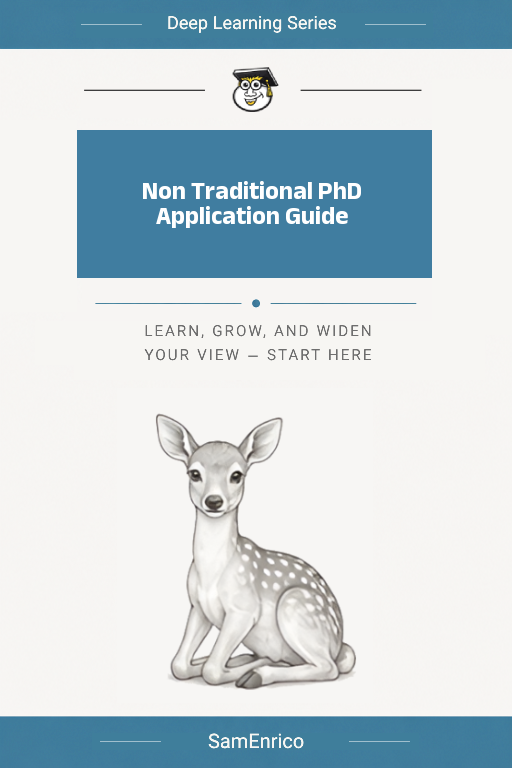
Non Traditional PhD Application Guide eBook
Apply as a career-changer or returning student wit
by Broome Wes
Apply as a career-changer or returning student without recent publications using professional research and industry analysis.
Formats
Free sample
Chapter 1: The Asset Heist--When Maria sat down to write her Ph D application after seventeen years as a supply chain director, she did what most career-changers do. She opened a blank document and typed her job titles in reverse chronological order: Regional Manager, Operations Lead, Logistics Coordinator. Then she stared at the page and felt something close to shame. Where was the publications section? Where was the research experience?
She had delivered $40 million in cost savings, survived three mergers, and built forecasting models that predicted demand within 2 percent accuracy. But none of that looked like a Ph D application. She closed her laptop and spent another year not applying.Maria’s mistake was not a lack of qualifications. Her mistake was a lack of translation. She believed that academic committees spoke one language and she spoke another, and that no one would bother to interpret her resume into theirs.
This book exists because that belief is wrong—and because the cost of that wrong belief is measured in thousands of qualified people who never apply, never try, and never discover that their professional experience is not a liability but their single greatest asset.The problem is not your resume. The problem is the lens you are using to read it.The Anxiety That Keeps Good People Out Let us name the fear directly. You are worried that a Ph D admissions committee will look at your CV, see the absence of peer-reviewed publications, and toss your application in the figurative trash. You are worried that your age—whatever it is, over thirty, over forty, over fifty—will be held against you. You are worried that the years you spent managing people, budgets, and projects count for nothing in a world that prizes undergraduate theses and lab assistantships.These fears are rational in the sense that they come from a real place.
Graduate admissions have historically privileged the linear path: high school to college to Ph D, with maybe a year or two of a research assistantship in between. The hidden curriculum of academia rewards those who never left. But here is what the data actually says, and here is what admissions committees will not tell you in their brochures.According to surveys of doctoral admissions across fifty universities, the majority of admitted Ph D students do not have first-author publications. Not most. Not some.
The majority. What they have is evidence of research behaviors: the ability to formulate a question, select a method, handle ambiguity, and persist through failure. Those behaviors are not exclusive to academia. They are the daily work of project management, data analysis, regulatory compliance, and operational leadership. You have been doing research your entire career.
You just have not called it that.The problem is not your qualifications. The problem is that you are using the wrong dictionary.The Hierarchy of Assets: What You Actually Bring To fix this problem, we need a shared framework. Throughout this book, we will refer to the Hierarchy of Assets—a way of understanding what you bring to a Ph D application and in what order of importance. This hierarchy resolves the confusion that plagues most career-changers: should I lead with my work history, my old reports, a new portfolio, or my interview skills? The answer is all of them, but in a specific order.Level 1 is your primary asset.
This is your past work outcomes—problem-solving under real-world constraints. Budgets, deadlines, imperfect data, office politics, regulatory hurdles, stakeholder conflicts. Every time you delivered a project, fixed a broken process, or predicted a future outcome under uncertainty, you were doing the cognitive work that a Ph D requires. The context was different. The underlying skill was identical.
A traditional applicant proves they can think rigorously by surviving peer review. You prove the same thing by surviving a product launch, a regulatory audit, or a quarter-end crisis where millions of dollars were at stake. That is Level 1.Level 2 is your secondary asset. This is your existing corporate documents: quarterly reports, risk assessments, process maps, code repositories, policy memos, training manuals, post-mortem analyses. You have produced hundreds of these documents.
You have never called them research, but they contain the same elements as academic writing: problem statements, methods, findings, limitations, and implications. The difference is formatting and jargon, not substance. Level 2 assets are valuable because they already exist. You do not need to create anything new. You need to retrofit what you already have.Level 3 is your tertiary asset.
This is new portfolio material you may need to generate if your existing documents are weak, confidential, or misaligned with your target field. A Technical Validation Report, a Git Hub repository, a conference proceeding. These are not replacements for your professional experience. They are proof that you can initiate and complete a research project independently—a signal that you are not just someone who followed instructions at work but someone who can generate new questions. Most career-changers will not need all of Level 3.
You will build only what your target field requires. But knowing that you can build it, in four to six weeks, without institutional affiliation, removes the panic of the blank publications section.Level 4 is your performance asset. This is your ability to defend your research live in an interview. Unlike the first three levels, which are documents, Level 4 is a behavior. It matters only after you have secured an interview, and it matters enormously in that moment.
But it is also the easiest to prepare, because the questions are predictable and the answers can be scripted. Most career-changers are better at Level 4 than traditional applicants, because you have already survived job interviews, client presentations, and executive briefings. You know how to perform under pressure. You just need to translate your answers.The Hierarchy of Assets gives you a roadmap. Start with Level 1: identify the problem-solving outcomes from your career that best signal research readiness.
Then move to Level 2: retrofit the documents you already have. Then, if needed, build Level 3 materials. Finally, prepare Level 4 for interviews. Do not skip levels. Do not reverse the order.
A Technical Validation Report (Level 3) cannot compensate for a weak articulation of your primary asset (Level 1). But a strong Level 1 will carry you through even if your Level 3 is minimal.The Translation Spectrum: When to Translate and When to Stay Plain The second major confusion that keeps career-changers stuck is the question of tone. Should you write like an academic or like a professional? Should you hide your industry background in academic jargon or celebrate it in plain language? The answer depends on the document.
This is the Translation Spectrum.At one end of the spectrum is heavy translation. You use this for your CV and for portfolio documents. Here, you convert corporate terms into methodological language. A sales trend analysis becomes quantitative regression modeling. A policy memo becomes qualitative case study research.
A project post-mortem becomes reflective methodological critique. You are not lying. You are using the vocabulary of the field you are trying to enter. This is like learning to order coffee in another country—you are not betraying your identity, you are being polite to the local culture. Heavy translation is politeness.In the middle…
This is the end of the free sample. Get the eBook to keep going. Buy now
About this book
Details
- Author
- Broome Wes
- Publisher
- SamEnrico
- Language
- English
- Genre
- Non-Fiction, Student's Shortcut, Non Traditional Path
- Released
- 2026-05-29
- Pages (approx.)
- 132
- Available as
- eBook, Audiobook

Read better in the ZLOADR app
Your eBooks on your phone or tablet. Sign in with your SamEnrico account and start reading.
More by Broome Wes
 Sales Idea GenerationBroome Wes$11.99
 High Intensity Interval Training BasicsBroome Wes$11.99
 Nonverbal Cues In Politics WorkbookBroome Wes$11.99
 EMDR For Trauma Driven OCDBroome Wes$11.99
 Survey Translation with AI ToolsBroome Wes$11.99
 The Silent Witnesses: The Birth of Modern Ecology in Europe's Forgotten WildsBroome Wes$11.99
 Bloodline of Power: The Untold Story of the Bush Dynasty’s Backroom DealsBroome Wes$11.99
 Understanding CampylobacteriosisBroome Wes$17.99
 How to Start a Construction of Industrial Facilities (except Buildings) Business (Beginners Guide)Broome Wes$11.99
 Greek University Master GuideBroome Wes$12.99
 Corporate ControllerBroome Wes$11.99