
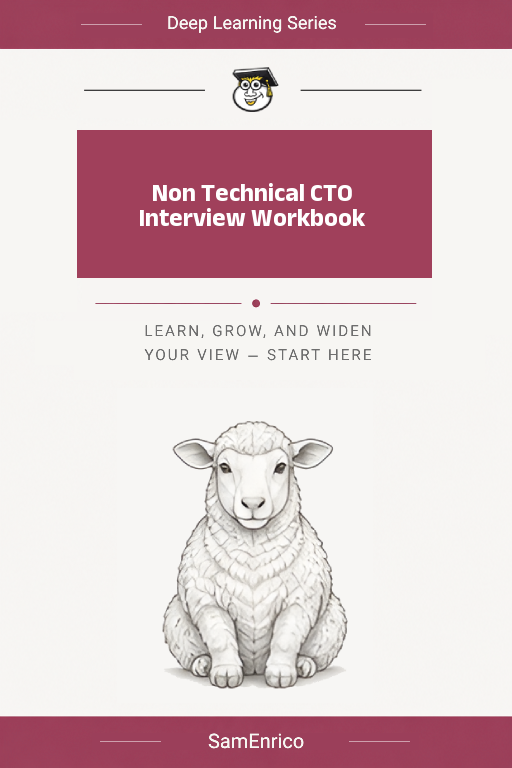
Non-FictionStartup GuideExecutive Search
Non Technical CTO Interview Workbook eBook
Evaluate technical co founder candidates using beh
Evaluate technical co founder candidates using behavioral questions, portfolio reviews, and reference checks without writing a single line of code yourself.
Formats
Free sample
Chapter 1: The $500,000 Blind Spot--–- Every non-technical founder I’ve ever met has made the same mistake. They walk into their first technical co-founder interview excited, hopeful, and completely unarmed. They sit across from someone who speaks in complete sentences, uses words like “microservices” and “tech debt,” and seems genuinely confident. Within thirty minutes, they’re mentally drafting the equity split. Three months later, they’re wondering why nothing works, why the engineer they hired won’t talk to them, and why their brilliant idea is still not in front of customers.
This chapter is about why that happens and how you will stop it from happening to you.The Story You Don’t Want to Believe Let me tell you about Sarah. Sarah was a former marketing director who had spent two years building a marketplace for freelance designers. She had seed funding, early customer interest, and one massive problem: she couldn’t build the product herself. She had tried no-code tools. She had tried outsourcing to an agency.
Nothing worked. She needed a technical co-founder.Through a mutual friend, she met Alex. Alex had worked at Google for three years. He had a computer science degree from a top university. He spoke confidently about architecture, scalability, and “best practices.” Sarah was thrilled.
Here was someone who clearly knew more than she did about technology. She offered him 35 percent equity and a co-founder title after two conversations. No reference checks. No trial project. No behavioral questions.
Just two conversations and a handshake.Eight months later, Sarah had spent half her seed funding, had zero working product, and had not spoken to Alex in three weeks. He had stopped coming to meetings. The code he had written was, according to an outside consultant Sarah eventually hired, “a disaster of cosmic proportions.” Nothing was documented. Nothing was tested. The database schema changed three times without explanation.
Alex had also, Sarah discovered, been interviewing for other jobs for the past two months.When Sarah asked Alex what happened, he said: “You didn’t understand the technical complexity. You kept changing requirements. I lost confidence in the vision.”Sarah hired a lawyer. Alex kept 15 percent of the equity because she had forgotten to include a vesting schedule. The company died six months later.Here is what Sarah learned, and what you need to understand before you read another word of this book: technical skill is almost never the reason technical co-founder relationships fail.
The reason they fail is almost always about judgment, communication, and alignment under pressure. Sarah didn’t lose because Alex couldn’t code. She lost because she never learned how he handled disagreement, ambiguity, or failure. She never asked. She was too busy being impressed.The Three Real Jobs of a Technical Co-Founder Most non-technical founders believe a technical co-founder’s job is to write code.
That is like saying a CEO’s job is to answer emails. It is technically true and completely useless as a description of success.A technical co-founder has three real jobs, none of which you can evaluate by looking at a Git Hub profile or asking about programming languages.The first job is making architectural trade-offs under uncertainty. Every startup has limited time, limited money, and limited attention. Should you build for scale you don’t have yet? Should you use that new framework that promises faster development but has a tiny community?
Should you fix the technical debt now or ship the feature that a customer is waiting for? These are judgment calls, not technical questions. A great technical co-founder can explain why they chose A over B in plain English, including what they gave up. A bad one will tell you they didn’t give up anything, which means they either don’t understand trade-offs or are lying to you.The second job is building and retaining engineering culture. If you are the non-technical founder, you cannot evaluate code quality directly.
But you can evaluate whether the people who work for your CTO want to keep working for them. You can evaluate whether the CTO documents decisions, shares credit, and mentors junior engineers. You can evaluate whether the engineering team has a “bus factor” of one – meaning only the CTO understands critical systems. These are behavioral and cultural questions, and they matter more than syntax.The third job is translating business risk into technical decisions. When a customer says they will leave if a feature isn’t delivered by Friday, a technical co-founder must decide how to respond.
Do they cut corners? Do they push back? Do they explain the long-term cost of rushing? Do they have a framework for making these decisions, or do they just react? This is not about coding.
It is about judgment, communication, and honesty.Here is the hard truth that the top one percent of technical co-founder hires understand and you need to internalize now: you cannot evaluate these three jobs by asking technical questions. In fact, asking technical questions will actively mislead you because technical fluency is not correlated with any of these three capabilities. Some of the worst technical co-founders I have seen were brilliant programmers who built elegant systems that nobody wanted and alienated everyone who tried to work with them.The 70 Percent Statistic That Should Terrify You Noam Wasserman’s research in The Founders’ Dilemmas followed thousands of startup founders over more than a decade. His finding about technical co-founder relationships is stark: nearly 70 percent of co-founder breakups are caused by misaligned expectations, not technical incompetence. The technical co-founder could code just fine.
The problem was that the two founders disagreed about decision rights, work hours, product direction, equity, or communication style. They never had the difficult conversations before signing the agreement because they were too busy being excited.Seventy percent.That means if you hire a technical co-founder using traditional methods – looking at resumes, asking technical questions, trusting your gut – you have a seven in ten chance of breaking up within eighteen months. Those are worse odds than Russian roulette.The good news is that the 30 percent who succeed do something different. They evaluate for judgment before competence. They test for communication under pressure before architecture.
They check references for toxicity before they check for programming languages. They use structured, repeatable processes that remove gut feelings from the equation. That is exactly what this workbook will teach you.Your Hidden Biases Are Already Working Against You Before we go any further, we need to talk about something uncomfortable. You have biases. Not the political kind.
The psychological kind. These biases are evolutionarily ancient, completely automatic, and guaranteed to lead you toward the wrong technical co-founder if you don’t actively fight them.The first bias is fluency bias. Fluency bias is the tendency to believe that information that is easier to process is more truthful. When a candidate speaks smoothly, without hesitation, using technical terms confidently, your brain interprets that as competence. But fluency and accuracy are not correlated.
Some of the most fluent speakers I have encountered were also the most wrong. They just had more practice sounding confident. The inverse is also true: genuinely thoughtful technical people often hesitate…
This is the end of the free sample. Get the eBook to keep going. Buy now
About this book
Details
- Author
- Darling Frieda
- Publisher
- SamEnrico
- Language
- English
- Genre
- Non-Fiction, Startup Guide, Executive Search
- Released
- 2026-05-29
- Pages (approx.)
- 142
- Available as
- eBook, Audiobook

Read better in the ZLOADR app
Your eBooks on your phone or tablet. Sign in with your SamEnrico account and start reading.
More by Darling Frieda
 Franklin RNA Research Legacy CourseDarling Frieda$11.99
 Gut Microbiome Brain Axis GuideDarling Frieda$11.99
 Firefighter Failure FearDarling Frieda$11.99
 Carson Post Silent Spring Depression GuideDarling Frieda$11.99
 The Caregiver Veteran Care GuideDarling Frieda$11.99
 The Quantum Leap: How a Single Algorithm Changed the WorldDarling Frieda$11.99
 Tangaroa and Hina: The Tide That Bound the SkyDarling Frieda$11.99
 Understanding Foreign Accent SyndromeDarling Frieda$17.99
 AI Fraud Detection GuideDarling Frieda$12.99
 Ultimate Handbook Guide to Wendeng : (China) Travel GuideDarling Frieda$11.99
 Value Stream CoachDarling Frieda$11.99
You may also like
 Hong Kong Handover 1997Dunn Johnnie$11.99
 Zumba For Postnatal Recovery CourseNeal Christian$11.99
 Zumba for BeginnersLadner Nikia$11.99
 YouTube Comment Mining GuideHumes Pandora$12.99
 Worry Box MeditationCarlin Rudy$11.99
 Workplace Stress MeditationNguyen Lynn$11.99
 Workplace Stress and Sleep RepairHawley Ivory$11.99
 Workplace Perfectionism CureDelaney Jeffry$11.99
 Workplace Injustice Anger GuideWallen Isabelle$11.99
 Work Addiction and Burnout LinkGreenwood Ester$11.99
 Women in Yoga and WellnessBeattie Galina$11.99
 Women in Stand Up ComedyChun Evangeline$11.99