
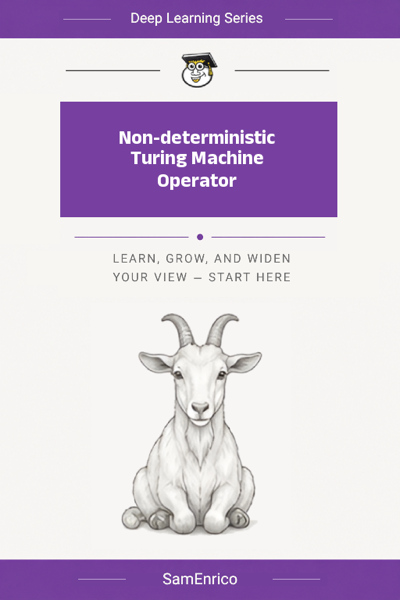
Non-FictionInformativeEducational
Non-deterministic Turing Machine Operator eBook
A Coursebook on Non-deterministic Turing Machine O
A Coursebook on Non-deterministic Turing Machine Operator
Formats
Free sample
Chapter 1: The Guesser's Gambit...--This book will teach you to think like a machine that can imagine.Not a machine that follows a single, rigid path—the way every computer you have ever used works. Not a machine that crunches numbers one after another, obediently executing a predetermined sequence of instructions. Those are deterministic machines, and they are useful. They are also, in a very real sense, blind.Deterministic machines cannot guess. They cannot wonder "what if." They cannot try multiple possibilities simultaneously and accept the first one that works. They are the accountants of computation: precise, reliable, and utterly incapable of creative leaps.A non-deterministic Turing machine is different. At each step, it can choose among multiple possible next moves. It can split into parallel copies of itself, each exploring a different path. If any of those paths leads to an accepting state, the entire machine accepts. This is not magic—it is a precise mathematical model of imagination.This chapter introduces the fundamental shift in perspective that separates deterministic from non-deterministic thinking. You will learn to view a Turing machine not as a mechanical automaton but as an operating system for computation. You will meet the guesser—the conceptual entity that represents the machine's ability to choose among multiple paths. And you will write your first non-deterministic program: a verifier that checks whether an input matches a fixed pattern, using exactly zero guesses.By the end of this chapter, you will understand why determinism is merely a special case of non-determinism, and why every deterministic machine you have ever used is, technically, a non-deterministic machine that never splits. That insight is the foundation upon which everything else in this book is built.1.1 The Deterministic Cage Every computer you have ever encountered—your laptop, your phone, the server hosting this text—is a deterministic machine. Given the same initial state and the same input, it will produce the same output every single time. This predictability is essential for banking, air traffic control, and sending emails. But it is also a cage.Consider a simple problem: find a factor of a large composite number, say 15,179,462,877. A deterministic algorithm might try dividing by 2, then 3, then 5, then 7, trudging through possibilities one by one. In the worst case, it must test all primes up to the square root of the number—a number so astronomically large that even the fastest supercomputer would take longer than the age of the universe.But what if the machine could guess? What if, at the start of the computation, it could simply write down a candidate factor without having to search for it? If the guess is correct, the machine verifies it quickly and accepts. If the guess is wrong, that branch of the computation simply dies (or, more precisely, rejects), while other branches continue with different guesses.This is the essence of non-deterministic computation: separate the act of guessing from the act of verifying. The machine does not need to know how to find the answer. It only needs to know how to recognize a correct answer when it sees one. The guesser supplies the witness; the verifier checks it.Deterministic machines must both find and verify—a much harder task. Non-deterministic machines offload the search to the guesser and focus on the check. This shift, from "how do I find the answer?" to "how do I recognize the answer?" is the single most important idea in this book.1.2 The Machine We Will Build Before we can program a non-deterministic Turing machine (NDTM), we must understand its anatomy. A Turing machine, in its classical deterministic form, consists of:An infinite tape divided into cells, each containing a symbol from a finite alphabet (typically including a special "blank" symbol).A tape head that can read the current cell, write a new symbol, and move left or right.A finite state register that holds the machine's current state.A transition function δ that maps (current state, current symbol) to (new state, new symbol, direction).The machine starts in a designated start state, with the input written on the tape and the head at the leftmost symbol. At each step, it consults δ, updates its state, writes a symbol, and moves the head. If it enters an accepting state, it halts and accepts. If it enters a rejecting state (or has no valid transition), it halts and rejects. Deterministic: one instruction per configuration.An NDTM replaces the deterministic transition function δ with a non-deterministic transition relation Δ. Where δ maps a (state, symbol) pair to exactly one triple (new state, new symbol, direction), Δ maps the same pair to a set of possible triples. At each step, the machine may choose any of the available transitions. This choice is the non-deterministic "guess."Formally:Deterministic: δ: Q × Γ → Q × Γ × {L, R}Non-deterministic: Δ ⊆ (Q × Γ) × (Q × Γ × {L, R})In practice, when we program an NDTM, we do not write explicit transition tables. Instead, we will use a high-level pseudocode that includes a GUESS keyword. This keyword instructs the machine to non-deterministically select a value from a specified set and continue execution along separate branches for each possible value.For example, the following code guesses a binary digit:text Copy Downloadx = GUESS {0, 1}This creates two branches: one where x = 0, and one where x = 1. Each branch proceeds independently, as if the machine had split into two parallel copies. If any branch eventually reaches an accept state, the entire NDTM accepts.1.3 The Guesser, Not the Oracle At this point, you may be tempted to think of the GUESS operation as magic—a deus ex machina that simply produces the correct answer. This is a dangerous misconception.The GUESS operation does not know which branch will lead to acceptance. It does not consult a hidden oracle. It does not peek into the future. It simply forks the computation into multiple parallel paths, each with a different value. The machine then explores all paths simultaneously (or, in simulation, one after another). If the problem has a solution, some branch will guess it by chance. That branch will verify the solution and accept. The other branches will guess incorrectly and reject (or loop, or get stuck—we will handle those cases in later chapters).The power of non-determinism is not that the machine always guesses correctly. The power is that the machine accepts if any branch accepts. This is an existential quantifier over computation paths: there exists a path that leads to acceptance.Think of it this way: you are searching for a key in a dark room. A deterministic machine would systematically check every square inch, one at a time. A non-deterministic machine would instantaneously illuminate the entire room; if the key is present, the light catches it, and you see it instantly. The machine does not "know" where the key is—it simply observes all locations at once and accepts if the key exists somewhere.This is why we will use the term guesser rather than "oracle" in the early chapters of this book. An oracle (introduced in Chapter 11) is a formal external subroutine that answers questions instantly. The guesser is an internal mechanism of the NDTM itself. The distinction matters: the guesser is not magic; it is a precise description of the machine's ability to…
This is the end of the free sample. Get the eBook to keep going. Buy now
About this book
Details
- Author
- Headrick Samara
- Publisher
- SamEnrico
- Language
- English
- Genre
- Non-Fiction, Informative, Educational
- Released
- 2026-05-11
- Pages (approx.)
- 142
- Available as
- eBook, Audiobook

Read better in the ZLOADR app
Your eBooks on your phone or tablet. Sign in with your SamEnrico account and start reading.
More by Headrick Samara
 The AI Talent Migration WaveHeadrick Samara$11.99
 Daily Review for Librarians GuideHeadrick Samara$11.99
 Slippery Elm Gut GuideHeadrick Samara$11.99
 Smoking Cessation Hypnosis App GuideHeadrick Samara$11.99
 Catherine the Great Crimean Annexation MethodsHeadrick Samara$11.99
 The Great Timber Heist: How One Man Stole an Entire ForestHeadrick Samara$11.99
 The Silk Road's Forbidden Knowledge: The Ethical Dilemma of Ancient Central Asian ScienceHeadrick Samara$11.99
 Understanding Benign Paroxysmal Positional VertigoHeadrick Samara$17.99
 Accrual Accounting Made SimpleHeadrick Samara$12.99
 ITIN Application for Foreign OwnersHeadrick Samara$12.99
 How to Start a Cutting Torch Business (Beginners Guide)Headrick Samara$11.99
You may also like
 Hong Kong Handover 1997Dunn Johnnie$11.99
 Zumba For Postnatal Recovery CourseNeal Christian$11.99
 Zumba for BeginnersLadner Nikia$11.99
 YouTube Comment Mining GuideHumes Pandora$12.99
 Worry Box MeditationCarlin Rudy$11.99
 Workplace Stress MeditationNguyen Lynn$11.99
 Workplace Stress and Sleep RepairHawley Ivory$11.99
 Workplace Perfectionism CureDelaney Jeffry$11.99
 Workplace Injustice Anger GuideWallen Isabelle$11.99
 Work Addiction and Burnout LinkGreenwood Ester$11.99
 Women in Yoga and WellnessBeattie Galina$11.99
 Women in Stand Up ComedyChun Evangeline$11.99