
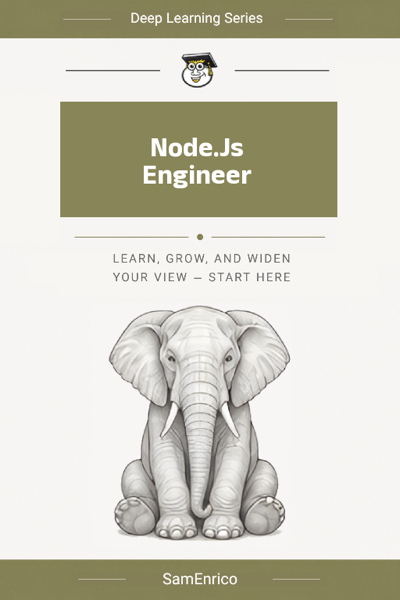
Non-FictionInformativeEducational
Node.Js Engineer eBook
A Coursebook on Node.Js Engineer
by Carlin Elvie
A Coursebook on Node.Js Engineer
Formats
Free sample
Chapter 1: The Single Thread That Conquered the World--The phone rang at 2:17 AM on Black Friday. Sarah, the on-call engineer for a fast-growing ticketing platform, stared at her dashboard in disbelief. The Node.js API that had handled 500 requests per second during load testing was now struggling with 50. Response times had climbed from 40 milliseconds to 14 seconds. The event loop was clogged. Somewhere in the codebase, a synchronous operation was blocking everything else. The company would lose an estimated $90,000 for every hour the problem persisted.This is the nightmare that every Node.js engineer eventually faces. And it almost always traces back to a misunderstanding of the single most important concept in the entire ecosystem: the event loop.Welcome to the first principle of becoming a true Node.js engineer. Not someone who can just install Express and write a few routes, but someone who understands why Node.js behaves the way it does under pressure. Someone who can look at a production outage, identify the blocked loop, and fix it in minutes instead of hours. Someone who gets promoted because they prevent the 2 AM phone call in the first place.This chapter dismantles the myth that Node.js is "just Java Script on the server." It reveals the architectural decisions that enable a single thread to handle thousands of concurrent connections. More importantly, it teaches you to write code that respects the event loop, identifies blocking operations before they reach production, and uses Worker Threads when CPU-intensive tasks are unavoidable.By the end of this chapter, you will have built your first piece of the e-commerce cart service that will grow across this entire book. You will also have intentionally broken it to understand exactly why responsiveness matters from day one.The Mental Model Shift Before writing a single line of code, you must abandon a mental model that works for many other platforms. In traditional threaded environments like Apache HTTP Server or Java Servlet containers, each incoming connection typically receives its own operating system thread. When a request arrives, a thread is assigned to it. If that thread performs I/O, such as reading from a database or calling an external API, the thread sits idle, waiting for the response. Meanwhile, that thread continues consuming memory and CPU scheduler overhead.This model works reasonably well when the number of concurrent connections stays low. At a few hundred threads, modern operating systems context-switch between them without significant penalty. But at ten thousand threads, performance collapses. Each thread consumes approximately 1 megabyte of memory for its stack, so ten thousand threads would require ten gigabytes just for thread overhead. Context switching becomes a bottleneck. The system thrashes.Node.js takes a radically different approach. It uses a single main thread for executing Java Script code. That one thread handles all incoming requests, processes them, and sends responses. When that thread would otherwise wait for I/O, it does not wait. Instead, it initiates the operation, registers a callback, and immediately moves on to the next request. The operating system notifies Node.js when the I/O operation completes, and the callback is placed in a queue to be executed later.This is the event loop. And understanding its phases is the difference between writing Node.js code that scales and writing code that falls over at the worst possible moment.libuv: The Engine Beneath the Hood Node.js does not implement the event loop itself. The core of Node.js is built on top of a C library called libuv. Originally developed for Node.js by libuv is now a standalone asynchronous I/O library used by other projects as well. libuv abstracts away operating system differences, providing a consistent interface for asynchronous operations across Linux, mac OS, Windows, and other platforms.libuv maintains a thread pool for certain operations that cannot be performed asynchronously at the operating system level. File system operations, DNS lookups, and some cryptographic functions use this thread pool, which defaults to four threads. However, the Java Script execution itself remains single-threaded. The thread pool simply allows these blocking operations to occur without freezing the main thread. The results are then returned to the Java Script thread via the event loop.Understanding this distinction is critical. When someone says Node.js is single-threaded, they are referring to the Java Script execution thread. The underlying libuv library can and does use multiple threads, but those threads are invisible to your Java Script code except through callbacks.The Six Phases of the Event Loop The event loop is not a simple queue. It consists of distinct phases, each with its own queue of callbacks. Understanding the order of these phases allows you to predict when different types of asynchronous operations will execute relative to each other.Here are the six phases in their exact execution order:1. Timers Phase This phase executes callbacks scheduled by set Timeout() and set Interval(). A timer's callback does not execute exactly after the specified delay. Instead, the delay is the minimum time before the callback can execute. The actual execution depends on the state of the event loop and the duration of other callbacks.2. Pending Callbacks Phase This phase executes I/O callbacks that were deferred from the previous loop iteration. These are typically error handlers for system operations such as ECONNREFUSED for network connections.3. Idle, Prepare Phase These phases are used internally by libuv for housekeeping. Your application code never interacts directly with them.4. Poll Phase This is the most important phase for most applications. The poll phase retrieves new I/O events and executes their callbacks. This includes callbacks from network connections, file reads, and almost everything else. If there are no pending timers, the event loop may block in this phase waiting for new events.5. Check Phase This phase executes callbacks scheduled by set Immediate(). Despite the name, set Immediate() callbacks run after the poll phase, not immediately.6. Close Callbacks Phase This phase executes callbacks registered for closed connections, such as socket.on('close').Between each phase, the event loop processes microtasks from process.next Tick() and resolved Promises. These are handled specially, as we will explore shortly.The Whiteboard: Visualizing the Event Loop Imagine a carousel with six compartments labeled with the phases above. The carousel rotates continuously, clockwise, each compartment stopping briefly to empty its queue of callbacks. Between compartments, a set of rapid microtask processors swoops in, emptying process.next Tick() and Promise microtask queues before the carousel moves to the next compartment.This visual model reveals why certain code patterns behave unexpectedly. A set Timeout with a 0ms delay does not execute immediately. It enters the timers phase queue and must wait for the carousel to complete all current phases and return to the timers phase again. Meanwhile, process.next Tick() callbacks execute between phases, potentially starving the carousel if scheduled recursively.Microtasks and Macrotasks: The Priority Ladder Java Script developers familiar with the browser event loop will recognize the distinction between microtasks and macrotasks. Node.js follows the same pattern but with additional task types.Macrotasks include:set Timeout and set Interval callbacksset Immediate callbacks I/O callbacks Socket events Microtasks include:Promise resolution callbacks (.then(), .catch(), .finally())queue Microtask() callbacksprocess.next Tick() callbacks (technically not a microtask in the specification, but Node.js treats them as higher priority than microtasks)The critical rule: All microtasks execute before the next macrotask begins. Within microtasks, process.next Tick() callbacks execute…
This is the end of the free sample. Get the eBook to keep going. Buy now
About this book
Details
- Author
- Carlin Elvie
- Publisher
- SamEnrico
- Language
- English
- Genre
- Non-Fiction, Informative, Educational
- Released
- 2026-06-03
- Pages (approx.)
- 159
- Available as
- eBook, Audiobook

Read better in the ZLOADR app
Your eBooks on your phone or tablet. Sign in with your SamEnrico account and start reading.
More by Carlin Elvie
 Polonium Litvinenko GuideCarlin Elvie$11.99
 Compulsive Spending Triggers Journal WorkbookCarlin Elvie$11.99
 Facebook Envy and Mental HealthCarlin Elvie$11.99
 The Name Repetition MethodCarlin Elvie$11.99
 Mindful Gardening PracticeCarlin Elvie$11.99
 Vanished Without a Trace: The Disappearance of Louis Le PrinceCarlin Elvie$11.99
 The Lost Code of the Naxi: China's Secret Script of the Blue MoonCarlin Elvie$11.99
 How to Start a Awnings and Sun Blinds (wholesale) Business (Beginners Guide)Carlin Elvie$11.99
 Chinese Food GuideCarlin Elvie$12.99
 Clean Water Product FitCarlin Elvie$12.99
 Understanding Congenital Diaphragmatic HerniaCarlin Elvie$17.99
You may also like
 Hong Kong Handover 1997Dunn Johnnie$11.99
 Zumba For Postnatal Recovery CourseNeal Christian$11.99
 Zumba for BeginnersLadner Nikia$11.99
 YouTube Comment Mining GuideHumes Pandora$12.99
 Worry Box MeditationCarlin Rudy$11.99
 Workplace Stress MeditationNguyen Lynn$11.99
 Workplace Stress and Sleep RepairHawley Ivory$11.99
 Workplace Perfectionism CureDelaney Jeffry$11.99
 Workplace Injustice Anger GuideWallen Isabelle$11.99
 Work Addiction and Burnout LinkGreenwood Ester$11.99
 Women in Yoga and WellnessBeattie Galina$11.99
 Women in Stand Up ComedyChun Evangeline$11.99