
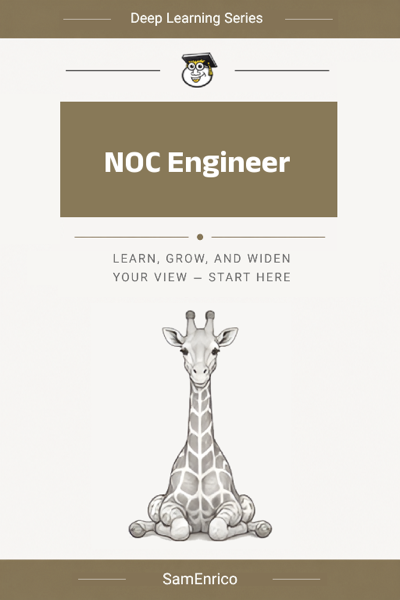
Non-FictionInformativeEducational
NOC Engineer Audiobook
A Coursebook on NOC Engineer
by Fritz Troy
A Coursebook on NOC Engineer
Formats
Free sample
Chapter 1: The Wires That Bind--–- In the summer of 2019, a team of silicon architects at a leading tech company gathered to review the physical layout of their latest 64-core processor. The individual cores were marvels of engineering—each one packed with execution units, caches, and prediction logic that would have filled an entire chip a decade earlier. The team had solved heat dissipation, clock distribution, and a hundred other microscopic problems. Yet when they ran the first full-chip simulation, they discovered something unsettling. Their 64-core processor performed only marginally better than their previous 32-core design.
Doubling the cores had not doubled the performance. In fact, for certain workloads, adding cores actually made things slower.The problem was not the cores. The problem was what connected them. The shared bus—the elegant, simple architecture that had served the industry for thirty years—had finally hit a wall. And behind that wall, every wire on that chip was screaming for attention.The Promise That Faded Every engineer who has ever studied computer architecture learns about Moore's Law: the observation that the number of transistors on a chip doubles approximately every two years.
For decades, this was celebrated as a promise of ever-increasing performance. But somewhere around the 45nm process node, a less-publicized reality began to assert itself. Dennard scaling—the principle that smaller transistors could run at the same power density—had broken down. And with it, the assumption that we could simply add more logic and watch performance climb.The shared bus was a perfect illustration of this breakdown. Consider a typical ARM AMBA AXI bus, the workhorse of system-on-chip design for two decades.
A bus is, in its simplest form, a set of shared wires connecting multiple masters (processors, DMA engines) to multiple slaves (memory controllers, peripherals). The beauty of a bus is its simplicity: any master can talk to any slave by asserting control of the wires. For a small system—say, a smartphone chip with a single application processor, a graphics core, and a memory controller—this works beautifully. Arbitration is straightforward. Latency is predictable.
The area overhead is negligible.But watch what happens as we scale. At eight masters, the electrical loading on the bus wires becomes significant. Each additional master adds capacitance to every signal line, slowing down transitions and forcing a reduction in clock frequency. At sixteen masters, the arbitration logic becomes a bottleneck: even…
This is the end of the free sample. Get the Audiobook to keep going. Buy now
About this book
Details
- Author
- Fritz Troy
- Publisher
- SamEnrico
- Language
- English
- Genre
- Non-Fiction, Informative, Educational
- Released
- 2026-06-02
- Pages (approx.)
- 145
- Available as
- eBook, Audiobook

Listen in the VoxFlicks app
Audiobooks and audio dramas wherever you go. Sign in with your SamEnrico account and press play.
More by Fritz Troy
 Franchise Global Code Of ConductFritz Troy$11.99
 Sports Nutrition MythsFritz Troy$11.99
 ADHD and Stimulant AbuseFritz Troy$11.99
 The Self Hypnosis for RuminationFritz Troy$11.99
 Anger Management for MilitaryFritz Troy$11.99
 The Iron Tower of Falias: A Druid's Last StandFritz Troy$11.99
 BOI Information Collection GuideFritz Troy$12.99
 Disclosed vs Undisclosed FactoringFritz Troy$12.99
 Understanding Rubinstein–taybi Like SyndromeFritz Troy$17.99
 How to Start a Accounting Business (Beginners Guide)Fritz Troy$11.99
You may also like
 Hong Kong Handover 1997Dunn Johnnie$11.99
 Zumba For Postnatal Recovery CourseNeal Christian$11.99
 Zumba for BeginnersLadner Nikia$11.99
 YouTube Comment Mining GuideHumes Pandora$12.99
 Worry Box MeditationCarlin Rudy$11.99
 Workplace Stress MeditationNguyen Lynn$11.99
 Workplace Stress and Sleep RepairHawley Ivory$11.99
 Workplace Perfectionism CureDelaney Jeffry$11.99
 Workplace Injustice Anger GuideWallen Isabelle$11.99
 Work Addiction and Burnout LinkGreenwood Ester$11.99
 Women in Yoga and WellnessBeattie Galina$11.99
 Women in Stand Up ComedyChun Evangeline$11.99