
Non-FictionBiographyComputing History
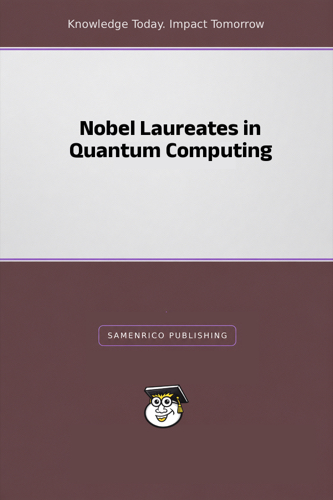
Nobel Laureates in Quantum Computing eBook
Profiles pioneers of superposition, entanglement,
Profiles pioneers of superposition, entanglement, and quantum algorithms.
Formats
Free sample
Chapter 1: The Man Who Refused to Play Dice...--–- In the autumn of 1927, the most intelligent gathering in human history convened in Brussels. Seventeen Nobel Laureates sat in the gilded splendor of the Solvay Conference’s main hall, their collective brainpower so immense that journalists of the era joked that the room contained “half the genius of the Western world.” Among them were Marie Curie, glowing with her two Nobels in physics and chemistry; Max Planck, the aging father of the quantum; and a young Werner Heisenberg, still nursing the bruises of intellectual combat. But the attention of the room, as always, fixed on two men at the center of the front row: Albert Einstein, fifty years old, his wild white hair already a trademark, and Niels Bohr, forty-two, tall, broad-shouldered, speaking with the deliberate, almost ponderous clarity of a man who had thought about every word before it left his mouth.They did not like each other. That is not quite right. They respected each other enormously.
Einstein had nominated Bohr for the Nobel Prize. Bohr had written admiring letters to Einstein. But they disagreed about the very nature of reality, and that disagreement had curdled into something sharper than mere academic debate. Einstein believed in a universe that existed whether or not anyone looked at it. He had spent a decade refining his theory of general relativity, which described gravity as the curvature of spacetime—a majestic, deterministic clockwork of planets and light beams following preordained paths.
“God does not play dice,” he liked to say, and he meant it with the force of religious conviction.Bohr believed something stranger. As the founder of the Copenhagen interpretation of quantum mechanics, he argued that the act of measurement fundamentally creates the properties of a quantum system. An electron does not have a position until you measure it. It does not have a momentum. It exists in a fog of probabilities, and the measurement collapses that fog into a single, concrete reality.
This was not a technical detail, Bohr insisted. It was the deepest truth about the universe.The 1927 Solvay Conference was supposed to be about “Electrons and Photons,” a dry technical subject. Instead, it became a battle for the soul of physics. Einstein arrived with a pocket full of thought experiments designed to punch holes in Bohr’s probability-soaked worldview. Each morning, he would present a new scenario—a box of light, a slit, a moving shutter—that he claimed would force quantum mechanics to contradict itself.
Each afternoon, after a tense lunch, Bohr would rise, walk to the blackboard, and spend hours dismantling Einstein’s arguments from within quantum mechanics’ own rules. The other Laureates watched like spectators at a heavyweight title fight. Paul Ehrenfest, a close friend to both men, wrote to a colleague: “Einstein keeps making jokes about Bohr. Bohr keeps smiling. It is terrible.”By the end of the conference, Bohr had beaten back every attack.
Einstein conceded nothing. He simply announced that he would return the following year with better arguments. He did. And in 1930, at the sixth Solvay Conference, Einstein unveiled his most devastating thought experiment yet: a box of light with a clock-controlled shutter that seemed to violate the quantum uncertainty principle. Bohr paced the floor all night.
By dawn, he had found the flaw—Einstein had forgotten that the clock itself would be affected by gravity, dragging Einstein’s own theory of relativity into the fight. Bohr won again. But the war was far from over.The Paper That Changed Everything The battle lines had been drawn, but the decisive engagement would not occur at a grand conference. It would occur quietly, in the pages of a journal, five years later, when Einstein was living in Princeton, New Jersey, having fled Nazi Germany. He was fifty-six years old, lonely, separated from his European colleagues, and increasingly isolated from the mainstream of physics.
Quantum mechanics had become the orthodoxy, taught in universities around the world. Einstein remained its most famous heretic.In March 1935, Einstein published a paper with two younger collaborators, Boris Podolsky and Nathan Rosen. The title was deceptively technical: “Can Quantum-Mechanical Description of Physical Reality Be Considered Complete?” But the content was a bomb. The paper described a strange scenario that would become known as the EPR paradox, after the initials of its authors.Here is what the EPR paper proposed. Imagine two particles that interact briefly and then fly apart.
Quantum mechanics describes them with a single wave function, not two separate ones. Now, suppose you measure the position of the first particle. According to quantum mechanics, you instantly know the position of the second particle, no matter how far away it has traveled—even if it is now on the other side of the galaxy. Alternatively, if you choose to measure the momentum of the first particle instead, you instantly know the momentum of the second.Einstein’s argument was simple and devastating. If you can choose to measure either position or momentum on the first particle, and that choice instantly determines the corresponding property of the second particle, then the second particle must have had both a definite position and a definite momentum all along—regardless of whether you measured it.
But quantum mechanics famously says that a particle cannot have both a definite position and a definite momentum at the same time. Therefore, Einstein concluded, quantum mechanics is incomplete. There must be some “hidden variables”—unknown factors that quantum mechanics leaves out—that would restore the deterministic, clockwork universe he had always believed in.To make his point vivid, Einstein coined a phrase that would haunt physics for the next eighty years. He called the instant correlation between distant particles “spooky action at a distance.” He meant it as a reductio ad absurdum—a demonstration that quantum mechanics led to nonsense. If you took quantum mechanics seriously, Einstein argued, you had to believe in a universe where flipping a switch in Princeton could instantly flip another switch on Andromeda, faster than light, faster than causality.
That was not science. That was magic.Bohr was devastated. He had believed the debate was over. Now Einstein had thrown down a new challenge, one that cut to the deepest questions of locality, causality, and the nature of measurement. Bohr spent weeks crafting a response, publishing it in the same journal later that year.
He argued, with characteristic density, that Einstein had misunderstood what quantum mechanics actually claimed. The second particle does not “have” a position or momentum before measurement. The measurement on the first particle does not “cause” the second particle to have a property. The two particles are not separate objects. They are a single quantum system, and the measurement on one is a measurement on the whole.
There is no spooky action, Bohr said, because there is no separate particle for the action to travel to.To most physicists, Bohr’s response seemed less like a refutation and more like a restatement of the faith. But the majority of the community sided with Bohr anyway. Quantum mechanics worked. Its predictions had been verified in thousands of experiments. Einstein’s hidden variables were just a philosopher’s fantasy, untestable, irrelevant.For thirty…
This is the end of the free sample. Get the eBook to keep going. Buy now
About this book
Details
- Author
- Medrano Barabara
- Publisher
- SamEnrico
- Language
- English
- Genre
- Non-Fiction, Biography, Computing History
- Released
- 2026-06-08
- Pages (approx.)
- 130
- Available as
- eBook, Audiobook

Read better in the ZLOADR app
Your eBooks on your phone or tablet. Sign in with your SamEnrico account and start reading.
More by Medrano Barabara
 Legal Liability Pandemic PrimerMedrano Barabara$11.99
 Blood Sugar Stable MealsMedrano Barabara$11.99
 Sibling Separation MemoirMedrano Barabara$11.99
 Weekly Goal SettingMedrano Barabara$11.99
 PLEASE Master DBT SkillMedrano Barabara$11.99
 Raking Leaves StrengthMedrano Barabara$11.99
 Clearing Spouse's BelongingsMedrano Barabara$11.99
 The Phantom of the Fur Trade: Canada’s 19th-Century Industrial Espionage MysteryMedrano Barabara$11.99
 The Last Unicorn’s Lament: A Myth Reborn in the Modern AgeMedrano Barabara$11.99
 Service Providers Guide to Transcription ServicesMedrano Barabara$11.99
 How to Produce Whipped CreamMedrano Barabara$11.99
 A Collector's Handbook to the Morris Isis (1932-35)Medrano Barabara$11.99
You may also like
 Hong Kong Handover 1997Dunn Johnnie$11.99
 Zumba For Postnatal Recovery CourseNeal Christian$11.99
 Zumba for BeginnersLadner Nikia$11.99
 YouTube Comment Mining GuideHumes Pandora$12.99
 Worry Box MeditationCarlin Rudy$11.99
 Workplace Stress MeditationNguyen Lynn$11.99
 Workplace Stress and Sleep RepairHawley Ivory$11.99
 Workplace Perfectionism CureDelaney Jeffry$11.99
 Workplace Injustice Anger GuideWallen Isabelle$11.99
 Work Addiction and Burnout LinkGreenwood Ester$11.99
 Women in Yoga and WellnessBeattie Galina$11.99
 Women in Stand Up ComedyChun Evangeline$11.99