
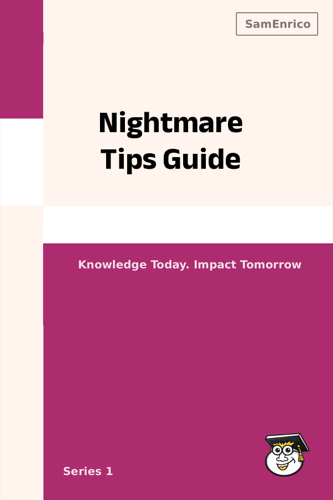
Free sample
Chapter 1: The 3 AM Alarm...--It happens again. The gasp. The sweat-soaked sheets. The racing heart that refuses to believe you are safe in your own bed. You glance at the clock: 3:14 AM.
Again. The images are already fading—slipping through your fingers like water—but the fear remains, a cold weight pressing against your chest. You tell yourself it was just a dream. But your body doesn't believe you. Your amygdala, that small almond-shaped cluster deep in your brain, is still firing as if a predator is in the room.
Your cortisol levels are spiking as if you are running for your life. And your prefrontal cortex—the rational part of your brain that normally says "You are safe in bed"—is still offline, still recovering from the shock of being jolted awake mid-REM cycle.If this scene feels familiar, you are not broken. You are not weak. And you are not alone.Approximately 50 to 85 percent of adults report at least one nightmare per year. That is the majority of the adult population.
But for a significant subset—between 2 and 8 percent of adults, or roughly 6 to 25 million people in the United States alone—nightmares are not rare events. They are chronic, recurring, and debilitating. These individuals experience nightmares at least once per week, often multiple times per week, for months or years on end. The condition has a name: Nightmare Disorder. And it is one of the most underdiagnosed and undertreated sleep disorders in clinical practice.This book exists because that statistic is unacceptable.
Nightmares are not random punishments from an indifferent universe. They are not signs of madness or moral failure. They are not something you must simply endure. Nightmares are coded messages from your subconscious—emergency broadcasts designed to get your attention. And like any emergency broadcast system, the goal is not to smash the speaker.
The goal is to decode the message, address the threat, and recalibrate the alarm so that it only sounds when there is a genuine emergency.By the time you finish this chapter, you will understand exactly what a nightmare is at the neurological level. You will be able to distinguish between three very different phenomena: standard bad dreams, clinical nightmares, and night terrors. You will know which one you are experiencing. You will complete a diagnostic self-assessment that directs you to the specific chapters most relevant to your situation. And you will understand…
This is the end of the free sample. Get the Audiobook to keep going. Buy now
About this book
Details
- Author
- Gates Rossana
- Publisher
- SamEnrico
- Language
- English
- Genre
- Non-Fiction, Self-Help / Tips
- Released
- 2026-06-09
- Pages (approx.)
- 153
- Available as
- eBook, Audiobook

Listen in the VoxFlicks app
Audiobooks and audio dramas wherever you go. Sign in with your SamEnrico account and press play.
More by Gates Rossana
 The Nun Who Walked Across IndiaGates Rossana$11.99
 Data Leak FAQ Customer DocumentsGates Rossana$11.99
 Fermented Foods for Gut HealthGates Rossana$11.99
 The Restful Alertness StateGates Rossana$11.99
 Dean AchesonGates Rossana$11.99
 Acupuncture For Long COVIDGates Rossana$11.99
 Reformation German Princes Alliance ManualGates Rossana$11.99
 Finance Team Year End CrunchGates Rossana$11.99
 The Blockbuster Brawl: How the 2018 Paul Goldschmidt Trade Redefined BaseballGates Rossana$11.99
 The Glass Ceiling of Olympus: How the First Woman Astronaut Faced the World’s StareGates Rossana$11.99
 The Alchemists of Byzantium: Secrets of Fire and GoldGates Rossana$11.99
 Understanding Absence of Gluteal MuscleGates Rossana$17.99
You may also like
 Scripting TipsGass Lynnette$11.99
 Difficult Conversation TipsButts Antonetta$11.99
 Pattern Recognition TipsMatos Melonie$11.99
 Parent Time Tips GuideHardesty Asuncion$11.99
 Anticipatory Grief TipsHamilton Kristy$11.99
 Resilience Tips GuideAvalos Lovella$11.99
 Remote Work Tips GuideGlory Sharkey$11.99
 Memory Palace TipsCambell Julianna$11.99Memory Palace TipsCambell Julianna$11.99
 Pain Meditation TipsLiles Hassie$11.99
 Interruption Tips GuideTobin Hobert$11.99
 Habit Tips GuideLister Lekisha$11.99