
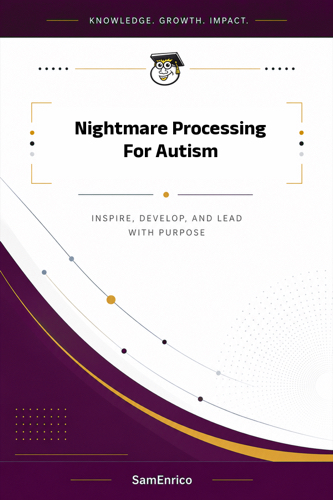
Nightmare Processing For Autism Audiobook
Adapt techniques for sensory and communication dif
Adapt techniques for sensory and communication differences.
Formats
Free sample
Chapter 1: The Silence After Screaming...--Every night, millions of autistic people wake up in terror, and every morning, they are asked a question they cannot answer: "What was your dream about?"The silence that follows is not stubbornness. It is not avoidance. It is not a failure of trust or a lack of vocabulary. It is the direct, predictable result of a neurological mismatch between how nightmares actually present in the autistic brain and how the world expects trauma to be processed. This chapter dismantles the single most damaging assumption in sleep medicine, trauma therapy, and parenting advice for autistic individuals: the belief that verbal recounting of nightmares is inherently therapeutic.
For a significant portion of the autistic population, being asked to "talk it out" after a nightmare does not bring relief. It brings shame, confusion, and a second wave of panic—not because the nightmare was too terrible to name, but because the act of naming requires neurological tools that may not be available in that moment.The standard protocols for nightmare treatment—Image Rehearsal Therapy (IRT), Cognitive Behavioral Therapy for Insomnia (CBT-I), and even simple "talk about it" parenting advice—all rest on a foundation of neurotypical assumptions about memory, emotion, and language. These assumptions are rarely stated aloud, which makes them invisible and therefore unassailable. But they are there, hiding in plain sight. The first assumption is that a nightmare has a narrative structure: a beginning, a middle, and an end.
The second assumption is that the dreamer can access that narrative and translate it into linear language. The third assumption is that the act of translation will reduce distress rather than amplify it. For many autistic individuals, all three assumptions are false.This chapter introduces the foundational concepts that will guide every intervention in this book. You will learn about alexithymia—the difficulty identifying and describing one's own emotions—and why it turns nightmares into physical "body flashbacks" rather than stories. You will encounter the "Sensory Storm" model, which reframes nightmares not as narratives to be decoded but as assaults on specific sensory channels.
And you will understand autistic inertia, the neurological phenomenon that explains why the "freeze" response in dreams mirrors waking shutdowns, making it nearly impossible to "fight back" even when lucid. By the end of this chapter, you will see nightmares—and the autistic response to them—in an entirely new light. And you will…
This is the end of the free sample. Get the Audiobook to keep going. Buy now
About this book
Details
- Author
- Carver Rosalind
- Publisher
- SamEnrico
- Language
- English
- Genre
- Non-Fiction, Self-Help, Autism
- Released
- 2026-06-07
- Pages (approx.)
- 155
- Available as
- eBook, Audiobook

Listen in the VoxFlicks app
Audiobooks and audio dramas wherever you go. Sign in with your SamEnrico account and press play.
More by Carver Rosalind
 Real Estate PersuasionCarver Rosalind$11.99
 Alcoholic Parent RecoveryCarver Rosalind$11.99
 Online Learning Dubai GuideCarver Rosalind$11.99
 Low Carb Mindset RetrainingCarver Rosalind$11.99
 Swallowed by WildernessCarver Rosalind$11.99
 Trader Gambling AddictionCarver Rosalind$11.99
 Boundaries With FamilyCarver Rosalind$11.99
 The Iron Masters of Meroë: Forging an EmpireCarver Rosalind$11.99
 The Last Stand of the Righteous Fists: The Boxer Rebellion's Defiant UprisingCarver Rosalind$11.99
 How to Start a Engines for Forklift Trucks Business (Beginners Guide)Carver Rosalind$11.99
 How to Produce Golf Cart EnclosuresCarver Rosalind$11.99
 A Collector's Handbook to the Daimler Db18 Sports SpecialCarver Rosalind$11.99
You may also like
 Hong Kong Handover 1997Dunn Johnnie$11.99
 Zumba For Postnatal Recovery CourseNeal Christian$11.99
 Zumba for BeginnersLadner Nikia$11.99
 YouTube Comment Mining GuideHumes Pandora$12.99
 Worry Box MeditationCarlin Rudy$11.99
 Workplace Stress MeditationNguyen Lynn$11.99
 Workplace Stress and Sleep RepairHawley Ivory$11.99
 Workplace Perfectionism CureDelaney Jeffry$11.99
 Workplace Injustice Anger GuideWallen Isabelle$11.99
 Work Addiction and Burnout LinkGreenwood Ester$11.99
 Women in Yoga and WellnessBeattie Galina$11.99
 Women in Stand Up ComedyChun Evangeline$11.99